


Tinklaraštis
Advice on choosing equipment: power, compatibility, subsidies and running costs.
Quiet generator for home and where to put it

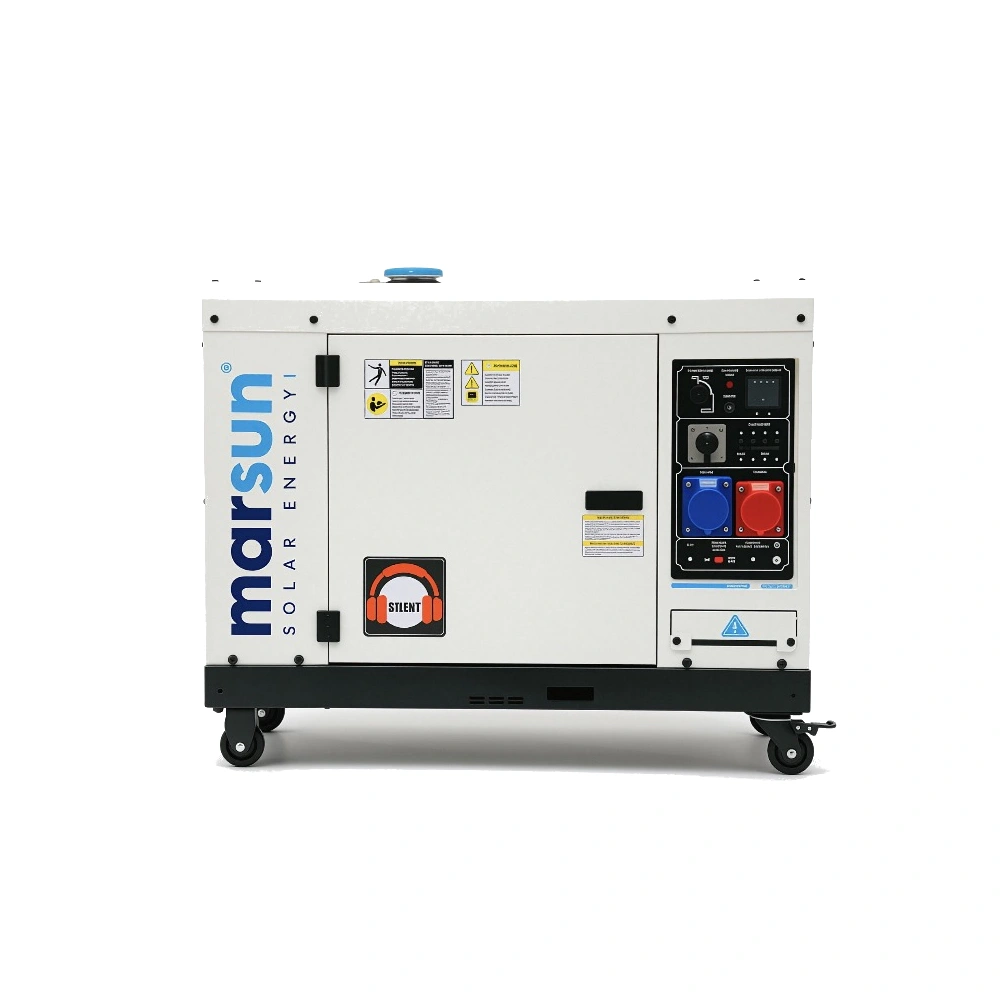
According to the manufacturer’s data, the quietest generators in the Hybrid Energy catalogue are the inverter Marsun MVB6PI and MVBG6PI at 68 dB each, followed by the diesel MVD6, MVD8 and MVD10 with a sound-insulated canopy at 72 dB each. The manufacturer does not say at what distance these figures were measured. A generator must run outdoors, not in a garage and not inside the house, more than 6.1 m from windows, doors and vents.
Key points
- Decibels without a distance are only a rough guide: the catalogue gives the measuring distance for just one model, the MHD50S (74 dB at 7 m), and the measurement conditions of the other models are unknown.
- A sound that is 10 dB louder seems roughly twice as loud to the ear (NIDCD), so 68 dB and 97 dB, if measured the same way, would mean very different noise.
- The quietest models have less power: the 68 dB models are single-phase, 5.5 kW. For a three-phase house, among the models with a sound-insulated canopy the manufacturer gives the lowest noise for the diesel MVD6, MVD8 and MVD10 (72 dB).
- A generator must not be used in a garage even with the doors and windows open (CDC): its exhaust contains carbon monoxide (CO).
- Noise is reduced by distance and a factory-fitted canopy, not by a closed box: the MVB6PI description requires at least 1 m of clear space on all sides.
What counts as a quiet generator
There is no single definition of a “quiet” generator: the word is used for a model whose manufacturer-stated noise level is lower than that of other models. But decibels without a measuring distance tell you little, because the same unit sounds different next to you and at your neighbour’s fence.
In the Hybrid Energy catalogue, noise is given according to the manufacturer’s data, and for most models the manufacturer does not state the measurement conditions. A distance is given only for the Marsun MHD50S: 74 dB at 7 m. So if one model’s description says 68 dB and another’s says 72 dB, this does not yet mean the first is actually quieter: they may have been measured at different distances and under different loads.
The decibel scale is not linear. The US National Institute on Deafness and Other Communication Disorders (NIDCD) writes that a sound 10 dB louder seems roughly twice as loud to the ear, even though the sound intensity rises tenfold. If 68 dB and 97 dB were measured under the same conditions, the difference would be 29 dB, almost three such steps. That is why it is worth asking not only “how many decibels” but also “at what distance”.
Which Hybrid Energy generators are quieter
According to the manufacturer’s data, the lowest noise level is listed for the inverter Marsun MVB6PI and MVBG6PI (68 dB). The diesel MVD6, MVD8 and MVD10 with a sound-insulated canopy are listed at 72 dB, and the larger MVD12 and MVD15 at 74 dB. According to the manufacturer, the inverter MVB6PI, MVBG6PI and MVB3.5PI deliver pure sine wave voltage; we covered generator types in more detail in the article diesel, petrol or inverter generator.
| Model | Type, power, phases | Sound-insulated canopy | Noise (manufacturer’s data, measurement conditions not stated) | Price |
|---|---|---|---|---|
| Marsun MVB6PI | petrol, inverter, 5.5 kW, single-phase | not stated in the manufacturer’s data | 68 dB | 1 469 € |
| Marsun MVBG6PI | petrol or LPG, inverter, 5.5 kW, single-phase | not stated in the product name | 68 dB | 1 669 € |
| Marsun MVB2PI | petrol, portable, 1.8 kW, single-phase | not stated in the product name | ≤ 73 dB | 619 € |
| Marsun MVB3.5PI | petrol, inverter, 3 kW, single-phase | not stated in the product name | ≤ 75 dB | 769 € |
| MVB6000 kit with ATS | petrol, 6 kW, three-phase | not stated in the product name | 70–75 dB | 1 749 € |
| Marsun MVD6 | diesel, 5.5 kW, three-phase | yes | 72 dB | 1 969 € |
| Marsun MVD8 | diesel, 7.5 kW, three-phase | yes | 72 dB | 1 539 € |
| Marsun MVD10 | diesel, 9 kW, three-phase | yes | 72 dB | 2 079 € |
| Marsun MVD12 | diesel, 11 kW, three-phase | yes | 74 dB | 3 639 € |
| Marsun MVD15 | diesel, 14 kW, three-phase | yes | 74 dB | 4 099 € |
| Marsun MHD20H | diesel, liquid-cooled, built-in ATS, 20 kW, three-phase | not stated in the product name | 72 dB | 9 099 € |
| Marsun MHD50S | diesel, liquid-cooled, built-in ATS, 50 kW, three-phase | not stated in the product name | 74 dB (at 7 m) | 11 499 € |
| For comparison: MVD8000 kit with ATS | diesel, 7.5 kW, three-phase | no (open frame) | 97 dB | 2 449 € |
| For comparison: Marsun MVBG3.5PI | petrol or LPG, 3 kW, single-phase | not stated in the product name | ≤ 97 dB | 619 € |
| For comparison: Marsun MVB8 | petrol, 7.5 kW, three-phase | not stated in the product name | ≤ 97 dB | 1 619 € |
Prices are shown as in the catalogue. The noise figures come from the product descriptions and the manufacturer’s data; the manufacturer does not say at what distance or under what load they were measured (except for the MHD50S). LPG is liquefied petroleum gas; an ATS is an automatic transfer switch that switches the house over to the generator when grid voltage is lost.
The table shows a trade-off. The quietest 68 dB models are single-phase, so they will not power a three-phase heat pump or other three-phase equipment. For a three-phase house, among the models with a canopy the manufacturer gives the lowest noise for the MVD6, MVD8 and MVD10 (72 dB). The description of the 7.5 kW MVD8 gives 72 dB, while the MVD8000 kit with ATS of the same power is listed at 97 dB. The MVD8000 product page says it is an open-frame version without a sound-insulated canopy, whereas the MVD8 has a canopy. The measurement conditions are not stated for either model, so do not compare these figures directly; check with Hybrid Energy before choosing. The figures for the MVB3.5PI (≤ 75 dB) and the dual-fuel MVBG3.5PI (≤ 97 dB) also differ, so please ask about these models as well. How to choose the power and an ATS is explained in the article home generator: power, ATS and three-phase connection.
Where to put a generator
The generator must stand and run outdoors. The US Centers for Disease Control and Prevention (CDC) say a generator should be used only outdoors, more than 20 feet (about 6.1 m) from any windows, doors and vents. The Marsun MVB6PI description likewise says to use the generator only outdoors because its exhaust contains carbon monoxide (CO), to leave at least 1 m of clear space on all sides and not to use it in rain or snow.
This means that outdoors the generator needs protection from rain and snow that does not cover its air openings or exhaust, and a spot as far as possible from bedroom windows. The MVD8 description also advises choosing the installation site with the neighbours and ventilation in mind. Consider the weight too: the MVD8 weighs 180 kg and measures 980 × 550 × 760 mm, while the MVB6PI weighs 47 kg. For a heavy unit, it is worth planning the base in advance.
ESO recommends placing a portable generator according to the conditions in its manual and connecting it to the house wiring only through a fixed connection with a transfer switch, so that the generator’s voltage cannot get into the ESO grid. ESO advises leaving this work to qualified specialists only. The further from the house the generator stands, the longer the cable you may need, so plan the location and the cable route together.
Why not in a garage, basement or inside the house
A garage looks like the most convenient place: it is dry, close to the distribution board, and the cable is short. But the CDC is clear: never use a generator inside your home or garage, even if doors and windows are open. A basement is part of the house, so the same applies to it. The reason is carbon monoxide: the Marsun MVB6PI description states that the exhaust contains carbon monoxide.
The CDC also advises having a battery-powered or battery-backup carbon monoxide detector at home when you use a generator. This matters most when the power is out: a mains-powered detector without a backup battery may not work at that time.
If you want to put the generator in the garage only because the cable would be short, choose another spot outdoors and a longer cable. In a Hybrid Energy quote, the longer cable and groundwork are listed separately, so you will see in advance what a safe location costs.
How to reduce noise without blocking the generator’s airflow
The simplest measures are distance and a model with a factory-fitted sound-insulated canopy. The manufacturer does not say how many decibels additional measures take off, so they and their cost are listed separately in the quote.
- Distance from windows. With the generator more than 6.1 m from windows, doors and vents (CDC), there will also be less noise in the bedroom. If possible, choose a side of the house without bedroom windows or neighbours’ windows.
- No closed boxes. A home-made box or shed around the generator would interfere with the ventilation mentioned in the MVD8 description. The MVB6PI description requires at least 1 m of clear space on all sides; for other models, apply the same principle according to their manual.
- Base. The 180 kg MVD8 or the 650 kg liquid-cooled MHD20H needs a stable base. Whether anti-vibration mounts are needed is decided by the manual for the specific model.
- Neighbours. Permitted noise limits are set by law, but generator decibels are measured at an unknown distance, so you cannot compare them with those limits directly. If the neighbours are close, choose the quietest model of suitable power and the furthest safe spot.
What you can do yourself
- Draw a plan of your plot and mark the windows, doors, vents and neighbouring houses.
- Find a spot outdoors more than 6.1 m from the windows, doors and vents of the house, with enough space around the generator (the MVB6PI description requires at least 1 m on all sides; for other models, see the manual).
- Work out how to protect the spot from rain and snow without covering the air openings and the exhaust.
- Decide whether you need three-phase power: if yes, look at the MVD series models with a canopy; if single-phase is enough, the MVB6PI or MVBG6PI.
- Buy a battery-powered or battery-backup carbon monoxide detector.
- Measure the distance from the chosen spot to the distribution board, take photos of the spot and the board, and send them through the enquiry form.
What we will do
Hybrid Energy generator installation and start-up cost from €400. This covers choosing the backup power layout, connecting the generator, starting it up and testing it with the grid disconnected. The work is done by a certified electrician. We work anywhere in Lithuania, and installation usually takes no more than one working day.
Before any work you receive a quote that lists equipment, labour, materials, delivery and the final total separately. A base, groundwork, a longer cable and noise reduction measures, if needed, are listed separately. The offer is valid for 10 working days. Delivery within Lithuania is free, and the generator comes with a 2-year statutory warranty.
Email sales@hybridenergy.lt, call +370 636 52 222 (Mon–Fri 9:00–18:00) or fill in the form.
Frequently asked questions
Which generator is the quietest in the Hybrid Energy catalogue?
According to the manufacturer’s data, the quietest in the Hybrid Energy catalogue are the single-phase inverter Marsun MVB6PI and MVBG6PI at 68 dB each. Among the three-phase models with a sound-insulated canopy, the lowest noise is listed for the MVD6, MVD8 and MVD10 at 72 dB each. The manufacturer does not state the measuring distance or load for these models, so compare the figures with caution.
Can a generator be used in a garage?
No. The CDC says never to use a generator inside your home or garage, even if doors and windows are open, because the exhaust contains carbon monoxide (CO). Hybrid Energy suggests placing the generator outdoors and, if the distribution board is far away, adding a longer cable and groundwork to the quote as separate items, so that you do not have to fall back on the garage.
How far from the house should a generator be?
The CDC recommends using a generator outdoors, more than 20 feet (about 6.1 m) from windows, doors and vents. The Marsun MVB6PI description also says to leave at least 1 m of clear space on all sides. Hybrid Energy suggests planning the location and the cable route together, because the cable length depends on the distance to the distribution board.
Is a 72 dB generator quiet?
That depends on the distance at which it was measured, and for most models the manufacturer does not state it. In the Hybrid Energy catalogue, a distance is given only for the MHD50S: 74 dB at 7 m. According to the NIDCD, a sound 10 dB louder seems roughly twice as loud to the ear, so 72 dB and 97 dB, if measured the same way, would mean very different noise.
Can I put a generator in a box to make it quieter?
A home-made closed box is not suitable: the Marsun MVB6PI description requires at least 1 m of clear space on all sides, and the MVD8 description points out the need for ventilation. Hybrid Energy suggests choosing a model with a factory-fitted sound-insulated canopy and a spot further away, and listing any additional noise reduction measures separately in the quote.
Sources
- CDC, Carbon Monoxide (CO) Poisoning Basics: cdc.gov/carbon-monoxide/about/: generator only outdoors, more than 20 feet from windows, doors and vents, never inside the home or garage, a carbon monoxide detector with a battery (checked 27 November 2026).
- ESO, Rekomendacijos rezervinio šaltinio įsirengimui (recommendations for installing a backup power source, in Lithuanian): eso.lt (checked 27 November 2026).
- NIDCD (NIH), How Loud is Too Loud?: nidcd.nih.gov/health/how-loud-too-loud: a 10 dB increase seems roughly twice as loud (checked 27 November 2026).
- Hybrid Energy, home generators with installation: hybridenergy.lt/generatoriai-namams-su-pajungimu/ (checked 27 November 2026).
- Marsun manufacturer’s data in the Hybrid Energy product descriptions: MVB6PI and MVD8 (checked 27 November 2026); the other models in the table are based on catalogue data from 26 November 2026.