



Tinklaraštis
Advice on choosing equipment: power, compatibility, subsidies and running costs.
Diesel, petrol or inverter generator for your home: which to choose

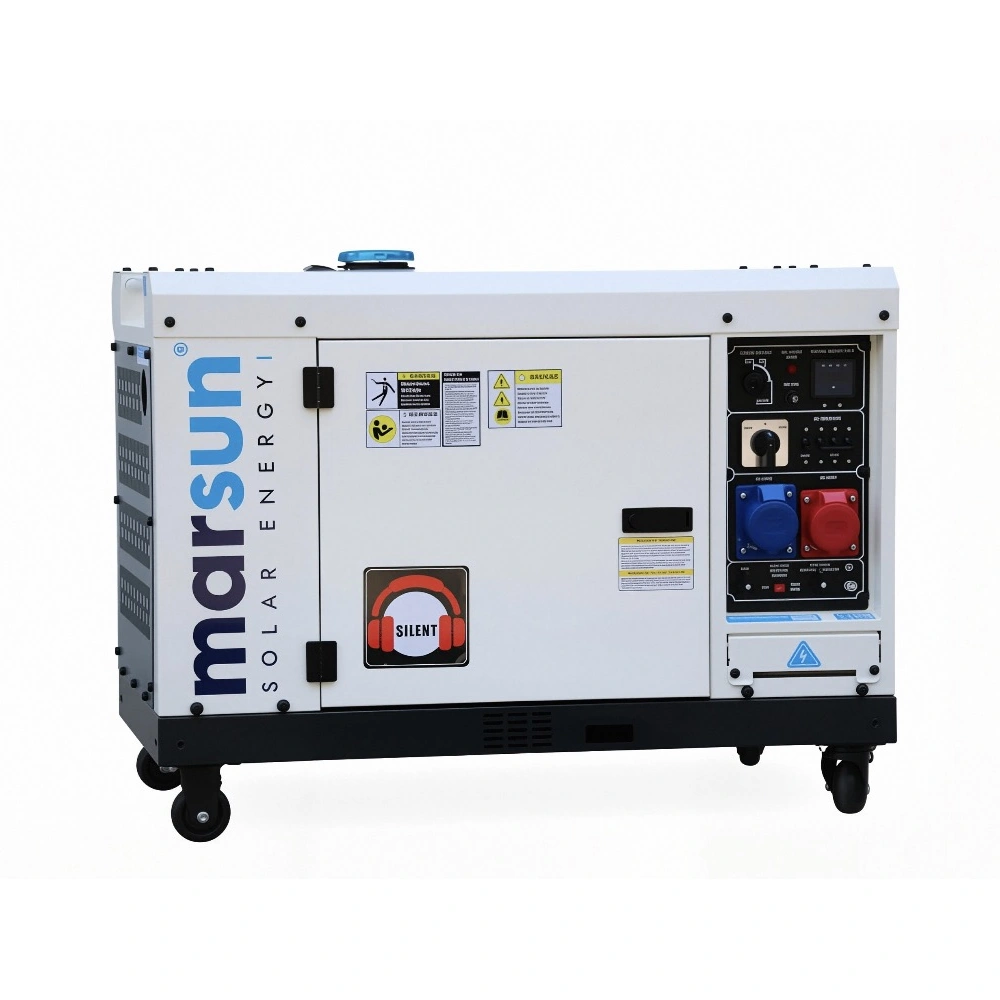
For power cuts of 2–3 hours a petrol generator is enough; for a day or longer, a diesel is the better choice. In the Hybrid Energy catalogue the diesel Marsun MVD8 uses 275 g of fuel per kWh, while the petrol MVB8 of the same 7.5 kW power uses up to 374 g. Inverter technology is listed in the descriptions of the MVB3.5PI, MVB6PI, MVBG3.5PI and MVBG6PI. Installation and start-up cost from €400.
| Model | Fuel | Rated power and phases | Price | Fuel consumption (manufacturer’s data) | Fuel per hour at rated power (calculated) | l/h (calculated) | Tank | Continuous run time (manufacturer’s figure) | Noise (manufacturer’s data, measurement conditions not stated) | Starting |
|---|---|---|---|---|---|---|---|---|---|---|
| Marsun MVB3.5PI (inverter technology) | petrol | 3 kW, single-phase | 769 € | ≤ 395 g/kWh | ≤ 1.19 kg | ≤ 1.6 l | 6 l | 3.5 h (100% load) | ≤ 75 dB | manual |
| Marsun MVBG3.5PI (inverter technology) | petrol or LPG | 3 kW, single-phase | 619 € | ≤ 395 g/kWh | ≤ 1.19 kg | ≤ 1.6 l | 13 l | 6.5 h (100% load) | ≤ 97 dB (per the product description; the MVB3.5PI is listed at ≤ 75 dB, so check with Hybrid Energy before buying) | manual |
| Marsun MVB6PI (inverter technology) | petrol | 5.5 kW, single-phase | 1 469 € | 453 g/kWh | 2.49 kg | about 3.4 l | 12 l | 6.7 h (load not stated) | 68 dB | electric (Start/Stop button) |
| Marsun MVBG6PI (inverter technology) | petrol or LPG | 5.5 kW, single-phase | 1 669 € | 453 g/kWh | 2.49 kg | about 3.4 l | 12 l | 6.7 h (load not stated) | 68 dB | electric |
| Marsun MVB8 | petrol | 7.5 kW, three-phase | 1 619 € | ≤ 374 g/kWh | ≤ 2.81 kg | up to 3.8 l | 25 l | 5.5 h (100% load) | ≤ 97 dB | electric, Two-Wire Start connection |
| Marsun MVD8 | diesel | 7.5 kW, three-phase | 1 539 € | 275 g/kWh | 2.06 kg | about 2.5 l | 12.5 l | 12 h (load not stated) | 72 dB | electric, Two-Wire Start connection |
| Marsun MVD10 | diesel | 9 kW, three-phase | 2 079 € | 265 g/kWh | 2.39 kg | about 2.8 l | 12.5 l | up to 12 h (load not stated) | 72 dB | electric, connection for an external ATS module |
| Marsun MHD20H (liquid-cooled) | diesel | 20 kW, three-phase | 9 099 € | < 205 g/kWh | < 4.10 kg | < 4.9 l | 70 l | 8 h (load not stated) | 72 dB | electric starter, built-in ATS |
Prices are taken from the catalogue. Fuel per hour is calculated as follows: the manufacturer’s g/kWh multiplied by the rated power in kW; litres (calculated) are the kilograms divided by a density of 0.74 kg/l for petrol or 0.84 kg/l for diesel. Inverter technology is listed in the descriptions of the MVB3.5PI, MVB6PI, MVBG3.5PI and MVBG6PI, while the descriptions of the three-phase MVB8, MVD8, MVD10 and MHD20H list an AVR (automatic voltage regulator). LPG is liquefied petroleum gas. The run time stated by the manufacturer may not match the calculated one: for example, a 12 l tank at a 5.5 kW load (about 3.4 l/h) would last roughly 3.6 h, and the MVD8’s 12.5 l tank at 7.5 kW (about 2.5 l/h) roughly 5 h (calculated). The manufacturer does not say which load its run times refer to.
Key points
- For power cuts of 2–3 hours a petrol model is enough: according to the manufacturer, the Marsun MVB8 runs for 5.5 h on its 25 l tank at 100% load.
- A diesel uses less fuel per kWh: the MVD8 275 g, the MVB8 up to 374 g, which is up to 26% fewer kilograms (calculated). The drawback: the MVD8 weighs 180 kg, the MVB8 75/80 kg.
- For a day or longer, the liquid-cooled MHD20H fits: 70 l tank, built-in ATS, heated fuel unit, and it shuts down when 10% of the fuel is left.
- Inverter technology and a clean sine wave are listed in the descriptions of the MVB3.5PI, MVB6PI, MVBG3.5PI and MVBG6PI; these are single-phase 3 and 5.5 kW models and will not power three-phase equipment.
- The dual-fuel MVBG3.5PI and MVBG6PI run on petrol or LPG; all noise figures are the manufacturer’s, without measurement conditions.
Diesel or petrol generator: 2–3 hours or a whole day without power
For a short power cut of 2–3 hours a petrol generator is enough, while for a day or longer a diesel with an ATS is more practical. An ATS is an automatic transfer switch that switches the house over to the generator when grid voltage is lost. Three things make the difference: how much fuel is burnt per kWh, the size of the tank and whether you have to start the generator yourself.
According to the manufacturer, the petrol Marsun MVB8 (7.5 kW, three-phase) runs for 5.5 h on its 25 l tank at 100% load, and the compact MVB3.5PI (3 kW) for 3.5 h. These models get through a short power cut without refuelling. The downsides of petrol: it uses more fuel per kWh, and the MVB8 description gives a noise level of up to 97 dB.
During a long power cut, what matters most is how much fuel you will need and who will start the generator. The diesel MVD8 uses 275 g of fuel per kWh and the petrol MVB8 up to 374 g, so at the same load you need up to 26% fewer kilograms of diesel (calculated). The liquid-cooled MHD20H (20 kW) has a 70 l tank, a built-in ATS and a heated fuel unit, and shuts down when 10% of the fuel is left in the tank. The downsides of diesel: it is heavier (the MVD8 weighs 180 kg, the MVB8 75/80 kg), and the MVD8 tank holds 12.5 l, half the size of the MVB8’s. Compare prices in pairs: the diesel MVD6 costs 1 969 € and the petrol MVB6 1 419 €; the diesel MVD8 costs 1 539 € and the petrol MVB8 1 619 €.
Manual-start models (MVB2PI, MVB3.5PI, MVBG3.5PI) have to be started by you, so they suit you if you are at home during power cuts. If the house is often empty, choose an electric-start model with a Two-Wire Start connection or a kit with ATS. How to work out the power you need and choose an ATS is covered in the article home generator: power, ATS and three-phase connection.
How much fuel does a generator use per hour
At rated power, the 7.5 kW diesel MVD8 uses about 2.06 kg of fuel per hour, and the petrol MVB8 of the same power up to 2.81 kg (calculated from the manufacturer’s g/kWh). The calculation: multiply the manufacturer’s g/kWh by the load in kW to get grams per hour.
Example: if the load in your house during a power cut is 3 kW, the MVD8 will burn about 825 g of diesel per hour (275 × 3) and the MVB8 up to 1,122 g of petrol (374 × 3). The manufacturer does not state which load the g/kWh figure applies to, so at part load the real consumption may differ from the calculated figure.
To get litres, divide the kilograms by the fuel density in kg/l. In the table we used 0.84 kg/l for diesel and 0.74 kg/l for petrol, as in our product descriptions; both values fall within the limits in Orlen Lietuva’s safety data sheets: diesel density 0.82–0.845 g/cm³, petrol no more than 0.78 g/cm³ (15 °C). On that basis the MVD8 uses about 2.5 l of diesel per hour and the MVB8 up to 3.8 l of petrol (calculated). Multiply the litres by the pump price and you get the fuel cost of one hour. At pigiausidegalai.lt prices for 25 November 2026 (data from LEA, the Lithuanian Energy Agency: 95 petrol €1.694/l, diesel €2.141/l), an hour of fuel at rated power costs: MVB6PI €5.70, MVD8 €5.26, MVB8 €6.42, MVD10 €6.08 (calculated).
The lowest fuel consumption in the catalogue is listed for the liquid-cooled Marsun MHD models from 20 kW: the MHD50S less than 202 g/kWh, the MHD20H less than 205 g/kWh. They can carry a larger load, but they also cost more: the MHD20H costs 9 099 €.
What makes an inverter generator different, and does the catalogue have them
An inverter generator uses electronics to convert the current it produces into direct current and then back into 230 V, 50 Hz alternating current, so the voltage waveform is set by the electronics rather than by the engine speed. A conventional generator with an AVR (automatic voltage regulator) keeps the voltage steady by regulating the excitation, and the 50 Hz frequency comes from a constant engine speed.
In the Hybrid Energy catalogue, inverter technology and a clean sine wave are listed in the descriptions of four single-phase Marsun models: MVB3.5PI (3 kW), MVBG3.5PI (3 kW, petrol or LPG), MVB6PI (5.5 kW) and MVBG6PI (5.5 kW, petrol or LPG). The three-phase MVB8, MVD8, MVD10 and MHD20H in the table have an AVR. If you specifically need an inverter generator, choose one of the four PI models.
The limitation of the inverter models is power and phases: the largest is a 5.5 kW single-phase generator, so it will not run a three-phase heat pump or other three-phase equipment. If you will connect a boiler, heat pump or computer equipment to the generator, check what their manufacturer specifies for supply quality (for example, the permitted voltage distortion, THD) and send this requirement to Hybrid Energy together with the model. More on heating equipment in the article generator for a boiler and heat pump.
Dual-fuel generator: petrol and LPG
A dual-fuel generator runs on petrol or liquefied petroleum gas (LPG), so during a long power cut you have a second fuel to fall back on. The Hybrid Energy catalogue has two such models: the Marsun MVBG3.5PI (3 kW, manual start, 13 l tank, 619 €) and the MVBG6PI (5.5 kW, electric start, 12 l tank, inverter technology, 1 669 €).
Both are single-phase, so they suit single-phase circuits. The descriptions give only one fuel consumption figure each: up to 395 g/kWh for the MVBG3.5PI and 453 g/kWh for the MVBG6PI. The manufacturer does not give gas consumption, and it is not clear which fuel these g/kWh figures refer to. The MVBG3.5PI description states that power drops by 10% on gas, while the power of the MVBG6PI on gas is not stated. Check with Hybrid Energy before buying.
Which generator is quieter
According to the manufacturer’s data, the quietest in the table are the MVB6PI and MVBG6PI (68 dB), the diesel MVD8 and MVD10 with a sound-insulated canopy are at 72 dB, and the petrol MVB8 and MVBG3.5PI at up to 97 dB. The manufacturer does not say at what distance or load these were measured, so compare the figures with caution.
In the catalogue, the measuring distance is given for only one model: the MHD50S, 74 dB at 7 m. If the generator will stand close to a bedroom or the neighbours, noise reduction measures are added to the quote separately.
Maintenance: oil, cooling and engine speed
The descriptions state the type and amount of oil and how the engine is cooled. Petrol MVB8: 1.1 l of SAE 10W-30, air-cooled, 3,000 rpm. Diesel MVD8: 1.65 l of 15W-40, air-cooled. Diesel MHD20H: 9.5 l of 15W-40, liquid-cooled, 1,500 rpm.
An oil change interval is given only in the descriptions of the PI models: first change after 5 operating hours, then every 50–100 hours or once a season. The MVB8, MVD8 and MHD20H descriptions give neither the interval nor the engine service life in hours, so check with Hybrid Energy before buying. The drawback of a liquid-cooled generator is its weight: the MHD20H weighs 650 kg. If it needs a base or groundwork, these are listed separately in the quote.
What you can do yourself
- Note how long the power cuts lasted over the past year. If all were shorter than 3 hours, choose petrol; if any lasted a day or more, choose diesel.
- List what must be powered and mark the three-phase equipment. How to calculate the power is described in the article on power and ATS.
- Decide who will start the generator. If you are not always at home, you will need electric start and an ATS.
- Work out the fuel: g/kWh × load in kW × hours = grams of fuel for the length of the power cut.
- Check what the manufacturer of your boiler, heat pump or other sensitive equipment specifies for the power supply.
- Take photos of the distribution board and of the spot where the generator will stand, and send them through the enquiry form.
What we will do
Hybrid Energy generator installation and start-up cost from €400. This covers choosing the backup power layout, connecting the generator, starting it up and testing it with the grid disconnected. The work is done by a certified electrician, and we work anywhere in Lithuania. Installation usually takes no more than one working day.
Before any work you receive a quote that lists equipment, labour, materials, delivery and the final total separately. The offer is valid for 10 working days. Delivery within Lithuania is free, and the generator comes with a 2-year statutory warranty.
Email sales@hybridenergy.lt, call +370 636 52 222 (Mon–Fri 9:00–18:00) or fill in the form.
Frequently asked questions
Does Hybrid Energy sell inverter generators?
Yes. In the Hybrid Energy catalogue, inverter technology and a clean sine wave are listed in the descriptions of four Marsun models: MVB3.5PI (3 kW), MVBG3.5PI (3 kW), MVB6PI (5.5 kW) and MVBG6PI (5.5 kW). All are single-phase, and the MVBG3.5PI and MVBG6PI run on petrol or LPG. The three-phase MVB8, MVD8, MVD10 and MHD20H have an AVR (automatic voltage regulator). A three-phase heat pump or other three-phase equipment needs a three-phase MVB, MVD or MHD model.
How much fuel does a diesel generator use per hour?
Hybrid Energy calculated this from the manufacturer’s data: at rated power, the 7.5 kW Marsun MVD8 (275 g/kWh) uses about 2.06 kg of diesel per hour, the 9 kW MVD10 (265 g/kWh) about 2.39 kg, and the 20 kW MHD20H (less than 205 g/kWh) less than 4.10 kg. At a lower load, less fuel is burnt per hour.
Will a petrol generator last a whole day without power?
A petrol generator will cover a day if you refuel it several times: according to the manufacturer, the Marsun MVB8 runs for 5.5 h on its 25 l tank at 100% load. For long power cuts, Hybrid Energy suggests comparing it with the diesel MVD8, which uses 275 g of fuel per kWh (the MVB8 up to 374 g), and choosing a model with ATS.
How is a dual-fuel generator different from a petrol one?
A dual-fuel generator runs on petrol or LPG, so during a long power cut you have a second fuel to use. The Hybrid Energy catalogue has two such Marsun models: the MVBG3.5PI (3 kW, manual start, 13 l tank) and the MVBG6PI (5.5 kW, electric start, 12 l tank, inverter technology). Both are single-phase.
How much does a generator cost with installation?
Hybrid Energy installation and start-up cost from €400: this covers choosing the backup power layout, connecting the generator, starting it up and testing it with the grid disconnected. The generator, the ATS (if it is not part of the kit), cables and materials are priced separately in the quote. The offer is valid for 10 working days, and delivery within Lithuania is free.
Sources
- Hybrid Energy, home generator installation: hybridenergy.lt/en/home-generator-installation/ (checked 26 November 2026).
- Marsun manufacturer’s data in the Hybrid Energy product descriptions, checked 26 November 2026: MVB3.5PI, MVBG3.5PI, MVB6PI, MVBG6PI, MVB8, MVD8.
- Other Marsun models from the catalogue export of 26 November 2026: MVB2PI, MVB6, MVD6, MVD10, MHD20H, MHD50S.
- Orlen Lietuva safety data sheets: diesel (SDS 2025-09-30), density 0.82–0.845 g/cm³ (15 °C), and petrol (SDS 2022), density no more than 0.78 g/cm³ (15 °C); checked 26 November 2026.
- pigiausidegalai.lt (based on LEA data): 95 petrol and diesel prices on 25 November 2026, €1.694/l and €2.141/l; fuel cost per hour calculated.
- Fuel per hour and the percentage difference were calculated by Hybrid Energy from the g/kWh and rated power given in the descriptions (26 November 2026).