


Tinklaraštis
Advice on choosing equipment: power, compatibility, subsidies and running costs.
What size generator do I need for a boiler or a heat pump?

A gas boiler needs little electricity: Vaillant ecoTEC plus boilers use no more than 55–120 W.
A pellet boiler burner briefly uses up to 522 W during ignition (ATMOS A25). A heat pump is a
different matter: the product page of an 8 kW Midea heat pump states a minimum circuit ampacity
(MCA) of 29 A, and its built-in electric heater is 3 kW. For a boiler, voltage quality matters
most; for a heat pump, power.
This article does not repeat our general
article on home generator power and ATS.
Here we deal only with heating: what in a boiler or heat pump runs on electricity, where to find it
on the appliance’s rating plate, and how to choose a generator on that basis.
In short
- A gas boiler uses little electricity but is sensitive. The permissible voltage for the Vaillant
ecoTEC plus is 190–253 V; the manufacturer warns that a voltage above 253 V may damage
electronic components. So choose a generator for a boiler first by voltage quality, not by
kilowatts. - A pellet boiler uses most of its electricity only during ignition: the ATMOS A25 burner uses up
to 522 W with one ignition element, up to 1,042 W with two, and on average 42 W in normal
operation. The generator must be chosen for the ignition power. - With a heat pump, what matters is not the compressor power on the plate but what can switch on
together with it. The 8 kW single-phase Midea model has a built-in 3 kW electric heater, the
12–16 kW three-phase models a 9 kW one. - The power of a three-phase generator is stated for all three phases together. A single-phase heat
pump draws electricity from one phase only, so ESO advises checking how much load one phase can
take. - Convenience has a price: the inverter generators in our catalogue weigh 19–47 kg, but they are
single-phase and started by hand or with a button. The three-phase Marsun generators with a Two-Wire
Switch connector start automatically with an ATS: the petrol MVB7 weighs 73–78 kg, the diesel MVD
models from 170 kg.
How much electricity does a heating boiler use?
A boiler heats with gas, pellets or logs, but without electricity it usually does not work.
Electricity is needed not to make heat but to run the boiler: to light the flame, blow air, move
water around the system and control everything. So few watts are needed, but the requirements for
the voltage are strict.
Gas boiler. The Vaillant ecoTEC plus installation manual lists among the
functional elements the ignition electrode, the fan, the internal pump and the electronics box.
According to the manufacturer, all of this together uses no more than 55–120 W (from the smallest
612 to the 838 model), and less than 2–3 W on standby.
Pellet boiler. Here one part takes a lot of electricity, but only briefly: the
ignition element. The ATMOS A25 burner manual states: during ignition up to 522 W with one element,
up to 1,042 W with two (a special mode), on average 42 W at nominal output, 22 W at minimum and
3.3 W on standby. Add the pellet auger motor to that: ATMOS offers 25 W and 40 W augers for this
burner.
Log (solid fuel) boiler. The simplest case. For the ATMOS DC18S wood gasification
boiler the manufacturer states 50 W of auxiliary electrical power; the boiler has a flue gas
exhaust fan. ATMOS also fits these boilers with a safety cooling loop against overheating, so it is
worth finding out how your boiler is protected from overheating during a power cut.
Circulation pump. There is one in almost every heating system, often fitted
separately from the boiler. The example rating plate of the Grundfos ALPHA2 15-50 states: minimum
5 W and 0.05 A, maximum 22 W and 0.19 A. If the system has several pumps (underfloor heating,
hot water cylinder), add up the power of all of them.
These figures apply to specific models, not to all boilers. Your boiler’s power may be different,
so below we show where to find it.
Why does a boiler need “clean” electricity?
Boiler electronics work only within certain voltage limits, and a generator is not the mains
grid. ESO’s recommendations on backup power sources say so clearly: while you are using a generator,
the company is not responsible for the quality of the electricity supplied, so it recommends watching
the connected equipment and disconnecting it if you notice anything unusual.
Manufacturers state these limits precisely. The permissible connection voltage for the Vaillant
ecoTEC plus is 190–253 V, and the manual warns that a voltage above 253 V may damage electronic
components. For the Grundfos ALPHA2 pump, 1 × 230 V is stated with a permitted deviation of
–10 % / +10 %. The voltage of a basic generator, jumping as the load changes, can go outside these
limits, and exactly when a fan or pump switches on.
Stable voltage can be ensured in two ways:
- AVR (automatic voltage regulator) – a device in the generator that keeps the
output voltage steady when the load changes. The product pages of all the Marsun generators
mentioned in this article state AVR voltage stabilisation. - Inverter generator – a generator in which the current produced by the engine is
processed by an electronic converter (an inverter) before it reaches the socket. According to a
generator manufacturer, this technology delivers very stable power without surges and suits sensitive
electronics.
One generator manufacturer’s guide for business puts it simply: for sensitive equipment, an
inverter or regulated output is usually recommended. Whether your boiler may be powered by a
generator, and what requirements apply, check in the boiler manual or ask the boiler
manufacturer.
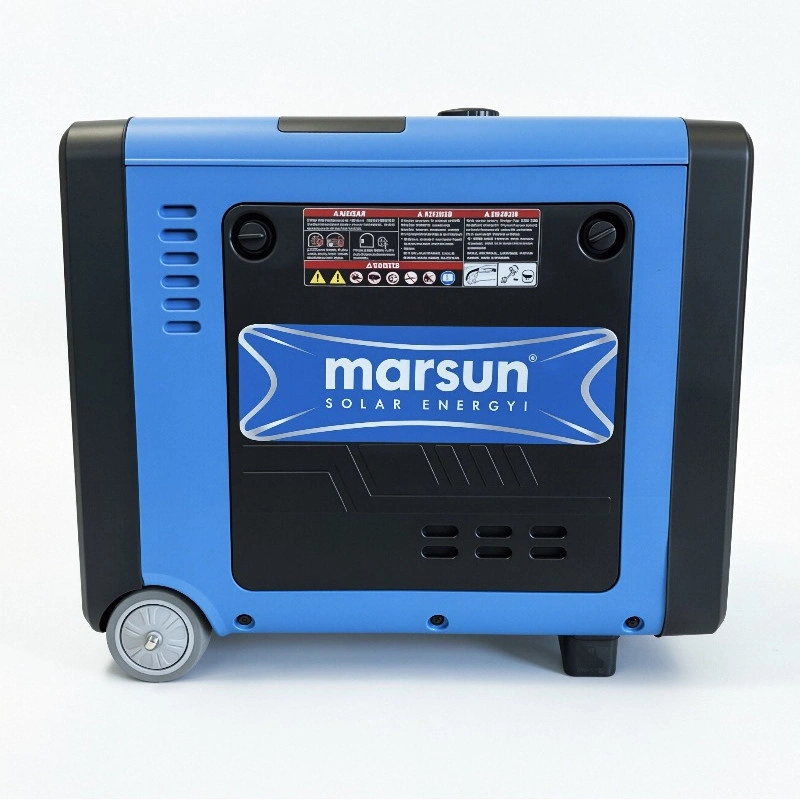
What to weigh up. The inverter Marsun generators in our catalogue are
single-phase, 1.8–5.5 kW, petrol or dual-fuel (petrol and LPG). The MVB3.5PI is started by hand, the
MVB6PI with a button, and the manufacturer does not state an ATS or automatic start connector for
them. So if the power goes out at night, you will have to start the generator yourself.
What size generator do I need for a heat pump?
A heat pump itself heats with electricity, so its power is measured in kilowatts, not watts.
It also has two main electricity consumers that can run at the same time: the heat pump with its
compressor and the backup electric heater.
Let us compare two Midea models from our catalogue using the manufacturer’s data sheet:
| Figure | Midea MHC-V8W (8 kW, monobloc) | Midea M-Thermal-12B3HB2 (12 kW, split) |
|---|---|---|
| Power supply | 220–240 V, 1 phase, 50 Hz | 380–415 V, 3 phases, 50 Hz |
| Electrical power used by the heat pump without the heater, at +7 °C outdoors and 35 °C flow to the floor | 1.63 kW | 2.44 kW |
| Electrical power used by the heat pump without the heater, at +7 °C outdoors and 55 °C flow to the radiators | 2.36 kW | 3.87 kW |
| Built-in electric heater | 3 kW, 1 stage | 9 kW, 3 stages |
| Minimum circuit ampacity (MCA) | 29 A | Not stated in the split model’s data sheet or product page; check the installation manual |
| Shop price | €3,249 | €4,749 |
The table shows the most common mistake: people see 1.63 kW and buy a small generator. But the
electric heater in a heat pump is there precisely for cold days, and that is also when you will need
the generator most. The heat pump and the heater together already make several kilowatts.
Starting current. A generator manufacturer’s sizing guide says that motors,
compressors and pumps briefly draw more power when they start, so you count not only running power
but also starting power. Midea uses an inverter (DC inverter) compressor in these models, but does
not state its starting current in the data sheet. Do not guess this figure: look for it in the
installation manual or ask the supplier.
Phases. ESO warns that three-phase generators state the total power of all three
phases, so when connecting single-phase appliances you need to check the maximum permitted load on
one phase. A single-phase 8 kW heat pump connected to an ordinary three-phase generator gets only
part of its power. The product pages of Marsun MVD series generators state equal power on a single
phase (Equal Power).
ESO also warns clearly: if the generator’s power is lower than your ESO connection capacity, you
will not be able to use high-power appliances, including a heat pump, at the same time while the
generator is running. For more on choosing the heat pump itself, see our article
“Heat Pump: What to Know Before You Buy”.
How to read the rating plate on a boiler or heat pump?
Every boiler, pump and heat pump has a rating plate: a sticker or plate with the electrical data.
Take a photo of it: the generator is chosen on that basis.
| What the plate says | What it means | Where you will find it (example) |
|---|---|---|
| V, Hz (e.g. 230 V, 50 Hz) | Mains voltage and frequency. The generator must supply the same voltage and frequency | Vaillant boiler plate |
| W | The maximum electrical power the appliance uses | Vaillant boiler plate |
| I1/1 (A): Min., Max. | Minimum and maximum current | Grundfos ALPHA2 plate |
| P1 (W): Min., Max. | Minimum and maximum power used | Grundfos ALPHA2 plate |
| V/~/Hz (e.g. 220–240/1/50) | Voltage, number of phases and frequency: 1 = single-phase, 3 = three-phase | Midea heat pump data |
| MCA (A) | Minimum circuit ampacity, used to size the cables and protection. It is a limit, not constant consumption | Midea heat pump data |
| Heater power (kW) and stages | The power the backup electric heater can switch on | Midea heat pump data |
Generator power is sometimes stated in kVA, which is apparent power, while
kW is its active (useful) part. In the example in a generator manufacturer’s guide,
kW is converted to kVA by dividing by 0.8. In our catalogue, the power of Marsun generators is stated
in kilowatts.
Examples: what size generator different houses need
Below are example calculations. The appliance figures are taken from the manufacturers’ documents
mentioned above, but your appliances’ figures will be different: calculate from your
own plates. We use the same generator manufacturer’s guide: add up the running power of all
appliances, add the largest starting power and a 20–30 % margin. Here we take 25 %.
| Example house | What we add up | With a 25 % margin | Generator from the catalogue | What to weigh up |
|---|---|---|---|---|
| Gas boiler (e.g. Vaillant ecoTEC plus 838) and underfloor heating pump (e.g. ALPHA2 15-50) | 120 W + 22 W = 142 W | about 0.18 kW | Marsun MVB3.5PI, 3 kW inverter, €769 | Petrol, noise up to 75 dB, started by hand. The 6 l tank lasts up to 3.5 h at 100 % load; at such a low load it will last longer, but the manufacturer does not say exactly how long |
| Pellet boiler with burner (e.g. ATMOS A25), 40 W auger and pump | Worst case, ignition with two elements: 1,042 W + 40 W + 22 W = 1,104 W | about 1.4 kW | The same Marsun MVB3.5PI, €769 | The same. If you want to use LPG, choose the Marsun MVBG6PI, 5.5 kW, €1,669 |
| Midea MHC-V8W heat pump (single-phase), radiators at 55 °C | 2.36 kW + 3 kW heater = 5.36 kW, excluding starting current | about 6.7 kW | Marsun MVD12, 11 kW three-phase with equal power per phase, €4,369, and ATS 6–15 kW, €199 | Diesel, 74 dB, 253 kg, needs space outdoors. Starts automatically when the power goes out |
| The same heat pump, if the heater is switched off while the generator runs | 2.36 kW, excluding starting current | about 3.0 kW | Marsun MVB6PI, 5.5 kW single-phase inverter, €1,469 | For long periods best loaded to no more than 4.1–4.4 kW; petrol, 68 dB, push-button start. On a cold day the house will warm up more slowly |
| Midea M-Thermal-12B3HB2 heat pump (three-phase), radiators at 55 °C | 3.87 kW + 9 kW heater = 12.87 kW | about 16.1 kW | Marsun MHD20H, 20 kW with built-in ATS and heated fuel unit, €9,099 | 650 kg, liquid cooling, 70 l tank. The calculated 16.1 kW exceeds the recommended long-term load stated on the product page (15–16 kW), so for this heat pump the MHD20H is at the limit. With a margin: the 25 kW Marsun MHD25H (long-term load 18.8–20 kW, 680 kg), €9,799 |
What do these examples show? For boilers, generator power hardly matters: even the smallest
inverter generator has plenty in reserve, so choose by voltage quality, fuel and whether you are
willing to get up at night to start it. For a heat pump, one decision settles everything: will the
electric heater run while the generator is powering the house? That decides whether a €1,469
generator is enough or you need a €4,300–9,800 unit.
We have not included the heat pump’s starting current in the table, because Midea does not state
it in the data sheet. Be sure to check it before you buy a generator.
ATS for a generator: do you need one and which to choose?
An ATS (automatic transfer switch between the grid and the generator) is a device that switches
the house over to the generator when the power goes out and back to the grid when it returns. For
heating it is useful if you are often away from home or the power goes out at night: without it the
boiler will not work until you get up and start the generator.
- Separate ATS units in our catalogue come in two sizes: ATS for 6–15 kW generators at €199 and ATS for 20 kW generators at €269. There are no larger separate ATS units in the catalogue.
- Marsun MVD series diesel generators have a Two-Wire Switch connector: through it the generator can be started by an ATS or a hybrid inverter.
- The Marsun MHD20H and other MHD models with “su ATS” (with ATS) in their name already have one built in, so no separate unit is needed.
- No ATS or automatic start connector is stated for the inverter PI models.
The most important thing is not the ATS but the connection itself. ESO writes that a generator
may be connected to the internal wiring of the whole building only with a fixed connection and means
that stop the generator’s voltage from getting into the ESO grid, and that this work should be
entrusted to qualified specialists. A generator manufacturer’s manual explains why: if connected
improperly, current from the generator can feed back into the distribution grid and electrocute
utility workers or other people, and when the power returns the generator may explode, burn or cause
a fire.
The generator manufacturer stresses one more thing in its manual: the exhaust contains poisonous carbon
monoxide, which has no smell and no colour, and breathing it can cause loss of consciousness and death.
A generator must never be run in a garage or house or near open windows and doors, and in an enclosed
or even partly enclosed space a dangerous amount of exhaust gas can build up. This also applies to
the rooms where the boiler or heat pump stands.
What you can do yourself
- Take photos of the rating plates on the boiler, every circulation pump and the heat pump.
- Write down how many W or A each one states and add them up. For a heat pump, note the electric heater’s power separately.
- Log in to ESO self-service and check whether your connection is single-phase or three-phase and what the permitted power is.
- Find out how the boiler is connected: by a plug or directly to the fuse box. This decides what kind of connection the electrician will need to install.
- Decide whether during a power cut you want to heat only with the boiler or with the heat pump too, and whether you will be at home to start the generator.
- Plan where outdoors, away from windows and doors, the generator will stand.
How we can help
Hybrid Energy works out how much electricity you really need and selects a generator so that it
works with your boiler or heat pump as one system. We deliver the equipment anywhere in Lithuania
within 14 days and install it. Delivery is free, all products carry the manufacturer’s warranty, and
the consultation before purchase is free.
Send us photos of the rating plates, your connection type from ESO self-service, and tell us what
must keep running during a power cut: sales@hybridenergy.lt,
+370 636 52 222 (Monday to Friday, 9:00–18:00). If you need backup not
only for heating but for the whole house, you will find a comparison in the article
“Backup Power When the Grid Goes Down: Generator, Battery or Hybrid Inverter?”.
Frequently asked questions
Do I need an inverter generator for a gas boiler?
What matters most is stable voltage. The Vaillant ecoTEC plus accepts 190–253 V; a higher
voltage may damage its electronics. A generator manufacturer’s guide recommends
an inverter or regulated output for sensitive equipment. Check in the boiler manual whether it may run
on a generator. All Marsun models offered by Hybrid Energy that are named here have AVR.
What size generator do I need to run a gas boiler?
Usually a very small one. Vaillant ecoTEC plus boilers use 55–120 W, and the Grundfos ALPHA2
15-50 circulation pump up to 22 W. Even a 3 kW generator has plenty in reserve. Hybrid Energy
advises looking first at voltage quality, fuel and how the generator starts, and checking the power
against your own boiler’s rating plate.
Can a generator run a heat pump?
Yes, if you count the electric heater too. The 8 kW single-phase Midea model uses
1.63–2.36 kW without the heater, but it also has a 3 kW heater, and its product page states an MCA
of 29 A. By Hybrid Energy’s calculation, such a heat pump needs about
6.7 kW of generator power with the heater, about 3 kW without.
Can I run a single-phase heat pump on a three-phase generator?
You can, but ESO warns that a three-phase generator’s power is stated for all three phases
together, so you need to check the permitted load on one phase. The product pages of Marsun MVD series
generators state equal power on a single phase (Equal Power). Hybrid Energy selects the generator
according to your heat pump’s number of phases and current.
Can I just plug a generator into the boiler socket or the fuse box?
Not directly. ESO says a generator may be connected to the house wiring only through a fixed
connection that stops its voltage from getting into the ESO grid, and advises leaving this work to
qualified specialists. A wrong connection can electrocute people working on the grid.
Hybrid Energy will help choose the generator and advise on the connection.
Sources
- ESO, Rekomendacijos rezervinio šaltinio įsirengimui (Recommendations for installing a backup source) – connection type, three-phase generator power, heat pump, fixed connection, power quality:
eso.lt (checked 8 November 2026) - Vaillant, ecoTEC plus VU/VUW ..6/5-5 installation and maintenance instructions (0020244997_07) – electrical power, permissible voltage, data plate symbols:
vaillant.co.uk (checked 8 November 2026) - ATMOS, A25 pellet burner operating and maintenance manual – ignition and operating power:
atmos.eu (checked 8 November 2026) - ATMOS, DC18S wood boiler technical data – auxiliary electrical power, cooling loop:
atmos.eu (checked 8 November 2026) - Grundfos, ALPHA2 installation and operating instructions – nameplate, supply voltage:
grundfos.com (checked 8 November 2026) - Midea, M-Thermal PRO R32 Monoblok and Split data sheets (manufacturer’s documents on our product pages):
monobloc,
split (checked 8 November 2026) - Honda, EU22i generator page – inverter technology and sensitive electronics:
honda.co.uk (checked 8 November 2026) - Honda, “What Type of Generator Do I Need for Commercial Use” – running and starting power, 20–30 % margin, kVA:
honda.co.uk (checked 8 November 2026) - Honda, EU22i owner’s manual – carbon monoxide, connection to a building’s wiring:
honda (checked 8 November 2026) - Marsun, MVD6 data sheet – AVR, equal power on a single phase:
hybridenergy.lt (checked 8 November 2026) - Hybrid Energy product pages (AVR, weight, noise, starting, prices):
Marsun MVB2PI,
Marsun MVB3.5PI,
Marsun MVB6PI,
Marsun MVBG6PI,
Marsun MVB7,
Marsun MVD6,
Marsun MVD12,
Marsun MHD20H,
Marsun MHD25H,
ATS 6–15 kW,
ATS 20 kW,
Midea MHC-V8W,
Midea M-Thermal-12B3HB2 (checked 8 November 2026)