


Tinklaraštis
Advice on choosing equipment: power, compatibility, subsidies and running costs.
Who can connect a generator to a house in Lithuania and how to check the electrician

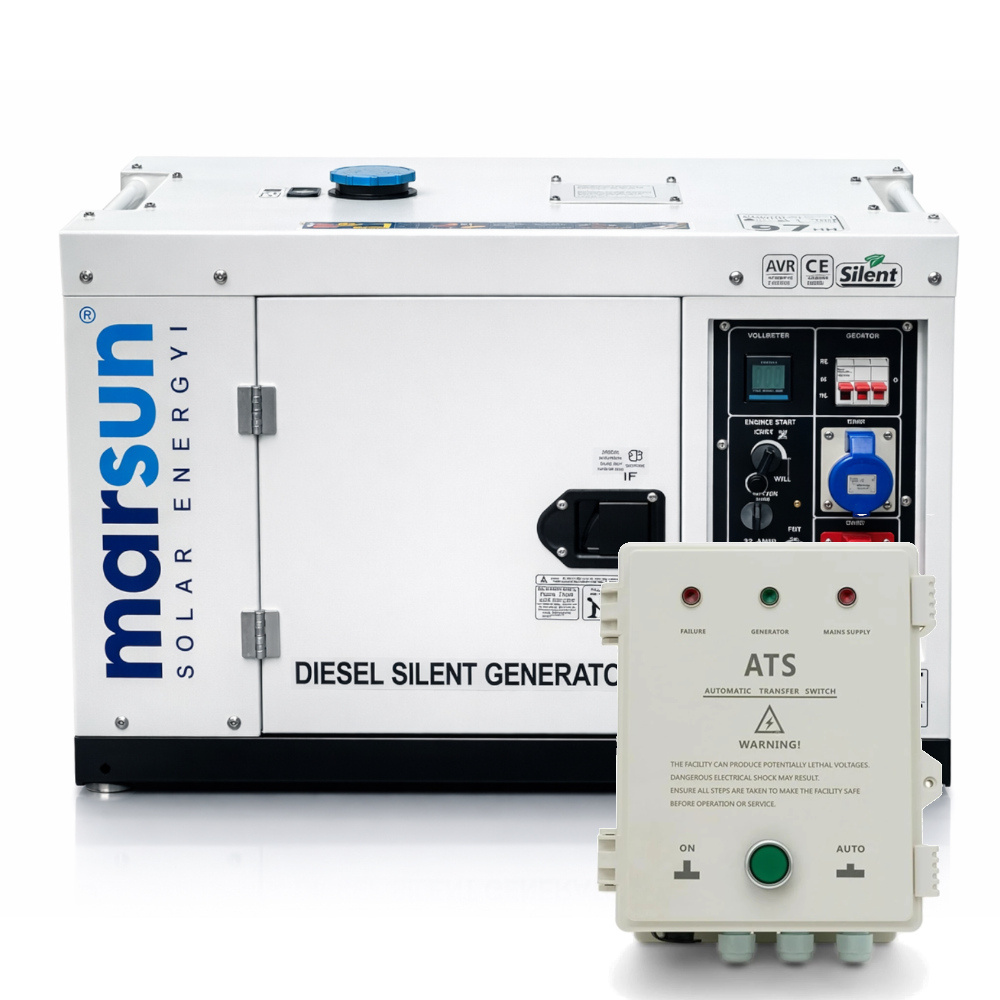
ESO, Lithuania’s electricity distribution operator, recommends connecting a generator to the house wiring through a fixed connection that stops its voltage from reaching the ESO grid, and leaving the job to qualified specialists. According to the same recommendations, you do not need to notify ESO separately. At Hybrid Energy, generators are connected by a certified electrician. Connection and start-up cost from €400.
Key points
- ESO recommends connecting a generator to the house wiring through a fixed connection and, for long-term backup, leaving the work to suitably qualified companies that install manual or automatic control equipment.
- Under Appendix 1 to the Bendroji energetikos darbuotojų atestavimo schema (General Energy Workers’ Certification Scheme), workers who install electrical equipment and electrotechnical staff working on consumer installations up to 1000 V must be certified. The scheme was approved by VERT, the National Energy Regulatory Council.
- A certified electrician holds an energy worker certificate (energetikos darbuotojo pažymėjimas), which you can check in the certification body’s register. One such register is published, for example, by UAB Kiwa Inspecta (a register of electricity sector certificates).
- ESO’s recommendations say you do not need to notify the company separately, but the consumer is responsible for connecting and maintaining the backup source.
- At Hybrid Energy, generators are connected by a certified electrician. Connection and start-up cost from €400 and usually take no more than one working day.
Can you connect a generator yourself?
ESO’s recommendations say that a generator may be connected to the wiring of the whole premises only by installing a fixed connection and measures that stop the generator’s voltage from reaching the ESO grid. On the work itself, the same text says: “Leave this work only to qualified specialists.” This is ESO’s recommendation, not a legal requirement.
The fixed connection is there so that the generator’s voltage does not reach the ESO grid. ESO’s recommendations state that connecting a generator to the wiring of the whole premises without such a connection and measures would create a serious risk to human life and health, and could also damage appliances or the generator or cause other harm. So it is not enough just to join the wires: you need to choose the connection point and a changeover switch that disconnects the house from the grid while the generator is running.
An extension cord plugged into a wall socket is not a fixed connection. What you can do yourself while you wait for the electrician is described below, in the section “What you can do yourself”. What makes up the connection price is explained in the article Connecting a generator to your house: the cost and what €400 covers.
What certification an electrician needs
Under Appendix 1 to the scheme, workers who install electrical equipment and electrotechnical staff working on consumer installations up to 1000 V must be certified, which means holding an energy worker certificate. In everyday speech it is called an “atestatas”. For wiring work in a house, these groups from the appendix matter most:
| Staff group (Appendix 1 to the scheme) | Scope of certification and rights granted | Minimum requirements | Continuing training |
|---|---|---|---|
| Workers who install electrical equipment | Carry out installation work on electrical equipment up to 35 kV | A level III electrician vocational training programme and an electrician qualification, or basic education, a certificate from a training programme for electrical equipment fitters and a 3-month traineeship | At least 12 academic hours in the last 3 years |
| Electrotechnical staff on consumer installations up to 1000 V, category VK | Carry out operation work on electrical installations up to 1000 V | A level III electrician programme and qualification, or basic education, a training programme certificate and at least 3 months’ experience with category PK | At least 12 academic hours in the last 3 years |
| Electrotechnical staff up to 1000 V, category PK | Carry out operation work up to 1000 V as a repair worker or crew member | Basic education and a training programme certificate, or a 6-month traineeship on installations up to 1000 V | At least 12 academic hours in the last 3 years |
| Engineering staff of energy companies responsible for installation (assembly) up to 35 kV | Manage and/or carry out installation work | College-level higher education in electrical engineering, electronic engineering or energy engineering, or post-secondary (aukštesnysis) education obtained before 2009 plus an electrician qualification (in the latter case a certificate from an electrical installation training programme is also required) | At least 24 academic hours in the last 5 years |
The table is based on Appendix 1 to the scheme (the version published by Kiwa). Before the work, check the version in force on e-tar.lt, the register of legal acts.
The letters VK, PK and AK stand for the electrical safety category: PK is initial, VK is intermediate and AK is high. With category PK a worker can work as a repair worker or crew member, while with VK they can also act as the person in charge of the work. Ask the electrician which category and scope of certification are shown on their certificate.
Certification is handled through EDAIS, the energy workers’ certification information system. Workers are certified by certification bodies such as UAB Kiwa Inspecta, which works under the General Energy Workers’ Certification Scheme approved by a VERT resolution (VERT 2020-12-18 Nr. O3E-1458).
How to check an electrician’s certificate
Ask the electrician to show you their energy worker certificate and check it in the certification body’s register. It takes a few minutes, and the person working on your distribution board will be someone whose qualifications you have checked.
On the certificate, look at four things: the name and surname, the scope of work (installation, įrengimas, or operation, eksploatavimas), the voltage, for example “iki 1000 V” (up to 1000 V), and the electrical safety category. Kiwa Inspecta publishes a register of electricity sector certificates on its website (an Excel file) where you can check whether such a certificate has been issued. If the electrician was certified by another body, ask which one and check that body’s register.
ESO publishes on its website a list of companies it works with on electricity network installation projects. But, as ESO itself says, you can also choose any other company with the required qualifications.
What ESO recommends
ESO’s recommendations on installing a backup power source are split into short-term use (a portable generator) and long-term use (your own backup power sources). These are ESO’s recommendations, not legislation.
| Case | ESO recommendation | What it means for you |
|---|---|---|
| Short-term | Connect a generator to the wiring of the whole premises only by installing a fixed connection and measures that stop voltage from reaching the ESO grid | Backup for the whole house needs changeover equipment; an extension cord plugged into a socket will not do |
| Short-term | Leave the work to qualified specialists; contact companies that provide electrical installation and/or operation services | Choose a certified electrician and check their certificate |
| Short-term | Preferably the generator should be the same type as the ESO supply connection (single-phase or three-phase); its power must be no lower than the combined power of the appliances connected at the same time | Before buying a generator, check your supply type and permitted power in ESO self-service (savitarna), and list your appliances before choosing a model |
| Short-term | Place and use the generator under the conditions given in its manual | Choose the spot after reading the section of the manual on where to place the generator |
| Short-term | While the generator is running, ESO is not responsible for the quality of the electricity; do not “lend” electricity to neighbours | Watch your appliances and disconnect them if you notice they are working unusually |
| Short-term | The consumer is responsible for the decision to install a backup source (ESO does not need to be notified separately); the consumer is also responsible for connection, operation and maintenance | You do not need to notify ESO separately, but connection and maintenance are your responsibility |
| Long-term | Leave the work to suitably qualified companies that will choose the connection point and install manual or automatic control equipment | Discuss with the electrician whether to fit a manual changeover switch or automatic equipment (ATS, automatic transfer switch) |
| Long-term | Choose the power according to the power of your ESO supply connection; the generator should be the same type as the supply (single-phase or three-phase) | You can find your supply type and power in ESO self-service |
| Long-term | When grid power returns, follow the instructions of the company that did the installation and those of the generator; usually first stop the generator, then use the changeover switch to reconnect the house wiring to the ESO grid | The electrician should show you how this is done in your house |
| Long-term | While the generator is running, ESO is not responsible for the quality of the electricity; do not “lend” electricity to neighbours | Watch your appliances and disconnect them if you notice they are working unusually |
| Long-term | The consumer is responsible for the decision to install a backup source (ESO does not need to be notified separately); the consumer is also responsible for operation and maintenance | You do not need to notify ESO separately, but maintenance is your responsibility |
How to choose the generator power and when you need a three-phase model is covered in the article Home generator: power, ATS and three-phase models.
What can happen if a generator is connected incorrectly
ESO’s recommendations state that if a generator were connected to the wiring of the whole premises without a fixed connection and measures that stop the generator’s voltage from reaching the ESO grid, there would be a serious risk to human life and health, and appliances or the generator could be damaged or other harm caused.
Other mistakes put your property at risk. ESO points out that connecting more load than the generator’s power can damage electrical equipment and/or the generator, and that ESO is not responsible for power quality while the generator is running. If you switch the house back to the grid without stopping the generator first, you break the sequence ESO recommends. That is why Hybrid Energy’s certified electrician not only connects the generator but also tests how the system works when the power goes off.
What to ask the electrician before the work starts
These questions will help you tell in one conversation whether the electrician is right for your job:
- Do you have an energy worker certificate? What scope of work, voltage and electrical safety category does it show? Where can I check it?
- How will the house be separated from the ESO grid: with a manual changeover switch or an ATS? Where in the distribution board will it be installed?
- Which circuits will run from the generator, and will its power be enough for them?
- Does the generator match my supply type (single-phase or three-phase)?
- How do I switch the house back to the grid when the power comes back?
- Will I get a quote before the work, with equipment, labour and materials listed separately?
- After connecting, will you test how the system works with the power off and show me how to use it?
What you can do yourself
ESO recommends leaving the generator connection to specialists, but you can do the preparation yourself. That makes the quote more accurate and the work faster.
- In ESO self-service, check whether your supply is single-phase or three-phase and what your permitted power is.
- List the appliances that must keep working during a power cut: the boiler, water pump, fridge, lighting, heat pump.
- Read the section of the generator manual on where to place it and decide where it will stand.
- Take a photo of your distribution board so that the circuit breakers and their labels are visible.
- Ask the electrician for their certificate and check it in the certification body’s register.
- Send everything through the enquiry form.
What we will do
Hybrid Energy will choose the generator and the backup power layout, send you a quote before the work (valid for 10 working days) and deliver the generator free of charge anywhere in Lithuania. A certified electrician will connect the generator, start it up and check how the system works with the power off. Connection and start-up cost from €400 and usually take no more than one working day. The generator comes with a 2-year statutory warranty. Home packages with connection are listed on the page Home generator installation.
Send an enquiry through the form, email sales@hybridenergy.lt or call +370 636 52 222 (Mon–Fri 9:00–18:00).
Frequently asked questions
Can I connect a generator to my house myself?
ESO recommends leaving this work to qualified specialists. Under ESO’s recommendations, a generator may be connected to the wiring of the whole premises only through a fixed connection that stops its voltage from reaching the ESO grid. You can prepare yourself: find out your supply type, list your appliances and photograph the distribution board. At Hybrid Energy, generators are connected by a certified electrician.
What certification does an electrician need to connect a generator?
Under Appendix 1 to the Bendroji energetikos darbuotojų atestavimo schema (General Energy Workers’ Certification Scheme, the version published by Kiwa), workers who install electrical equipment and electrotechnical staff working on consumer installations up to 1000 V must be certified. The certificate shows the scope of work, the voltage and the electrical safety category. At Hybrid Energy, generators are connected by a certified electrician.
How can I check that an electrician’s certificate is genuine?
Ask to see the certificate and find out which body issued it. Then check that body’s register: for example, UAB Kiwa Inspecta publishes a register of electricity sector certificates on its website. Compare the name, surname, scope of work and voltage. Hybrid Energy recommends doing this before any work on the distribution board.
Do I need to tell ESO that I have installed a generator?
Under ESO’s recommendations, you do not need to notify ESO separately after installing a backup power source. The consumer is responsible for the decision to install it, for connecting it and for maintaining it, and while the generator is running ESO is not responsible for power quality. Before the work, Hybrid Energy chooses a layout that separates the house from the ESO grid while the generator is running.
How much does it cost to have a certified electrician connect a generator?
At Hybrid Energy, connecting and starting up a generator costs from €400. This covers choosing the layout, connecting, starting up and testing with the power off. The generator, ATS, cables and additional work are priced in a quote that is valid for 10 working days. The connection usually takes no more than one working day.
Sources
- ESO, “Rekomendacijos rezervinio šaltinio įsirengimui” (Recommendations for installing a backup power source), sections “Trumpalaikiam naudojimui” (For short-term use) and “Ilgalaikiam naudojimui” (For long-term use): fixed connection, qualified specialists, list of companies, supply type, switching back when power returns, no need to notify ESO: eso.lt (checked 27 November 2026)
- Appendix 1 “Elektros energetikos sektoriaus darbuotojų, kurie privalo būti atestuojami, sąrašas” (List of electricity sector workers who must be certified) to the Bendroji energetikos darbuotojų atestavimo schema (General Energy Workers’ Certification Scheme), version published on the UAB Kiwa Inspecta website: kiwa.com (PDF) (checked 27 November 2026)
- UAB Kiwa Inspecta, “Asmenų sertifikavimas” (Certification of persons): certification under the scheme approved by VERT 2020-12-18 Nr. O3E-1458, EDAIS, certificate registers: kiwa.com (checked 27 November 2026)
- Hybrid Energy, “Generatoriai namams su pajungimu” (Home generator installation): certified electrician, connection price and what it includes, timing, quote, warranty: hybridenergy.lt (checked 27 November 2026)