


Tinklaraštis
Advice on choosing equipment: power, compatibility, subsidies and running costs.
Three-phase diesel generator for farms and business: from 5.5 to 250 kW

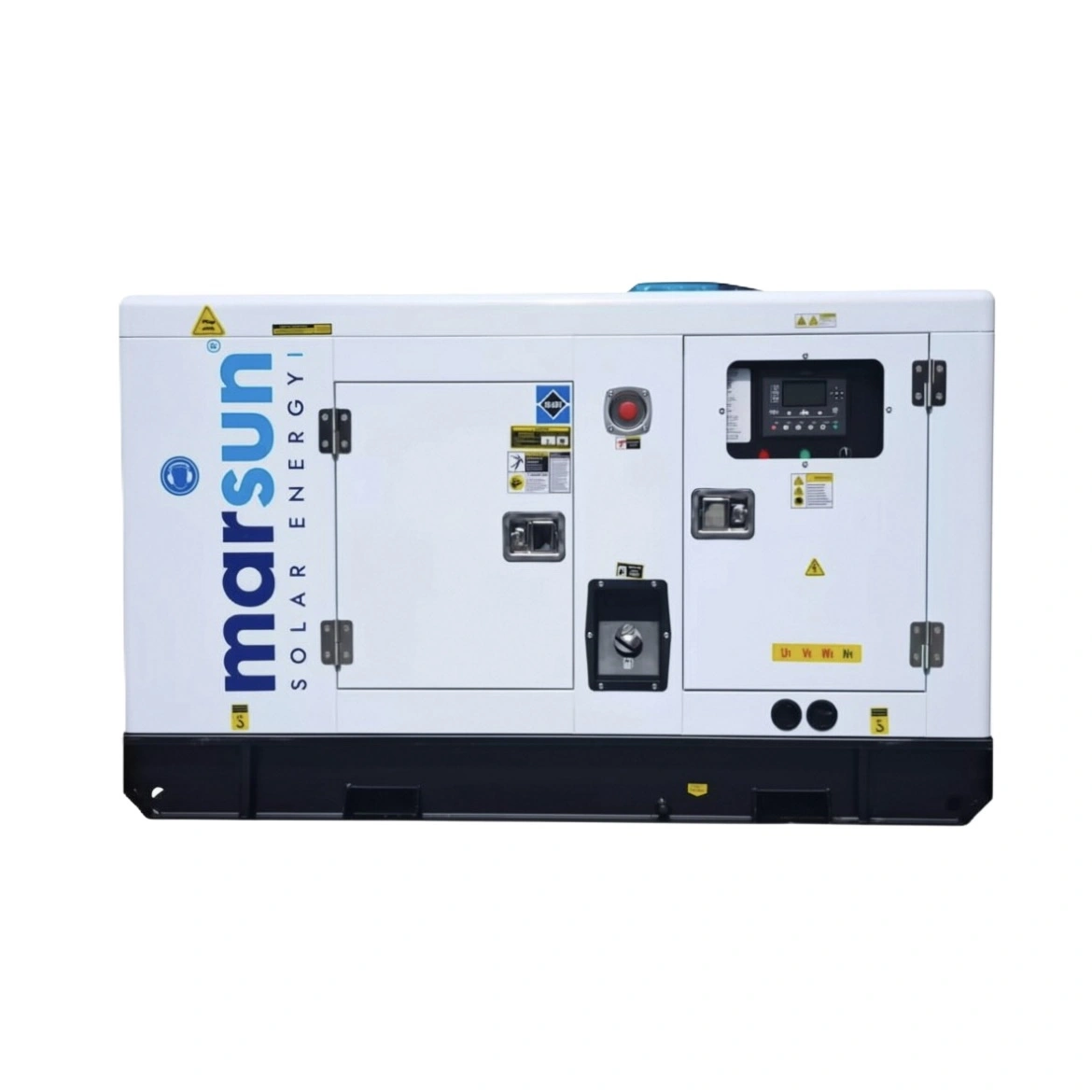
Hybrid Energy sells three-phase Marsun diesel generators from 5.5 to 250 kW, as well as the CAT Caterpillar 52 and 88 kW models. Among the main models, up to 14 kW we offer the air-cooled MVD series and from 20 kW the liquid-cooled MHD series, most of which have a built-in ATS. Installation and start-up on a farm or at a business cost from €400, and delivery within Lithuania is free.
Key points
- You need a three-phase generator when 400 V motors, compressors, refrigeration units or machine tools must keep running during a power cut. In the Hybrid Energy catalogue, generators above 15 kW are diesel only.
- Size the generator by what runs at the same time. Marsun recommends a long-term load of 75–80% of rated power, and the starting current of pumps and compressors is several times higher than the running current (exactly how much depends on the motor).
- A liquid-cooled MHD uses up to 0.24 l of diesel per kWh produced, the air-cooled MVD12 and MVD15 about 0.41 l (calculated from the manufacturer’s g/kWh). During long outages, your fuel costs depend on this difference.
- The MHD20, MHD20H and all MHD models from 25 kW have a built-in ATS. The MHD20B, MVD12 and MVD15 are automated with a separate ATS module or through a Two-Wire connection to a hybrid inverter.
- Installation costs from €400. MHD generators weigh 650–2,700 kg, so unloading, the base, cables and board rework are listed in the quote as separate lines.
When a farm or business needs a three-phase diesel generator
You need a three-phase generator when three-phase loads must keep running during a power cut: electric motors, fans, compressors, a cold room unit or machine tools. A single-phase generator will not start them. A diesel generator is the choice when outages last long or the generator runs many hours a year: in the Hybrid Energy catalogue, three-phase petrol models go up to 15 kW, and the more powerful generators are diesel only.
If you are considering whether a solar plant with battery storage would suit your farm better than a generator, see the comparison in the article does a farm need a generator or solar with storage. What ATS and AVR are and how single-phase and three-phase home generators differ is explained in the article on power, ATS and phases. Here we cover farms, workshops, warehouses, shops and small-scale production.
A three-phase generator also powers single-phase 230 V appliances, but not every model delivers its full power on one phase. Marsun MHD series generators do not, so single-phase loads have to be spread evenly across the phases. The MVD6, MVD8, MVD12 and MVD15 deliver their full power on a single phase; the manufacturer states that a conventional three-phase generator gives only a third of its power from the single-phase socket. For workshops that use powerful single-phase welders, this difference matters.
How to calculate generator power for a farm, workshop or cold room
Do not simply add up the power of all your equipment: count what must run at the same time during a power cut, and leave headroom for starting. Marsun recommends a continuous load of 75–80% of rated power: if 15 kW of equipment runs at once, you need a generator with about 19–20 kW of rated power.
- List what must keep working: for example, milking and milk cooling equipment, a water pump, ventilation, a cold room, tills, a server, lighting. You will find the power on each device’s rating plate. If the plate only gives amps, leave the conversion to an electrician.
- Mark which loads are three-phase and which are single-phase. Spread the single-phase ones across the three phases.
- Add up the power of the equipment that runs together and divide by 0.75–0.8. The result is the minimum rated power of the generator.
- Check the largest motor: its starting current is several times higher than its running current (how much depends on the motor), and it has to fit within the headroom while the other equipment is already running. If several motors can start together, start them one after another or choose a larger generator. We covered this in more detail in the article on workshop generators and starting current.
- Compare with the capacity of your ESO grid connection. ESO, Lithuania’s electricity distribution operator, advises choosing generator power according to the capacity of the existing connection. If the generator will supply only part of the site, those circuits are separated in the distribution board, and this work is listed in the quote.
A cold room compressor switches on in cycles, so its starting current must fit within the generator’s headroom at any moment, not only when the other equipment is off. For this reason a farm or shop with refrigeration equipment may need a larger generator than a simple sum of the loads suggests.
Three-phase diesel generators by power
The table lists Hybrid Energy’s main three-phase Marsun diesel generators from 5.5 to 250 kW; other models and kits are in the generator category. Diesel per hour is calculated at rated power from the manufacturer’s consumption in g/kWh and a diesel density of 0.84 kg/l, as on our product pages.
| Power class | Model | Rated / max power | Cooling | ATS | Tank | Diesel per hour (calculated) | Price |
|---|---|---|---|---|---|---|---|
| 5–8 kW | Marsun MVD6 | 5.5 / 6 kW | air | separate module | 12.5 l | about 1.8 l | 1 969 € |
| 5–8 kW | Marsun MVD8 | 7.5 / 8 kW | air | separate module | 12.5 l | about 2.5 l | 1 539 € |
| 11–14 kW | Marsun MVD12 | 11 / 12 kW | air | separate module | 25 l | about 4.5 l | 3 639 € |
| 11–14 kW | Marsun MVD15 | 14 / 15 kW | air | separate module | 25 l | about 5.7 l | 4 099 € |
| 20 kW | Marsun MHD20B | 20 / 22 kW | liquid | separate module | 60 l | up to 4.9 l | 6 299 € |
| 20 kW | Marsun MHD20 | 20 / 22 kW | liquid | built-in | 70 l | up to 4.9 l | 8 799 € |
| 25–30 kW | Marsun MHD25 | 25 / 27 kW | liquid | built-in | 70 l | up to 6.1 l | 9 499 € |
| 25–30 kW | Marsun MHD30 | 30 / 33 kW | liquid | built-in | 70 l | up to 7.3 l | 9 899 € |
| 40–50 kW | Marsun MHD40 | 40 / 44 kW | liquid | built-in | 70 l | up to 9.8 l | 11 999 € |
| 40–50 kW | Marsun MHD50 | 50 / 55 kW | liquid | built-in | 120 l | up to 12.2 l | 12 899 € |
| 80–100 kW | Marsun MHD80 | 80 / 88 kW | liquid | built-in | 120 l | up to 19.5 l | 16 699 € |
| 80–100 kW | Marsun MHD100 | 100 / 110 kW | liquid | built-in | 160 l | up to 24.4 l | 18 299 € |
| 250 kW | Marsun MHD250 | 250 / 280 kW | liquid | built-in | 1,000 l | up to 61.0 l | 34 799 € |
The catalogue also includes CAT Caterpillar generators: the DE65GC 52 kW (65 kVA) for 26 620 € and the DE110GC 88 kW (110 kVA) for 29 620 €. On the product pages of both CAT models, the stated power (kVA and kW) is standby power, not continuous power. The DE65GC’s CAT C3.3 engine runs at 1,500 rpm. The ATS panel is not included in this model’s price and is charged separately.
The full range of three-phase generators, including kits with ATS from 6 kW, is in the generator category.
Air-cooled or liquid-cooled: how the MVD and MHD differ
Among the main models, the air-cooled MVD units are lighter and cheaper, so they suit outages of a few hours with a load of no more than 14 kW. The liquid-cooled MHD units run at 1,500 rpm, use less fuel per kWh and have larger tanks, which is why Hybrid Energy offers them for long outages and for the everyday load of a farm or business.
| Parameter | Air-cooled MVD6, MVD8, MVD12, MVD15 | Liquid-cooled MHD20B–MHD250 |
|---|---|---|
| Rated power | 5.5–14 kW | 20–250 kW |
| Engine speed | 3,000–3,600 rpm | 1,500 rpm |
| Fuel consumption (manufacturer’s data) | 274–340 g/kWh | less than 205 g/kWh |
| Diesel per 1 kWh produced (calculated) | 0.33–0.41 l | up to 0.24 l |
| Fuel tank | 12.5–25 l | 60–1,000 l |
| Weight | 170–264 kg | 650–2,700 kg |
| ATS | separate module, bought separately | built-in, except MHD20B and MHD20BM |
| Full power on a single phase | yes | no |
At the average diesel price published by LEA, the Lithuanian Energy Agency, on 27 November 2026 (€2.141/l), one kWh costs up to €0.52 with an MHD, about €0.70 with the MVD6 and MVD8, and about €0.87 with the MVD12 and MVD15 (calculated). If both options suit your load and the generator produces 2,000 kWh a year, fuel for an MHD would cost about €690 less than for an MVD12 or MVD15.
If the generator will stand outdoors in winter, look for a heated fuel unit: it helps the engine start in the cold. The MHD20H, MHD25H, MHD40, MHD50, MHD80, MHD100 and MHD250 have one.
ATS and automatic starting at a business
If there is not always someone on the farm or at the business to start the generator when the power goes off, choose a model with an ATS (automatic transfer switch). The ATS monitors the grid: when the voltage is lost, it starts the generator and switches the site over to it, and when grid voltage returns, it switches the site back to the grid and stops the engine.
A built-in ATS comes with the MHD20, MHD20H, MHD25, MHD25H, MHD25W, MHD30, MHD40, MHD50, MHD50S, MHD80, MHD100 and MHD250. The MHD20B and MHD20BM are automated with a separate ATS for 20 kW generators, which costs 269 €, and the MVD12 and MVD15 with an ATS for 6–15 kW generators for 199 €. For lower power there are kits with the ATS already included in the price: MVD10000 with ATS (2 699 €), MVD12000 with ATS (4 349 €), MVD15000 with ATS (5 099 €) and MHD20000 with ATS (6 599 €).
If the site already has a solar plant with a hybrid inverter, you may not need an ATS module: the generator is connected to the inverter’s generator input, and the inverter starts and stops it through the Two-Wire connection. The manufacturer states that the generators are compatible with Deye, Solis, Solplanet, GoodWe, Victron Energy and Sungrow inverters. On the MHD20BM, MHD40, MHD50 and other models with Modbus, the parameters can be monitored remotely, which is convenient when the farm or warehouse is far away.
How much diesel a long outage needs
At rated power, the Marsun MHD20B uses up to 4.9 l of diesel per hour, the MHD40 up to 9.8 l and the MHD100 up to 24.4 l (calculated). At the diesel price of 27 November 2026, that is about €10.4, €21 and €52 per hour. Running at full power around the clock, the MHD40 would use up to 234 l, while its tank holds 70 l, so a long outage requires a fuel reserve or an additional tank, which is available as an option for this model.
Our calculation: manufacturer’s consumption in g/kWh × power in kW ÷ 1,000 = kg per hour; we then divide this figure by 0.84 kg/l. The manufacturer does not state the load at which the consumption was measured. The MHD20B and MHD40 product pages state that the tank lasts up to 8 hours of continuous running. When the generator runs at the recommended 75–80% load, it uses less fuel per hour than the table shows.
What generator installation on a farm or at a business includes
Installation and start-up cost from €400: this covers choosing the backup power layout, connecting the generator, starting it up and checking how the site switches over when grid voltage is lost. Quoted separately: the ATS (if it is not part of the kit or the generator), cables, protective devices and materials, board rework, a base, groundwork for the cable, a longer cable, unloading and noise reduction.
At a business site these lines often matter more than at a house. The MHD20B weighs 720 kg, the MHD40 850 kg and the MHD100 1,300 kg, so they need a solid base, and unloading needs lifting equipment. Connection to a Deye or Solis inverter and a battery is priced case by case. ESO’s recommendations state that a generator may be connected to the internal wiring only through a fixed connection with measures that prevent the generator’s voltage from reaching the ESO grid, and that this work must be left to qualified specialists. The quote lists equipment, labour, materials, delivery and the total separately. The offer is valid for 10 working days.
What you can do yourself
- Check your ESO contract or bill for the capacity of the site’s grid connection and whether it is three-phase.
- List the equipment that must keep working during a power cut and photograph its rating plates.
- Mark the largest motors, the refrigeration equipment and the equipment that can switch on at the same time.
- Estimate how often and for how long the power goes off and whether someone is always on site. If not, choose a generator with ATS.
- Plan a spot outdoors with access for a truck, and measure the distance to the distribution board. ESO advises placing a portable generator according to the conditions in the manufacturer’s manual.
- Fill in the installation enquiry form and attach the information you have collected.
What we will do
- Based on your grid connection and actual load, we choose the generator and the backup power layout, connect it, start it up and check how the site works when grid voltage is lost. Price: from €400.
- We work throughout Lithuania, and the work is done by a certified electrician; installation usually takes no more than one working day.
- Before any work you receive a quote that lists equipment, labour, materials, delivery and the total separately. The offer is valid for 10 working days.
- Delivery within Lithuania is free, and the generator comes with a 2-year statutory warranty.
You can send an enquiry through the form, by email at sales@hybridenergy.lt or by phone on +370 636 52 222 (Mon–Fri 9:00–18:00). More about the service is on the generators with installation page.
Frequently asked questions
What size three-phase generator does a farm need?
It depends on what must run at the same time during a power cut. Add up the power of that equipment and divide by 0.75–0.8, because Marsun recommends a long-term load of 75–80% of rated power: a 15 kW load needs a generator of about 20 kW. Hybrid Energy calculates the power from your grid connection and actual load before drawing up the quote.
What is the difference between an air-cooled and a liquid-cooled diesel generator?
In the Hybrid Energy catalogue, the air-cooled Marsun MVD models are rated at 5.5–14 kW, weigh 170–264 kg and run at 3,000–3,600 rpm. The main liquid-cooled MHD models are rated at 20–250 kW, run at 1,500 rpm and use up to 0.24 l of diesel per kWh produced, compared with about 0.41 l for the MVD12 and MVD15 (calculated from the manufacturer’s data).
Can single-phase appliances be connected to a three-phase generator?
Yes, but you need to consider the single-phase limit. Marsun MHD generators do not deliver full power on one phase, so single-phase loads have to be spread evenly. The MVD6, MVD8, MVD12 and MVD15 sold by Hybrid Energy deliver their full power on a single phase, so they also suit powerful single-phase equipment such as welders in a workshop.
How much diesel does a 40 kW generator use?
According to the manufacturer, the Marsun MHD40 sold by Hybrid Energy uses less than 205 g/kWh. At the full 40 kW load that is up to 9.8 l of diesel per hour, or about €21 per hour at LEA’s average price on 27 November 2026 (calculated). According to the manufacturer, the 70 l tank lasts up to 8 hours of running, and an additional tank is available as an option.
How much does it cost to install a three-phase generator at a business?
Installation and start-up by Hybrid Energy cost from €400: this covers choosing the layout, connecting the generator, starting it up and testing it with grid power off. Cables, protective devices, board rework, a base, groundwork and unloading are listed in the quote separately. The quote is valid for 10 working days, and the work is done by a certified electrician.
Sources
- Hybrid Energy: generators with installation: installation price, what it includes, the quote, timing, delivery, warranty; checked 27 November 2026.
- Hybrid Energy generator catalogue (product pages, linked in the table): prices, power, tank, g/kWh consumption, ATS; prices as of 26 November 2026.
- Marsun MHD20B product page: liquid cooling, 1,500 rpm, 720 kg, starting current 2–5 times the running current, 75–80% load; checked 27 November 2026.
- Marsun MHD40 product page: built-in ATS, Modbus, heated fuel unit, additional tank, 850 kg, up to 8 hours; checked 27 November 2026.
- Marsun MVD12 product page: air cooling, 3,600 rpm, full power on a single phase, external ATS module; checked 27 November 2026.
- CAT Caterpillar DE65GC product page: 52 kW (65 kVA) standby power, CAT C3.3, 1,500 rpm, ATS panel sold separately; checked 27 November 2026.
- Product pages of other Marsun models (MVD6, MVD8, MVD15, MHD20, MHD20H, MHD25, MHD25H, MHD30, MHD50, MHD80, MHD100, MHD250), based on the manufacturer’s description: cooling, engine speed, weight, heated fuel unit, Modbus, compatible inverters; reviewed 23 October 2026.
- pigiausidegalai.lt (based on LEA data): average diesel price on 27 November 2026, €2.141/l; fuel cost per hour and per kWh calculated.
- ESO: “Rekomendacijos rezervinio šaltinio įsirengimui” (Recommendations for installing a backup power source): fixed connection, protection against generator voltage reaching the ESO grid, power according to the grid connection, single-phase limit, placement according to the manual; checked 27 November 2026.