


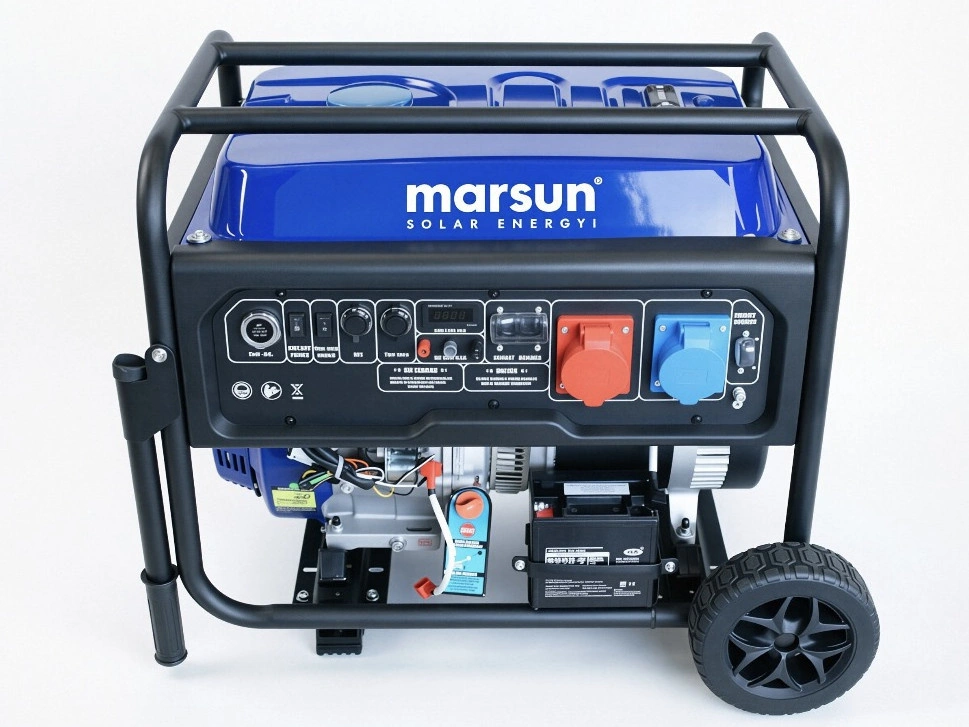

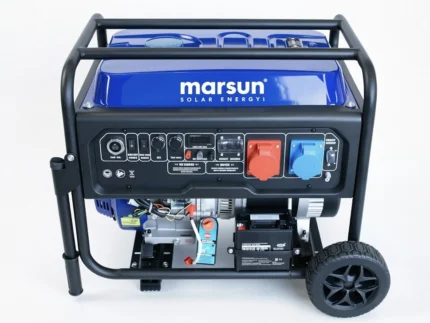
Marsun MVB7 6.5 kW Three-Phase Petrol Generator
€1,169.00
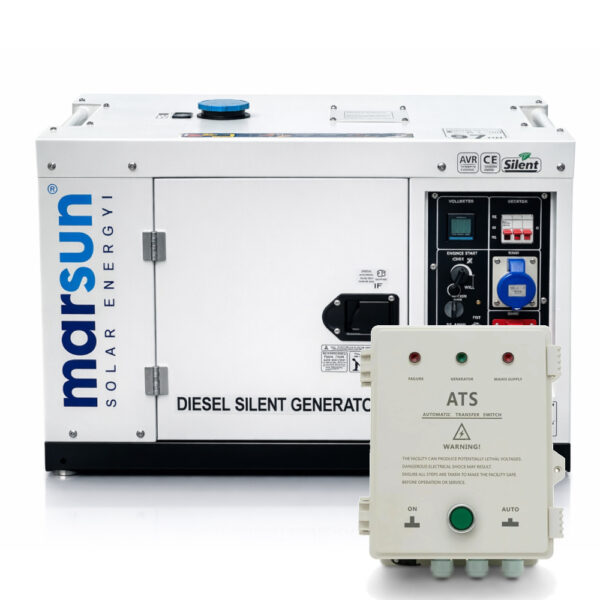
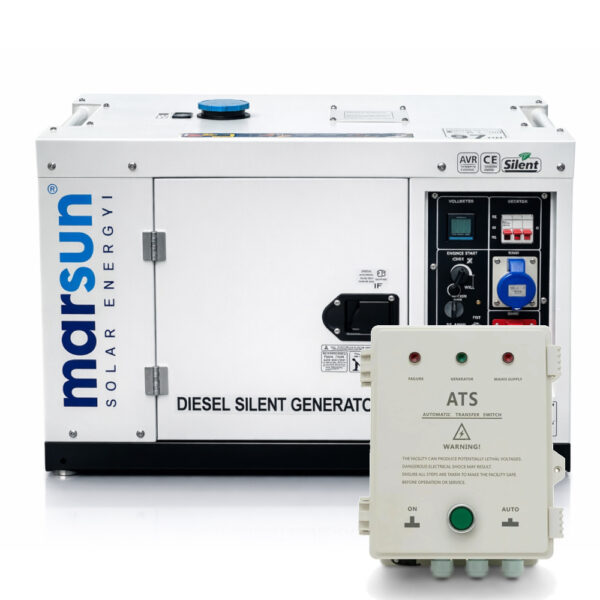
Marsun MVB7 is a 6.5 kW (7 kW maximum) three-phase petrol generator with AVR and a Two-Wire Switch connection; the 25 l tank gives up to 7 h at 100% load.
- Free delivery across Lithuania
- 14-day returns — we pay for the return shipping
- Manufacturer warranty, CE compliant
The Marsun MVB7 is the lowest-rated and lightest generator in this three-phase petrol series: 6.5 kW rated power (7 kW maximum), 73 / 78 kg, and a recommended continuous load (75–80 % of rated power) of 4.9–5.2 kW. It has an air-cooled FC190F engine (420 cm³), a copper alternator, AVR voltage regulation, electric start and a factory Two-Wire Switch connection through which a hybrid inverter or an ATS cabinet can start it automatically. The manufacturer states up to 7 h of continuous running at 100 % load on the 25 l tank, so it suits home backup power and solar systems with storage when the combined demand stays within about 5.2 kW; if you need more, look at the MVB8 or MVB10.
Technical specifications
| Parameter | Value |
|---|---|
| Fuel | petrol |
| Cooling | air |
| Rated power | 6.5 kW |
| Maximum power | 7 kW |
| Rated AC voltage | 230 V / 400 V |
| Frequency | 50 Hz |
| Phases | three-phase |
| Full power from one phase | yes |
| Alternator | copper |
| Engine model | FC190F |
| Engine type | 1-cylinder, 4-stroke, air-cooled |
| Displacement | 420 cm³ |
| Engine speed | 3000 rpm |
| Recommended engine oil | SAE 10W-30 |
| Oil quantity | 1.1 l |
| Noise level | ≤ 97 dB |
| Continuous run time | 7 h (at 100% load) |
| Fuel consumption | ≤ 374 g/kWh |
| Fuel tank capacity | 25 l |
| Weight (two values in the datasheet) | 73 / 78 kg |
| Dimensions (L × W × H) | 700 × 540 × 575 mm |
| Start | electric |
| Voltage regulation | AVR |
| Automatic-start connection | Two-Wire Switch |
| ATS module | optional, sold separately |
| Protection | no-load protection, overload circuit breaker, overpressure protection |
Download the manufacturer datasheet (PDF)
How the MVB7 differs from the MVB8 and MVB10
| Parameter | MVB7 (this model) | MVB8 | MVB10 |
|---|---|---|---|
| Rated / maximum power | 6.5 / 7 kW | 7.5 / 8 kW | 9 / 10 kW |
| Engine | FC190F, 420 cm³ | FC192F, 459 cm³ | FC192F, 459 cm³ |
| Recommended continuous load (75–80 %) | 4.9–5.2 kW | 5.6–6.0 kW | 6.8–7.2 kW |
| Manufacturer’s run time (100 % load, 25 l) | 7 h | 5.5 h | 8 h |
| Estimate from fuel consumption | ≈ 3.3 l/h, the tank would last ≈ 7.6 h | ≈ 3.8 l/h, the tank would last ≈ 6.6 h | ≈ 4.5 l/h, the tank would last ≈ 5.5 h |
| Weight | 73 / 78 kg | 75 / 80 kg | 78 / 83 kg |
Choose the MVB7 when the combined demand of the building and battery charging stays within about 5.2 kW and lower weight matters. If the demand reaches about 6.0 kW, the MVB8 is the better choice, and up to about 7.2 kW the MVB10. The manufacturer’s run times on a full tank do not follow the power order (MVB7 7 h, MVB8 5.5 h, MVB10 8 h), so plan fuel by each model’s own figures rather than by power.
What is a 6.5 kW petrol generator used for: home backup, building sites and workshops
Backup power for a house during a power cut, topping up a solar system with storage when there is not enough sun and the battery is empty, a construction site, a workshop, a garden plot, camping and outdoor events: the MVB7 suits all of these as long as the combined demand (building plus battery charging) stays within about 5.2 kW.
How much fuel does the MVB7 use and how long does it run on a full tank?
The manufacturer states that on a full 25 l tank the MVB7 runs continuously for up to 7 h at 100% load. This manufacturer figure is the one to rely on.
An indicative calculation from fuel consumption: ≤ 374 g/kWh × 6.5 kW ÷ 1000 = about 2.43 kg of petrol per hour. Divided by a petrol density of 0.74 kg/l, that is about 3.3 l/h, and the 25 l tank would then last roughly 7.6 h. This is only an estimate based on the manufacturer’s maximum consumption, not a measurement.
How does the MVB7 start automatically from a hybrid inverter?
The MVB7 has a factory Two-Wire Switch connection. It is a simple two-wire connection with a dry (voltage-free) contact: through it a hybrid inverter or an ATS cabinet starts and stops the generator by itself, with nothing for you to do.
The manufacturer’s compatibility list includes Deye, Solis, Solplanet, GoodWe, Victron Energy and Sungrow hybrid inverters. The inverter starts and stops the MVB7 by itself through the generator input (GEN) and the Two-Wire Switch connection, so no separate ATS cabinet is needed; at a site without solar, an ATS cabinet monitors the grid and starts the generator when the voltage is lost. Connection to the building installation and ATS configuration must be done by a qualified electrician.
How do you connect a backup generator to a house?
The generator is connected to the site’s internal network through a fixed connection, and switching can be automated with a hybrid inverter or a separately bought ATS module. ESO (Lithuanian grid operator) states:
“A generator may be connected to the internal electrical network of a whole building only by installing a fixed connection and measures that ensure the voltage produced by the generator is not fed into ESO’s networks… Entrust this work only to qualified specialists.”
The same ESO page advises choosing the power according to your supply connection and, when connecting single-phase loads to a three-phase generator, checking the limit of one phase, because the datasheet gives the total power of all three phases.
We handle it for you. We select the equipment for your site, deliver anywhere in Lithuania, install and connect it.
Load and phases: full power also from a 230 V socket
The MVB7 delivers its full 6.5 kW rated power from both the 400 V power socket and the 230 V single-phase socket (“Equal Power”), while the single-phase socket of an ordinary three-phase generator gives only a third. When planning the load, allow for starting currents: pumps and compressors draw 2–5 times more current when they start, and the sum of the loads switched on together must not exceed 6.5 kW.
The generator should not run at full (100%) load for long periods. The optimum for the engine and alternator is 75–80% of rated power, for the MVB7 about 4.9–5.2 kW. In a system with a battery, add the power the generator will use to charge the batteries to the building’s demand and multiply the sum by a 1.25 reserve factor. Manufacturer’s example: with a total demand of 10 kW you need a generator rated 10 kW × 1.25 = 12.5 kW. By this calculation the MVB7 suits a combined building and battery-charging demand of up to about 5.2 kW. Above 25 °C ambient temperature, or at high altitude, the maximum power can fall.
What to know before buying
- Noise. Noise level is up to 97 dB and the manufacturer does not state a sound-insulating canopy. Near homes it is worth placing it away from windows or adding a noise barrier.
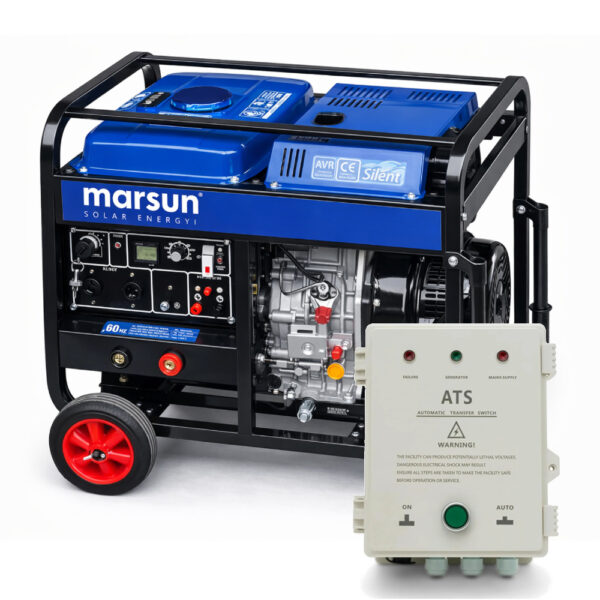
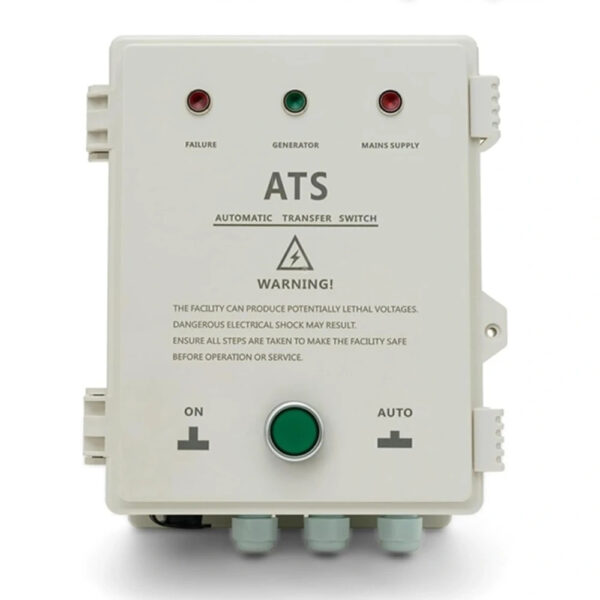
- Automatic changeover. There is no built-in ATS. A hybrid inverter starts the generator through the Two-Wire Switch connection; a site without an inverter needs a separately bought ATS module.
- Fuel and oil. The generator runs on petrol. Before the first start add 1.1 l of SAE 10W-30 oil to the crankcase: running without oil permanently damages the engine. After starting, wait 3–5 min with no load, and before stopping disconnect the loads and let the engine idle for 2–3 min.
- Location. Use outdoors only, in an open space: the exhaust gas contains carbon monoxide.
- Weight and size. 73 / 78 kg, 700 × 540 × 575 mm.
- Control panel. 230 V sockets and a 400 V power socket, voltmeter, frequency meter, hour meter, main fuse, key switch and oil-sensor indicator.
Frequently asked questions
How long does the Marsun MVB7 run on a full tank?
According to the manufacturer up to 7 h at 100% load, with a 25 l tank. An indicative calculation from fuel consumption gives a similar result, about 7.6 h.
How much fuel does the MVB7 generator use?
The manufacturer states no more than 374 g/kWh, i.e. at 6.5 kW load about 2.43 kg or roughly 3.3 l of petrol per hour. This is an indicative calculation.
Is the MVB7 a generator with ATS?
The MVB7 has no built-in ATS; an ATS module is bought separately. With a hybrid inverter no ATS is needed, because the inverter starts the generator through the Two-Wire Switch connection.
Which inverters is the MVB7 compatible with?
The manufacturer’s compatibility list includes Deye, Solis, Solplanet, GoodWe, Victron Energy and Sungrow hybrid inverters. Hybrid Energy checks the wiring scheme for your specific inverter and connects the system.
Can the MVB7 be connected straight to the house fuse board?
No, only through a fixed connection with measures that prevent voltage from reaching the ESO grid, and only by qualified specialists, as the ESO recommendations for backup sources state.
Is a 6.5 kW petrol generator suitable for a house, farm or building site?
Yes, the MVB7 is intended for home backup power, solar PV systems with storage, building sites, workshops, garden plots and outdoor events. The optimum long-term load is about 4.9–5.2 kW.
How loud is the MVB7?
The manufacturer states a noise level of up to 97 dB. It does not state a sound-insulating canopy, so choose the location carefully, away from living areas.
Can single-phase appliances be connected to the three-phase MVB7?
Yes, the full 6.5 kW rated power can also be used from the 230 V socket. Keep in mind that pumps and compressors draw 2–5 times more current when starting.
Does Hybrid Energy install the generator?
Yes, Hybrid Energy delivers the MVB7 anywhere in Lithuania, installs it, connects it to the site or the hybrid inverter and puts it into operation. A consultation before purchase is free.
Sources
- Marsun MVB7 manufacturer datasheet (PDF), checked 2026-10-26
- ESO — Recommendations for installing a backup power source, checked 2026-10-26
| Dimensions | 70 × 54 × 57.5 cm |
|---|---|
| Power | 6.5 kW |
| Phases | Three-phase |
| Brand | Marsun |
Reviews
There are no reviews yet.