


Tinklaraštis
Advice on choosing equipment: power, compatibility, subsidies and running costs.
Does a Solar Power Plant on a Warehouse Roof Pay Off?

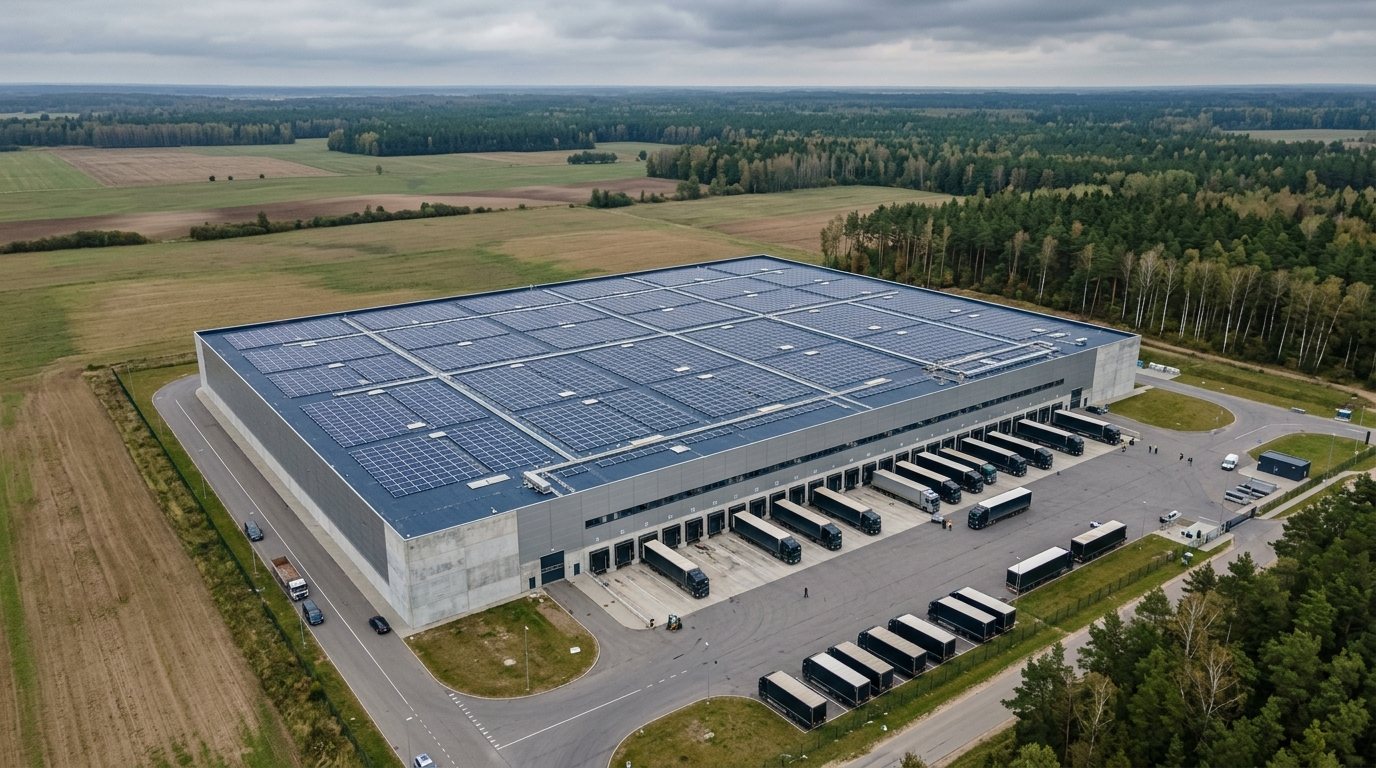
We’re Hybrid Energy — we sell grid-tied inverters, hybrid inverters, battery storage, and generators. We make less margin on a grid-tied inverter than on a hybrid inverter with battery storage, so it would be easier for us to sell the pricier solution. This piece doesn’t do that: it shows when a warehouse actually needs battery storage, and when battery storage just adds to the bill with no real benefit.
The short version
- A warehouse has something most other sites don’t: a large flat roof and daytime operation — while the sun is out, forklifts, lighting, loading-dock doors, and cooling equipment are already running. That means generation and consumption overlap in time better than they do in, say, a home.
- Because of that overlap, a grid-tied inverter without battery storage gives most warehouses the best value for money — it costs several times less, and the energy generated is already consumed on-site while the shift is running.
- A business site pays not only for kilowatt-hours but also for its permitted capacity — €3.00/kW per month excl. VAT, every month. Exceed that capacity, and the same capacity-charge rate becomes three times higher.
- An EV or forklift charger, switched on alongside other equipment, creates a short but high power spike — exactly the kind that can push a site close to its permitted capacity limit or over it.
- A 30 kW grid-tied inverter costs €1,149. A hybrid inverter of the same power starts at €3,049. That difference is worth paying only when you actually need to store energy, not just to have a pricier box on the wall.
What you’re choosing between
Two inverter types matter for a warehouse, plus one extra device worth factoring in alongside them — a charging station.
Grid-tied (string) inverter. Converts the solar modules’ direct current into alternating current and feeds it straight into the site’s panel or the grid. You can’t connect battery storage to it — it simply has no battery port. In our catalog, that’s for example Deye SUN-30K-G04 (30 kW, €1,149), Deye SUN-50K-G03 (50 kW, €1,749), and Deye SUN-100K-G03 (100 kW, €3,149) — power ratings that suit a larger warehouse roof.
Hybrid inverter. Differs from a grid-tied inverter in one respect: you can connect battery storage to it. ESO describes it this way:
„Dalis gaminamos elektros energijos pertekliaus gali būti kaupiama elektros energijos kaupiklyje (EEK) ir sunaudojama vakare.“ (in English: A portion of the surplus generated electricity can be stored in an electricity storage device (EEK) and used in the evening.)
A hybrid inverter of the same 30 kW power — Deye SUN-30K-SG02HP3-EU — costs €3,049, and battery storage for it is bought separately. The inverter alone, without battery storage, costs almost three times more than a grid-tied inverter of the same power.
EV or forklift charging station. This isn’t part of the solar system, it’s an extra load that may or may not line up with the solar schedule. In our catalog, such stations include Wallbox BS20-BC-22KW-APP (22 kW, €479) or Deye SUN-EVSE11K01-EU-AC (€449). The station itself doesn’t cost much. What’s expensive isn’t the unit — it’s that, switched on at the same time as other equipment, it can push a site closer to its permitted capacity limit.
The axis a warehouse’s choice turns on: what matters isn’t how much energy you generate, it’s how much of it you consume at that same moment, during the day, while the warehouse is operating. The bigger that overlap, the less sense battery storage makes.
Comparison at a glance
| Criterion | Grid-tied inverter | Hybrid with battery storage | + Charging station |
|---|---|---|---|
| Price of a 30 kW inverter (without battery storage) | €1,149 | from €3,049 | €429–€479 extra |
| Works during a grid outage | No — shuts off immediately | No, unless there’s battery storage or a generator input | Not relevant — determined by the inverter |
| Reduces the monthly capacity charge (€3.00/kW) | Indirectly — only if it lowers overall grid draw | Yes, if it actually shaves the spike | The opposite — adds a spike if charging at the same time as other equipment |
| When it starts paying off | Immediately, while the shift runs and the sun is out | Both day and evening — but the investment is bigger | Not applicable — it’s a cost, not generation |
| What happens when generation and consumption don’t match | Surplus is exported to the grid | Stored and used later | — |
| Maintenance | Minimal | Extra — battery condition, BMS | Minimal |
When the right answer is a grid-tied inverter without battery storage
A grid-tied inverter wins where the warehouse runs a day shift and consumes electricity roughly when the roof generates it: lighting, loading-dock door automation, forklift charging during lunch break, ventilation, office equipment. In that case, most of the generated energy is consumed on-site at that same moment, not in the evening — so battery storage’s main advantage, shifting energy into the evening, matters less to a warehouse than it would to, say, a home that’s empty all day.
Second, a less obvious scenario: a warehouse running two or three shifts, where activity doesn’t stop even in the evening. Here generation and consumption schedules still don’t match perfectly (there’s no sun after dark), but the overlap holds during the day shift, and the grid covers the night shift, when the lower off-peak transmission rate applies.
The mechanism is simple: a grid-tied inverter has nowhere to store what the site doesn’t manage to consume, so its economics depend entirely on how well generation and consumption line up. In a warehouse, that overlap is fundamentally better than at most other sites, because work happens in daylight.
What that costs. A grid-tied inverter shuts off when the grid goes down — that’s a safety feature, not a flaw, but it also means the solar plant doesn’t protect the warehouse from downtime. It also doesn’t directly reduce the monthly capacity charge, only to the extent it lowers the power drawn from the grid. And it does nothing to protect against the triple rate for exceeding capacity if the warehouse’s peak occurs in the evening or at night, when there’s no sun.
When the right answer is a hybrid inverter with battery storage
Battery storage wins where a warehouse’s peaks are frequent, high, and don’t line up with sunshine, or where a site is approaching its permitted capacity limit and doesn’t want to raise it because of the cost. ESO states:
„Atkreipiame dėmesį, kad viršijus objekto leistiną naudoti galią, vartotojas privalo sumokėti trigubą vartotojo objektui taikomo tarifo plano galios dedamosios kainą.“ (in English: We note that if a site exceeds its permitted capacity, the consumer must pay triple the capacity-charge rate of the tariff plan applied to that site.)
ESO — Elektros energijos persiuntimo paslaugų kainos verslui
This is exactly where forklift and EV charging stations become important. Every station running is a fixed extra load the warehouse draws from the grid. If several stations switch on at the same time as cooling equipment or a packing line, total draw can approach or exceed the permitted limit, and then the capacity charge has to be paid at three times the rate. A properly configured battery can shave exactly that short spike and keep the site under the limit.
A second scenario: a warehouse with a cooling or freezer zone. A constant cooling need means battery storage can act as short-term protection against grid disturbances in zones where even a few minutes without power affects product quality. In a long outage, battery storage can’t sustain cooling, or any other equipment, without a generator.
What that costs. A 30 kW hybrid inverter without battery storage already costs €3,049, versus €1,149 for a grid-tied inverter of the same power. Add battery storage and the price climbs further: for example, a 20 kW hybrid inverter with two battery modules (about 10.24 kWh total) costs €4,799, while a grid-tied Deye SUN-20K-G04 of the same power alone costs €999. The gap between these two catalog items is about €3,800, and it’s worth paying only when battery storage actually shaves peaks or covers a zone that can’t go without power for even a minute.
What the site decides for you
Some choices disappear before you even form an opinion.
Roof shape and orientation limit how much capacity can be installed at all. Shade-casting ventilation units, chimneys, a neighboring building’s shadow, or a north-facing roof side reduce usable area before any economic calculation even starts. That’s a technical constraint, not a pricing question, and it’s resolved by inspecting the specific roof, not by a general rule.
Permitted capacity sets a ceiling for both generation and consumption. If a site is permitted, say, 100 kW, a solar plant exceeding that limit will simply have nowhere to send part of its surplus without extra coordination with ESO. The same applies on the consumption side: every new charging station or cooling line pushes the site closer to that same limit.
The shift schedule decides whether a grid-tied inverter is enough. In a single-day-shift warehouse, generation and consumption overlap the most. In a two- or three-shift warehouse, part of consumption happens after the sun is gone, and it’s that part, not the warehouse’s total consumption, that makes the case for battery storage.
The number of chargers, and whether they run at the same time, decides whether a spike forms at all. A single 22 kW station running on its own rarely becomes a problem. Several stations switched on at once at the end of a shift already create a load that needs to be counted alongside the rest of the warehouse’s equipment, not separately.
What changes in day-to-day operation
A grid-tied inverter needs almost no attention in operation: it simply runs whenever there’s sun and grid power. A hybrid inverter with battery storage requires an upfront decision — which panel groups charge and discharge, and in what priority — plus periodic checks on battery condition. Charging stations need a schedule: where possible, it’s worth spreading forklift charging across the day rather than concentrating it in one hour, because concentrated charging is exactly what creates a spike.
What doesn’t change: neither option changes your supplier, contract, or the permitted capacity stated in it. What changes is only how much of that capacity the site actually uses, and when.
Do you really have to choose just one?
Usually one main solution is enough for a warehouse, but two combinations come up regularly.
Grid-tied inverter now, hybrid later. The warehouse installs a grid-tied system sized to its current roof area and consumption, and if a cooling zone, extra shifts, or several simultaneously running charging points appear later, the system is switched to a hybrid setup or a separate battery is added, if the inverter allows it.
Grid-tied inverter plus a separate forklift-charging schedule. Instead of buying expensive battery storage, the warehouse simply spreads forklift charging across the day so it doesn’t coincide with other peaks. That’s a solution that costs nothing and often solves the same problem another site would buy battery storage for.
Frequently asked questions
Does a solar plant without battery storage pay off for a warehouse?
It depends on how much generated energy you consume at that same moment. A warehouse running a day shift often consumes most of its generated energy immediately — for lighting, doors, forklift chargers. In that case, a grid-tied inverter, costing several times less than a hybrid, already delivers the benefit the plant was built for.
Will a forklift charger increase my electricity bill?
The price of the kilowatt-hours consumed changes little, but a charger adds a power spike. If that spike, combined with other equipment running at the same time, approaches or exceeds the permitted capacity, ESO states that the tariff plan’s capacity charge is then paid at triple the rate — that costs more than the charging itself.
Do I need battery storage if the warehouse runs a single shift?
Not always. In a single-day-shift warehouse, generation and consumption overlap best, so battery storage’s main benefit, shifting energy into the evening, is needed the least here. Battery storage becomes relevant once a cooling zone, multiple shifts, or frequent short grid disturbances appear.
What inverter power does my warehouse need?
That depends on roof area, orientation, and the site’s permitted capacity, not on the building’s total floor area. Send us these three details and we’ll calculate the right power rating — our catalog carries grid-tied inverters from a few kW up to 100 kW.
Can battery storage be added later to an already installed grid-tied inverter?
Not directly — a grid-tied inverter has no battery port. Battery storage needs a hybrid inverter or a separate system running in parallel with the existing one. We check this against your specific installed inverter before proposing a solution.
What we suggest you do
Send us three things: the warehouse’s permitted capacity (stated in your ESO contract), a roof plan with orientation and any shade-casting objects, and a shift and charging-station schedule, if stations already exist or are planned. We’ll calculate whether a grid-tied inverter is enough for the warehouse or whether it’s worth paying for a hybrid with battery storage. We deliver throughout Lithuania.
Sources
- ESO, Electricity transmission service prices for business customers — capacity charge, capacity overage: eso.lt (reviewed 2026-09-18)
- ESO, Electricity storage devices — storing surplus and using it in the evening: eso.lt (reviewed 2026-09-15)
- Hybrid Energy, catalog of grid-tied and hybrid inverters and charging stations — models, power ratings, and prices, e.g. Deye SUN-30K-G04, Deye SUN-30K-SG02HP3-EU (reviewed 2026-09-18)