


Tinklaraštis
Advice on choosing equipment: power, compatibility, subsidies and running costs.
Does a Cold Storage Warehouse Need a Generator or Battery Storage?

We’re Hybrid Energy — we sell diesel generators, hybrid inverters with battery storage, solar modules, and systems that combine them. We sell every option, so we have no reason to favor one over another. This piece won’t tell you which option is better overall; it shows which one wins specifically when a cold storage warehouse has a constant, round-the-clock load, and what each option costs.
The short version
- A cold storage warehouse’s load isn’t a short spike — the compressors run almost continuously, around the clock. Under that kind of constant full load, a battery with limited capacity drains in hours, not days; on its own it can almost never cover a long winter outage or supply failure.
- A compressor’s starting current is several times higher than its rated current. That means a brief startup spike can exceed the site’s permitted capacity, and the Lithuanian distribution network operator ESO charges triple the capacity-charge rate for going over it.
- A business site pays €3.00/kW per month excl. VAT just for the permitted capacity itself — whether the compressors started up ten times that month or a hundred.
- Sites in reliability groups two and three also pay a reliability-category charge: €1.00/kW/month or €0.50/kW/month. That’s another line item to factor in alongside the capacity charge, not separately.
- Most cold storage warehouses we see end up buying both — a generator for a long outage and battery storage or a hybrid inverter to shave compressor startup spikes — but rarely at the same time.
What you’re choosing between
A cold storage warehouse’s load differs from most other businesses in one key way: it barely drops. Compressors, fans, and defrost cycles run around the clock, not just during business hours. Each of the three options addresses a different part of that problem.
Diesel generator with ATS. A three-phase unit with an automatic transfer switch (ATS). Our range runs from 20 kW (Marsun MHD20B, 6 299 €) to 250 kW (Marsun MHD250, 34 799 €). The Marsun MHD models from 25 kW up have the ATS built in; for the 20 kW MHD20B it is an option, and our catalog also carries separate ATS units for 6–15 kW and 20 kW generators (€199 and €269). All units are three-phase with AVR, an automatic voltage regulator. The generator starts when the grid goes down and runs as long as there’s fuel in the tank, regardless of how many hours or days that takes.
Battery storage (a battery with a hybrid inverter). ESO describes how it works this way:
„Dalis gaminamos elektros energijos pertekliaus gali būti kaupiama elektros energijos kaupiklyje (EEK) ir sunaudojama vakare.“ (in English: A portion of the surplus generated electricity can be stored in an electricity storage device (EEK) and used in the evening.)
With a constant cooling load, the main benefit of battery storage isn’t backup power, it’s shaving compressor startup spikes so they don’t exceed the permitted capacity. Our catalog includes smaller modules (e.g., EASYWAY UNIV-HV, 23.04–61.44 kWh, €4,849–€10,399) and industrial systems with an inverter for larger warehouses (Solis EverCore C5, 100–261 kWh / 50–125 kW, €26,799–€49,999).
Combination. A generator for a long outage, battery storage or a hybrid inverter for everyday startup spikes. Technically this is often one system: some hybrid inverters have a generator input and can start the generator themselves.
The axis this whole choice turns on: a cold storage warehouse’s load is constant, not peak-based — it doesn’t drop at night or on weekends. That gives the generator a structural advantage over battery storage that doesn’t appear anywhere else in this series: it’s the only option that covers a round-the-clock, unrelenting load for as long as there’s fuel.
Comparison at a glance
| Criterion | Generator with ATS | Battery storage | Combination |
|---|---|---|---|
| What happens when the grid is down for hours and the compressors keep running | Everything runs as long as there’s fuel | Under a full, constant load, capacity runs out in hours | Everything runs |
| Protects against the triple charge for a compressor startup spike | No — the spike still passes through the grid before the generator kicks in | Yes — that’s exactly its job | Yes |
| Reduces the monthly capacity charge (€3.00/kW) | No | Yes, if it shaves the spike | Yes |
| Runs daily or only during an outage | Only during an outage | Daily, on every startup | Both modes |
| Dependence on load duration | None — only fuel limits the duration | High — a constant load drains battery storage fast | Not relevant |
| Noise and fuel | Both present | Neither | Only during an outage |
| What you need to do monthly | Test run | Nothing | Test run |
When the right answer is a generator
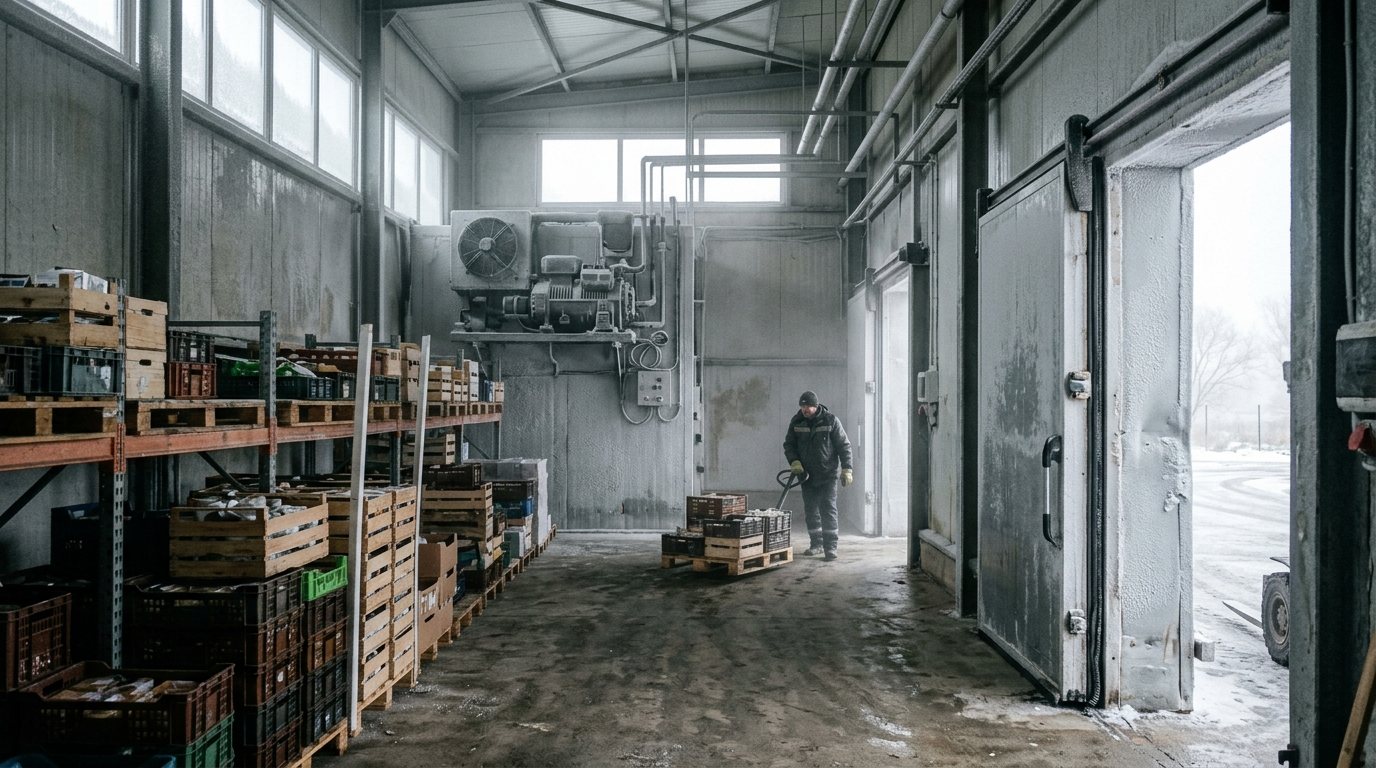
A generator wins where a power outage instantly turns into spoiled stock, and in a cold storage warehouse that’s almost always the case. The obvious scenario: a long winter grid outage, when the compressors need to run nonstop so the chamber doesn’t warm up. Here the question isn’t “how much will I save,” it’s “how much does the stock cost if the warehouse warms up.”
A less obvious scenario: a defrost-and-restart cycle, where compressors start up one after another. Battery storage, sized for a short spike, can’t handle that kind of continuous sequence — it needs time to recharge between startups, and a cold storage warehouse often doesn’t give it that time.
The mechanism is simple: a generator is the only option whose runtime depends not on capacity or weather but only on the fuel tank. That makes it the only one that reliably covers a long outage, no matter how many hours in a row the compressors need to run.
What that costs. The equipment sits idle most of the year. The 40 kW Marsun MHD40 costs 11 999 € (the ATS is built in), and you need to add fuel storage and regular test runs on top — without them, a generator nobody has touched won’t start on the day it’s needed. And most importantly, it won’t reduce a single monthly capacity charge.
When the right answer is battery storage
Battery storage wins where the problem isn’t power loss but compressor startup spikes that themselves push close to the permitted capacity limit. The obvious scenario: a warehouse plans to add another cold room or connect another compressor and learns it will need to raise its permitted capacity — battery storage can sometimes remove that need, because the spike only lasts minutes.
A less obvious scenario: the site already operates right at the permitted capacity limit, and every simultaneous startup of several compressors risks exceeding it. That’s why ESO states:
„Atkreipiame dėmesį, kad viršijus objekto leistiną naudoti galią, vartotojas privalo sumokėti trigubą vartotojo objektui taikomo tarifo plano galios dedamosios kainą.“ (in English: We note that if a site exceeds its permitted capacity, the consumer must pay triple the capacity-charge rate of the tariff plan applied to that site.)
ESO — Elektros energijos persiuntimo paslaugų kainos verslui
When the capacity charge is €3.00/kW/month, the triple rate means €9.00/kW per month for every kilowatt by which the site exceeded the limit during a compressor startup spike. That’s exactly the spike battery storage shaves, not overall consumption.
What that costs. Battery storage doesn’t cover a long grid outage: under a full, unrelenting cooling load, its capacity runs out in hours, not days. A smaller module, such as the EASYWAY UNIV-HV ST23K (23.04 kWh, €4,849), works for shaving a spike but not for emergency power to the whole chamber. Larger industrial systems, such as the Solis EverCore C5 (100 kWh / 50 kW, €26,799), have more capacity, but the price grows proportionally, and in an outage it will still run out before a generator’s fuel tank does.
What the site decides for you
Some choices disappear before you even form an opinion. These constraints matter more than price.
Permitted capacity sets the ceiling. If a site is permitted, say, 40 kW, no combination will let you draw more from the grid at once. Anything above the limit during a compressor startup has to be covered by battery storage, or you need to raise the permitted capacity and pay more every month.
The nature of the load in this segment rules out battery storage as the sole solution. A constant, round-the-clock load (compressors, fans, defrosting) is a generator’s job. Short, repeated startup spikes are battery storage’s job. A compressor’s starting current is several times its rated current, so its rated power in kilowatts says nothing about how much capacity is needed to stay under the permitted limit.
The operating schedule in this segment limits the benefit of shifting consumption to nighttime. For group-three consumers, ESO charges a transmission rate of €0.0313/kWh at peak load and €0.0197/kWh at off-peak load. The difference is €0.0116/kWh; that’s not the full electricity price, just the transmission portion. For a farm or workshop, that difference is a real benefit from shifting work to nighttime. For a cold storage warehouse it’s much smaller: the compressors run around the clock regardless of the time, so there’s simply nowhere to shift most of the load to.
The reliability category adds a charge that’s rarely discussed. For group-two and group-three sites, ESO applies a reliability-category charge: €1.00/kW/month for the first category and €0.50/kW/month for the second. In a cold storage warehouse, where a supply gap means spoiled stock, this line is often chosen deliberately, but it needs to be factored in alongside the capacity charge, not separately.
What changes in day-to-day operation
A generator requires routine maintenance: test runs, fuel reserves and their aging, oil, battery charge. A unit nobody has touched becomes a decoration on the day it’s needed — that’s the most common reason a warehouse ends up without power even though it owns a generator.
Battery storage doesn’t need daily upkeep, but it requires a decision up front: which panel groups (compressors, fans) stay powered when shaving a spike or during an outage. That’s decided during installation, and redoing it later costs more than getting it right the first time.
What doesn’t change: neither option changes your supplier, contract, or meter. The site remains the same ESO customer with the same permitted capacity — what changes is only how much of it you actually draw at once.
Do you really have to choose just one?
In this segment, usually not, and three combinations keep coming up.
Generator first, battery storage later or never. Fits warehouses where a power outage means a direct loss of stock and permitted capacity has some headroom. A generator with ATS is bought first, and battery storage is added later only if a capacity-overage problem shows up.
Battery storage first, generator later. Fits sites that already operate right at their permitted capacity limit, where every new compressor could push it over, but that haven’t had long supply outages. A generator is bought once the frequency or length of outages changes.
Both at once. Makes sense for a new or renovated warehouse: the panel is being redone anyway, and wiring critical groups (compressors, control systems) separately for the generator and battery storage costs nothing extra.
Frequently asked questions
Will battery storage protect a cold storage warehouse during a long outage?
Not fully, under a full, uninterrupted cooling load. Battery capacity is finite, and the compressors don’t reduce their load at night or on weekends, so capacity runs out in hours, not days. Only a generator, or a generator-and-battery combination, reliably covers a long outage.
How much does a generator for a cold storage warehouse cost?
It depends on the power rating. Our catalog runs from 20 kW (Marsun MHD20B, 6 299 €) to 250 kW (Marsun MHD250, 34 799 €). The Marsun MHD models from 25 kW up have the ATS built in; for smaller units a separate ATS unit costs €199–€269. Send us a list of your compressors and other equipment with their power ratings, and we’ll calculate it exactly.
Why do compressors cause problems with permitted capacity?
A compressor’s starting current is several times its rated current. For a brief moment, the site draws more from the grid than the contract allows, and ESO charges triple the capacity-charge rate for that overage: when the rate is €3.00/kW, it becomes €9.00/kW per month.
Can a generator with ATS be sized for a large cold storage warehouse?
The generator, yes — our catalog goes up to 250 kW, and the Marsun MHD models have the ATS built in, so no separate unit has to be matched. Check the whole setup with us before ordering, not after.
Will battery storage reduce the monthly capacity charge?
Yes, if it actually shaves the spike. The capacity charge is €3.00/kW per month excl. VAT and is calculated from the permitted capacity, not from actual consumption. If battery storage lets you avoid raising that limit, or keeps you under it during a compressor startup, it reduces both the charge itself and the risk of paying the triple rate for exceeding it.
What we suggest you do
Send us three things: your site’s permitted capacity (stated in your ESO contract), a list of your compressors and other cooling equipment with their power ratings, and how many times a month they start up at the same time. That’s enough for us to tell you whether you need a generator, battery storage, or both. We deliver throughout Lithuania.
Sources
- ESO, Electricity transmission service prices for business customers — capacity charge, reliability categories, time intervals, capacity overage: eso.lt (reviewed 2026-09-18)
- ESO, Electricity storage devices — storing surplus and using it in the evening: eso.lt (reviewed 2026-09-15)
- Hybrid Energy, generator catalog — models, power ratings, and prices: hybridenergy.lt (reviewed 2026-09-18)
- Hybrid Energy, product page for the Solis EverCore C5 125 kW / 261 kWh — an example industrial battery storage system: hybridenergy.lt (reviewed 2026-09-17)