


Tinklaraštis
Advice on choosing equipment: power, compatibility, subsidies and running costs.
Does a Wind Turbine Pay Off on an Open Farm Field, or Is Solar the Better Bet?

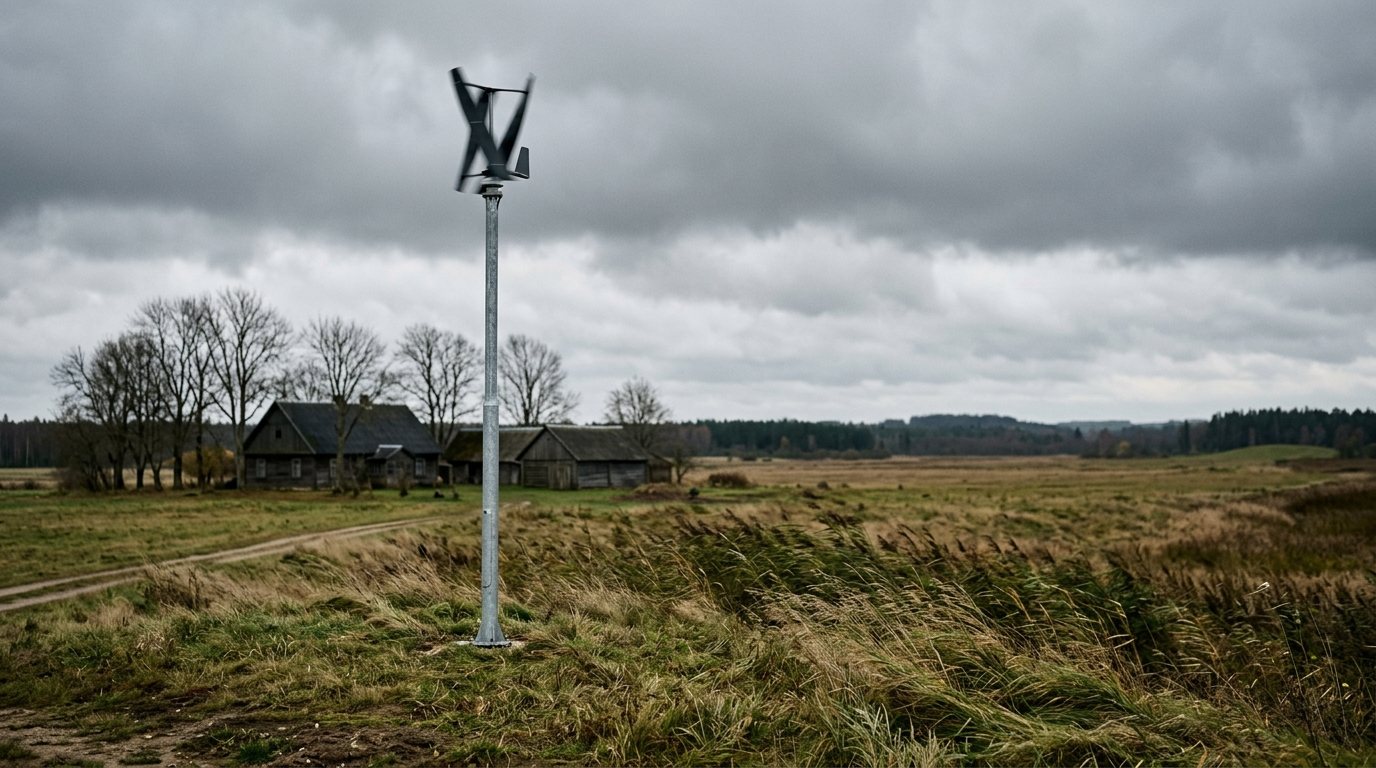
We are Hybrid Energy: we sell wind turbines, hybrid solar inverters with
battery storage, and diesel generators. We sell all of these options, so we
have no reason to favor any one of them. This article won’t tell you wind beats
solar. It shows what a wind turbine actually delivers on an open farm field,
when it loses to solar, and when the two together deliver more than either one
alone, before you form an opinion.
The short version
- Wind and solar work at different times of year in Lithuania: in December and
January there’s almost no sun, but there is wind. In summer it’s the reverse:
wind is weaker, while the sun works all day. That’s exactly why a wind turbine
makes sense as a supplement to solar and storage, not a
replacement for them. - One turbine without storage delivers little value in summer; it simply
sits idle whenever there’s no wind, while the sun already covers the load.
Wind compensates for the lack of sun precisely when the sun isn’t there. - A turbine without a suitable inverter or controller delivers no power to
the switchboard at all; that’s a separate part of the purchase, not an
accessory. For DOSPEL DRAGON turbines, our catalog includes SolarInvert WIN
series wind inverters, sized to the turbine’s output. - The mast and its foundation matter more than the turbine’s rated output.
The wind speed the mast has to withstand can decide things before you even
compare models: “the highest wind speed ever recorded in Lithuania’s
observation history was 40 m/s” (meteo.lt). - A business site pays for more than the kilowatt-hours it consumes: ESO
bills a capacity charge every month on the permitted capacity, €3.00/kW
excluding VAT. Wind alone doesn’t reliably reduce this charge, since
it can drop off exactly when your own peak hits. Only storage reliably shaves
the peak.
What you’re choosing between
A farm site in the open, a field, a pasture, a farmstead with no building
shadow, chooses between four technically different things.
Wind turbine with inverter. Our range includes two
vertical-axis lines: DOSPEL DRAGON, from 1 kW (DOSPEL DRAGON 1000, €2,949) up
to a 4.5 kW package (DOSPEL DRAGON PACKAGE 4.5 kW, €12,849), and the Giromill
line, from 300 W to 3 kW (SMARTWIND, DOMUS, EOLO). The difference isn’t the
axis, it’s output and price. There are 39 items in total. DOSPEL DRAGON’s
cut-in speed is 1.2 m/s (per the manufacturer’s product sheet), and it needs a
separate SolarInvert WIN series wind inverter: one, two, or three turbines,
depending on the model. The smaller Giromill turbines work with a universal
solar-and-wind controller rather than a grid-tied inverter; they charge a
battery instead of feeding power straight into the grid.
Solar plant with a hybrid inverter and battery storage.
A hybrid inverter differs from a grid-tied (string) inverter in one thing: you
can connect a battery to it. A grid-tied inverter feeds electricity only while
the sun shines and the grid is up; a hybrid stores part of the surplus and
releases it in the evening or when the grid goes down.
Diesel generator with ATS. A three-phase unit with an
automatic transfer switch (ATS in our catalog). From 18 kW (Marsun MHD20000,
€5,999) up to 90 kW (Marsun MHD100, €16,499). The ATS is bought separately:
€199 for 6-15 kW generators, €269 for 20 kW units, and we size larger ones to
the site. The generator starts when power goes down and runs as long as fuel
remains in the tank, regardless of weather.
Wind and storage together. A wind inverter and a hybrid
solar inverter with storage can feed the same switchboard: wind charges the
storage when it’s windy and dark, and the storage releases energy when there’s
neither wind nor sun.
The pivot this whole choice turns on: wind and solar are
strongest at different times of the year in Lithuania. That’s the only argument
that turns wind into a meaningful supplement rather than a replacement, and it
holds honestly in both directions: in winter, wind makes up for the lack of
sun, while in summer, when there’s less wind, one turbine without storage
doesn’t solve much.
Comparison at a glance
| Criterion | Wind turbine | Solar with storage | Diesel generator | Wind + storage |
|---|---|---|---|---|
| What it gives in December-January, when there’s almost no sun | Works if it’s windy | Almost nothing | Always works while there’s fuel | Works if windy; storage extends it |
| What it gives in summer, when there’s less wind | Little and irregular | Works all day | Always works while there’s fuel | Little from wind; no solar in this combination |
| Needs a separate inverter or controller | Yes, won’t work without one | Yes, a hybrid inverter | No, but needs an ATS | Yes, both |
| Reduces the capacity charge (€3.00/kW) | Unreliably, depends on whether wind is blowing at that moment | Yes, if storage shaves the peak | No | Yes, through storage |
| Dependence on weather | High and irregular | High, but predictable by season | None | High on both sides |
| Regular maintenance needed | Inspect the mast and its fastenings | Almost none | Test run | Mast and storage maintenance |
| Noise and moving parts | Spins, some noise | None | Engine, fuel, noise | Turbine spins |
When the right answer is a wind turbine
A turbine wins where the site already has a solar plant and needs exactly
what solar can’t provide: output in the dark, windy season. That means open
fields, pastures, farmsteads with no tall buildings or trees nearby blocking
the wind flow.
A second, less obvious case: a site with a small but constant electricity
need (a well pump, lighting, an electric fence), where a large hybrid system
with a big battery is too expensive for that level of consumption. A small
turbine can cover a steady need even at night, when the solar plant isn’t
working, since it also runs at night if there’s wind.
The mechanism: DOSPEL DRAGON’s cut-in speed is 1.2 m/s, and output grows
with wind speed up to the turbine’s limit. But without the SolarInvert WIN
inverter, that power never reaches the switchboard. The inverter converts the
turbine’s variable-frequency current into grid-compatible power, exactly the
way a grid-tied inverter does for solar modules.
What that costs. A DOSPEL DRAGON 1000 (€2,949) with a
WIN 1000-48 inverter (€1,599) and a base (€379) comes to €4,927 excluding the
mast and installation. Output is irregular: on windless days the turbine gives
nothing, and in summer, when wind in Lithuania is weaker, one turbine without
storage often gives less than the number on the box suggests. And most
importantly, like solar, a turbine doesn’t reliably lower the capacity charge,
since everything depends on whether the wind happens to blow exactly when your
peak hits.
When the right answer is solar with storage
Solar with storage wins where consumption is predictable, happens during
the day, and no trees or buildings shade the roof or site in the summer
months, exactly when wind is weakest and the sun is strongest.
The mechanism is the same ESO tariff that matters throughout this series:
„Galios dedamoji — 3,00 Eur/kW/mėn.“ (in English: Capacity charge: €3.00/kW
per month.)ESO — Electricity Transmission Service Prices for Business Customers
Unlike a wind turbine, storage can be controlled to reliably shave a peak:
it charges in advance and releases energy when you actually need it, rather
than whenever the wind happens to pick up.
What that costs. A Deye SUN-10K-SG02LP1-EU-AM3-PLUS hybrid
inverter costs €1,649; add storage on top, for example an EASYWAY UNIV-HV
ST15K with 15.36 kWh capacity costs €3,749. During a long winter outage,
storage won’t carry the farm: on a December afternoon there’s almost no sun,
and at full farm load the storage drains within a few hours.
When the right answer is a diesel generator
The generator wins where a power outage instantly turns into a risk to
livestock or spoiled product: a milking parlor, a water pump for the herd,
ventilation in a barn. Here the question isn’t “how much will the turbine
generate,” it’s “what does one day without power cost,” and neither the
turbine nor solar answers that, since both depend on the weather.
The mechanism is simple: a generator’s run time depends only on the fuel
tank, not on wind or sun. That’s why it’s the only one of the four options that
reliably covers a long winter outage, exactly when the wind can also drop and
the sun isn’t there.
What that costs. A 40 kW Marsun MHD40000 costs €10,699; on
top of that price, add an ATS unit, fuel storage, and regular test runs,
without them the generator won’t start on the day it’s needed. And most
importantly: it won’t lower your bill by a single euro, and it won’t lower the
capacity charge either.
When the right answer is wind and storage together
This combination wins where the site already has a hybrid inverter with
storage for solar, and the owner wants the storage to charge from wind as well
as the grid during the dark season. A second case: a site with no solar plant
at all, but with a steady, if modest, consumption that needs its own source
all year round, not just in summer.
The mechanism: storage doesn’t care where the energy comes from; it accepts
current from both solar and a wind inverter, as long as both are matched to the
same switchboard. Wind fills the storage exactly when the solar inverter is
silent.
What that costs. This is two separate, unreliable sources,
not one dependable one. On a calm, overcast winter evening, neither wind nor
sun will top up the storage; such a day is rare, but it happens. On top of
that, you’ll need to install and maintain two separate systems: the mast with
the turbine and its inverter, and the solar inverter with storage.
What the site itself decides for you
Some choices disappear before you even get to compare turbine models. These
constraints matter more than price.
The mast and its foundation must withstand not the average wind, but
the record one. The question to ask before “what output turbine” is
“what does the mast have to withstand at the strongest gust.” Meteo.lt
states:
„Didžiausias vėjo greitis, užfiksuotas Lietuvos stebėjimų istorijoje, buvo
40 m/s.“ (in English: The highest wind speed ever recorded in Lithuania’s
observation history was 40 m/s.)
That’s a record, not an average, but it’s exactly the gust the mast and
foundation need to be engineered for, not the wind that typically blows in
your field. Our catalog sells the mast and mounting parts separately from the
turbine: the M40 modular mast system (€219) and the DRAGON turbine base
(€379). The foundation itself, the concrete work, depends on the soil and mast
height at the specific site, so it’s calculated by the installer on site,
rather than from a general formula.
Meteo.lt only publishes the average annual wind speed as a map, not
a figure in text, so we don’t give a specific number for your location
here. You can check the map yourself, based on the 1991-2020 norm:
meteo.lt: average annual wind speed map
Distance from buildings and trees decides whether wind is useful at
all. A turbine placed in a building’s wind shadow or under tree canopy
gets turbulence instead of a straight airflow. That not only reduces the
energy it generates, it also loads the mast with uneven impacts that a straight
wind at the same speed doesn’t cause. So an open field with no tall obstacles
isn’t a preference, it’s a technical requirement: without it, a wind turbine
won’t earn back its price.
Permits depend on mast height and location. Whether a
specific mast needs a building permit depends on its height and the local
municipality’s territorial planning requirements for that particular plot; you
need to check this with the municipality before buying, not after the mast is
already purchased.
What changes in day-to-day operation
A turbine needs periodic inspection: the mast’s mounting points and guy
wires, the bearings, the blade condition. It’s a moving mechanism outdoors,
not a static module on a roof, so it wears differently than a solar plant.
The inverter or controller needs almost no maintenance, but it needs a
decision made upfront: whether the wind inverter connects to the same
switchboard as the solar inverter, or to a separate circuit. That’s decided at
installation.
What doesn’t change: none of the options changes your
supplier, contract, or meter. After connecting a turbine, the site remains the
same ESO customer with the same permitted capacity; what changes is only how
much of it you actually draw from the grid.
Do you really have to choose just one?
Usually not, two combinations come up repeatedly.
Solar first, wind later. Fits most sites: first a solar
plant with a hybrid inverter and storage is installed, since it covers most of
the year, and a wind turbine is added later, when you want to close the gap
specifically in the winter months.
Wind and a generator together, without solar. This comes
up at remote sites that are never staffed: maintaining solar modules there is
difficult, while a wind turbine provides a small but steady amount of energy
while the generator waits for a more serious outage.
Frequently asked questions
Will one wind turbine replace a solar plant on a farm?
No. Wind and solar work at different times of the year in Lithuania:
winter often brings stronger wind and almost no sun, while summer is the
reverse. A turbine without solar and storage produces irregularly, since
everything depends on the weather at that specific moment. It’s most useful as
a supplement to an existing solar or storage system, not as a sole source.
What turbine output does a farm need?
That depends on whether the turbine supplements an existing system or works
alone. Our catalog’s DOSPEL DRAGON output ranges from 1 kW to a 4.5 kW
package, while the Giromill line runs from 300 W to 3 kW for smaller, often
stand-alone needs. Send us the site’s consumption and local conditions, and
we’ll size it accordingly, not from a single number on a box.
Does a turbine need a separate inverter?
Yes. DOSPEL DRAGON turbines don’t feed their generated current into the grid
on their own; that requires a SolarInvert WIN series wind inverter, sized to
whether one, two, or three turbines are connected. Without the inverter, the
turbine spins, but no power reaches the switchboard. The smaller Giromill line
uses a universal solar-and-wind controller instead of an inverter, which
charges a battery.
Will a wind turbine lower my monthly capacity charge?
Unreliably. ESO charges €3.00/kW per month for permitted capacity, and this
fee is only reliably lowered by whatever shaves the peak exactly when it
happens. Wind can drop off exactly when you need the most energy, so it’s
storage, not the turbine itself, that reliably shaves the peak.
What does a turbine’s mast have to withstand?
According to meteo.lt, the highest wind speed ever recorded in Lithuania’s
observation history was 40 m/s, and it’s exactly that event, not the average
wind, that the mast and its foundation need to be engineered for. The
foundation calculation depends on the soil and mast height at the specific
site, so it’s done by the installer on location, based on the actual site,
not a general formula.
What we suggest you do
Send us three things: a description of your site’s location (is it open, or
are there buildings or trees nearby), your site’s permitted capacity (stated
in your ESO contract), and your existing or planned solar and storage system,
if you have one. That’s enough for us to tell you whether a wind turbine is
worth buying, and which one. We deliver across Lithuania.
Sources
- ESO, Electricity Transmission Service Prices for Business Customers:
capacity charge:
eso.lt (reviewed 2026-09-18) - Meteo.lt, Wind: the highest wind speed ever recorded:
meteo.lt (reviewed 2026-09-15) - Meteo.lt, average annual wind speed map (1991-2020 norm):
meteo.lt (reviewed 2026-09-15) - Hybrid Energy, wind turbine and wind inverter catalog: models, outputs,
and prices: hybridenergy.lt (reviewed 2026-09-18)