


Tinklaraštis
Advice on choosing equipment: power, compatibility, subsidies and running costs.
Patio heater or event tent heater: diesel, gas or electric?

Hybrid Energy sells both EMLO diesel infrared heaters and Termofol electric infrared
heaters, so we have no reason to favour either. In short: for a patio or terrace with a
230 V socket, an electric Termofol TF-IR fits (1.6–3.2 kW, €299–399). For an
event tent or marquee with no mains power, the 20 kW EMLO DC 20 GARDEN diesel heater
fits: on a battery it runs for up to 8 hours, but the tent must be at least 80 m²
and ventilated. Judge a gas heater by its own manufacturer’s manual.
Key points
- The electric Termofol TF-IR heats people and objects, not the air. But each heater
needs a socket, and a TF-IR3200 running non-stop for an hour uses
3.2 kWh. - The EMLO DC 20 GARDEN has an output of 20 kW and a
35 l tank. At maximum setting it uses 1.57–1.82 l/h; with an
average diesel price of €2.249 per litre (LEA, 6 November 2026), that is about
€3.53–4.09 per hour. A full tank lasts about 19–22 hours at that setting, and off the
mains it runs for up to 8 hours: that is what a 24 V battery gives. - To use a diesel heater in a closed tent, the manual sets clear conditions: a floor
area of at least 80 m², fresh-air exchange 6 times per
hour and a fire extinguisher nearby. When these conditions are met, no
chimney is needed in a large space. - Wind and open sides weaken any heater: the wind carries warmed air away and cools
people down. Both heaters we offer work by radiation, so point them at where people
sit and screen the windward side. - A gas patio heater runs on propane from a cylinder. Its output, gas consumption and
whether it may be used in a tent or under a roof are set out in the manufacturer’s
manual for the specific model, so read it before you buy.
Types of patio and tent heaters
Patio and tent heaters differ by energy source: some use diesel or kerosene, some mains
electricity, some liquefied gas. The source decides where the heater can stand, how
long it runs unattended and what conditions apply in an enclosed space.
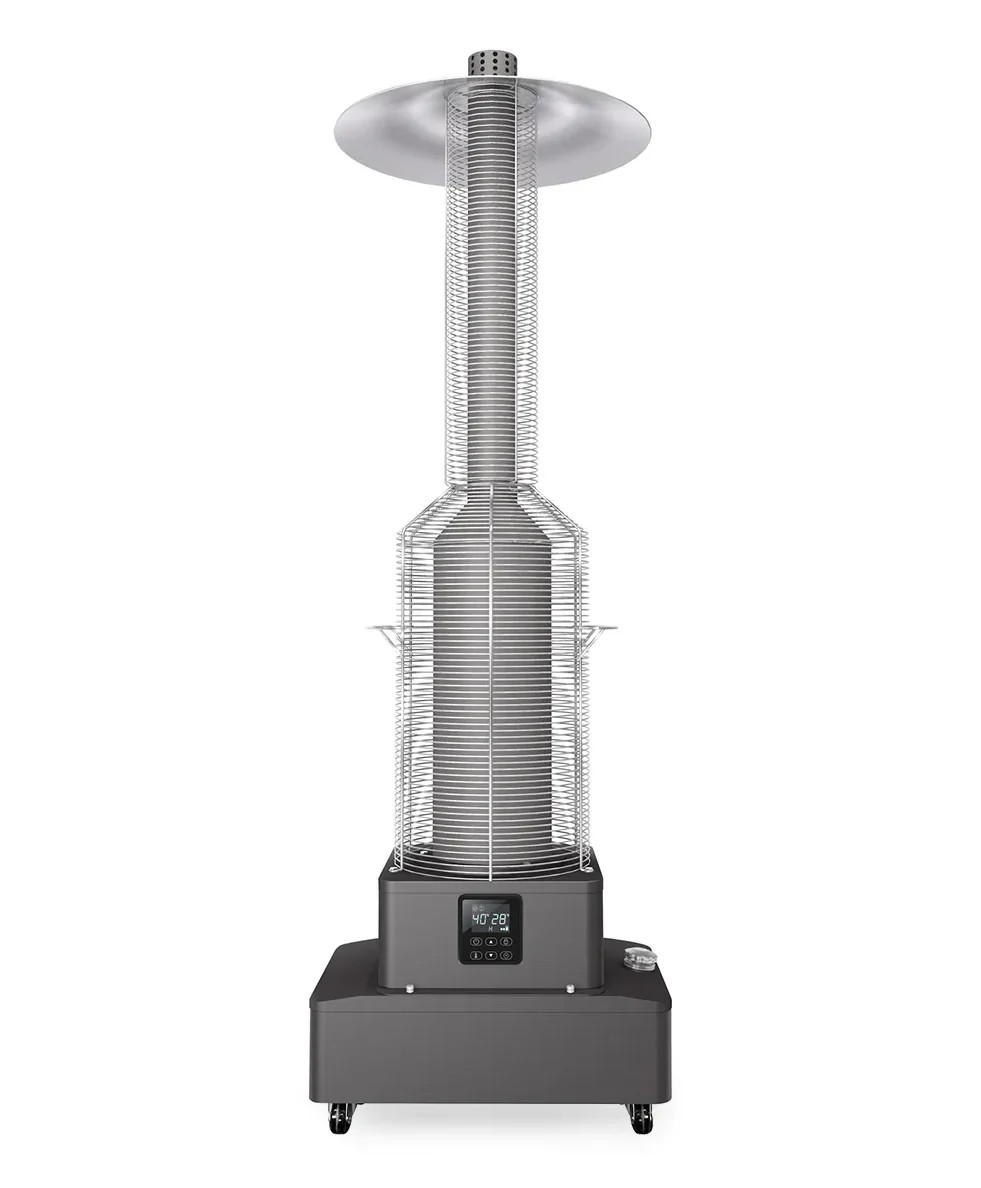
EMLO DC 20 GARDEN diesel infrared heater. A burner heats a
ceramic-coated tube and the heat travels as radiation. The fuel is diesel or kerosene;
it burns in the same space the heater warms, and the heater has no chimney. Output
20 kW, heated volume stated by the manufacturer up to 1400 m³. It runs on a
220–240 V supply or a 24 V DC battery (24 V 16 Ah; LiFePO4 22.4 V
8–16 Ah batteries and 18–24 V power-tool batteries also work); on a battery it runs
for up to 8 hours and draws 35 W of electricity. It is a free-standing heater: base
675 × 655 mm, height 2135 mm, weight 36 kg. It is controlled with a remote
and the TERMOFOL Smart app. We will quote the price of the
EMLO DC 20 GARDEN
on request.
Termofol TF-IR electric infrared heaters. They heat people and
objects, not the air, and mount on a wall or ceiling. There are three models:
TF-IR1600
(1600 W, €399),
TF-IR2400
(2400 W, €299) and
TF-IR3200
(3200 W, €349). All three are controlled with a remote and the Termofol Smart app
over Wi-Fi and have a timer. The TF-IR1600 has a carbon-fibre element and a glass-ceramic
panel, IP44, dimensions 810 × 180 × 77 mm. TF-IR2400 and TF-IR3200: an
aluminium panel with a special coating, IPX4, power control, 220–240 V supply,
minimum mounting height 2.2 m; length about 1460 and 1815 mm, weight 7.6 and
9.9 kg respectively.
Gas patio heater. It runs on propane from a cylinder and needs no
mains power. Its output, gas consumption and whether it may be used in a tent or under
a roof depend on the specific model and are given in its manufacturer’s manual, so we
have not included it in the table.
Two questions decide it: is there mains power on site, and is the
space enclosed? For an open patio, choose electric: it needs a socket. For a large tent
or a room of at least 80 m², especially with no mains power, choose diesel and
follow the conditions in the manual.
Diesel vs electric heater for a patio or tent: comparison
| Criterion | EMLO DC 20 GARDEN diesel | Termofol TF-IR electric |
|---|---|---|
| Where to use | A tent or room of at least 80 m² that is aired regularly; not an open terrace | A covered terrace, a balcony, a tent with mains power |
| What you need on site | Diesel or kerosene; 230 V supply or a 24 V battery (up to 8 h) | A 220–240 V socket for each heater |
| Output | 20 kW | 1.6 / 2.4 / 3.2 kW |
| Consumption per hour | 1.57–1.82 l of fuel (max.), i.e. about €3.53–4.09 with diesel at €2.249 per litre (LEA, 6 November 2026); plus 35 W of electricity | 1.6 / 2.4 / 3.2 kWh |
| Running time without refuelling | A 35 l tank lasts about 19–22 h at maximum setting | As long as power is supplied |
| In a closed tent | Per the manual: at least 80 m², air exchanged 6 times per hour, fire extinguisher | Burns no fuel; mounted no lower than 2.2 m (TF-IR2400/3200) |
| Installation | Free-standing, 2135 mm tall, 36 kg | Wall or ceiling; TF-IR1600 810 × 180 × 77 mm; TF-IR2400/3200 about 1460–1815 mm long, 7.6–9.9 kg |
| Moisture, sun and wind | Per the manual: do not use where it can get wet; no direct sunlight or strong wind near the heater | IP44 (TF-IR1600), IPX4 (TF-IR2400/3200) |
| Price | On request | €299–399 |
When to choose an electric Termofol TF-IR patio heater
An electric heater suits a café or home terrace under a canopy, a covered balcony
or a conservatory: places with a 230 V socket where the heater can be mounted no
lower than 2.2 m. You switch it on with a remote, the app or a timer, and it heats
people rather than air, so it is easy to run only when people sit down at the
tables.
A less obvious case: an event tent connected to the mains where you do not want fuel
burning. An electric heater burns no fuel, so the diesel heater manual’s conditions on
floor area and ventilation do not apply to it; only mounting height and the capacity of
the supply still matter.
Why it works: TF-IR uses radiation to heat people and objects, not the air, so the
people it is pointed at feel the warmth even when the surroundings are cool.
Costs and limits. Each heater needs a socket, and three TF-IR3200
together draw 9.6 kW and use 9.6 kWh per hour; what that costs in euros depends on
your electricity tariff. They do not work without mains power. The TF-IR1600 product
page does not state a minimum mounting height, so ask us before you hang it.
When to choose the EMLO DC 20 GARDEN diesel heater
A diesel heater suits places with no mains power or not enough of it: a large tent
or marquee, or a space without mains power such as a warehouse, a house under
construction or an outbuilding. With 20 kW
of output and a 35 l tank, you can heat a whole evening event without refuelling,
and it needs only 35 W of electricity, so a 24 V battery lasts up to 8
hours.
A less obvious case: a large tent that has sockets, but whose supply could not
handle several electric heaters. One 20 kW diesel heater draws only 35 W from the
mains, not kilowatts.
Why: the heat comes from burning fuel, not from the power cable, so how long the
heater runs depends on the tank and battery, not on the number of sockets.
Costs and limits. At maximum setting the fuel costs about
€3.53–4.09 per hour with an average diesel price of €2.249 per litre (LEA, 6 November
2026). You also have to bring the fuel and fill the tank, charge the battery, and find
room for the heater: it is 2135 mm tall and weighs 36 kg. In a closed tent it may
be used only under the manual’s conditions: at least 80 m², the air replaced with
fresh air 6 times per hour, a fire extinguisher nearby. A brief smell is noticeable at
start-up; the manufacturer says this is normal. We will quote the price on
request.
When a gas patio heater is worth considering
A gas patio heater, like a diesel one, does not depend on mains power, but it uses
propane from a cylinder instead of liquid fuel. Whether it may stand in a tent or under
a roof, what its output is and how much gas it uses are set out in the manufacturer’s
manual for the specific model, so compare that with the table in this article.
Costs and limits. Cylinders have to be swapped and stored
somewhere; you can only work out an exact cost per hour if you know the consumption of
the specific model. Hybrid Energy sells diesel and electric heaters, so if you are
choosing between those two, we will compare them for your site.
What decides the choice: power supply, tent, wind
Some options drop out before you compare prices. These limits matter more than any
row in the table.
Mains power. No socket, no electric heater. If there are sockets but
the combined output of several heaters exceeds what your supply can take, remember: each
extra TF-IR3200 adds 3.2 kW, while the diesel heater adds only 35 W.
Enclosed or open space. The DC series diesel heater manual allows
use in rooms with a floor area of at least 80 m², provided they are aired regularly.
In a smaller closed tent this heater must not be used, and never in sleeping areas or
while sleeping. The DC 20 GARDEN manual describes the same indoor use, and it also asks
that there be no moisture, direct sunlight or strong wind near the heater. That is why
Hybrid Energy does not offer it for an open terrace.
Wind and open sides. Wind carries warmed air away and cools people
down, so the same heater feels weaker in an exposed spot. Screening the windward side
often makes the space warmer than adding another heater.
Where the heater can be mounted. The TF-IR2400 and TF-IR3200 are
mounted no lower than 2.2 m, so you need a canopy, wall or tent frame strong enough
to hold them. If there is nothing to mount on, talk to us and we will find a solution;
the free-standing diesel heater only suits a tent or a room of at least 80 m².
Maintenance and day-to-day use
A diesel heater needs ongoing attention: keep a fuel supply, fill the tank, charge
the battery and, in an enclosed space, ventilate. The manual lists these safety
features and functions: overheating protection, flame monitoring, shut-off if tipped
over, a child lock, a 24-hour timer and fuel pre-heating below 5 °C. When the heater
is switched off, an electromagnetic valve returns the leftover fuel to the tank and the
fuel smell is noticeably reduced.
An electric heater needs no day-to-day maintenance: you mount it once and then switch
it on with the remote, the app or the timer.
What they have in common: both heaters emit infrared radiation that
warms people and surfaces, not the air. So both the diesel and the electric heater
should be pointed at where people sit or stand.
Can you combine a diesel and an electric heater?
Yes. Two combinations come up most often.
Electric for the terrace, diesel for events. A café heats its
terrace every day with fixed TF-IR heaters and brings a free-standing DC 20 GARDEN to an
event in a large tent (at least 80 m², aired regularly); off the mains, its 24 V
battery lasts up to 8 hours.
Electric by the tables, diesel for the large space. In a large tent
that meets the manual’s conditions, the diesel heater warms the shared space, and TF-IR
heaters hang over the areas where people sit longest and where there is a socket.
Frequently asked questions
Can you use a diesel heater in an event tent or marquee?
Yes, under the EMLO manual’s conditions. For the DC series, including the DC 20 GARDEN, the tent must be at least 80 m², its air replaced with fresh air 6 times per hour, and a fire extinguisher kept nearby. Never use the heater while sleeping or in small closed spaces. Hybrid Energy will check whether your tent qualifies.
How long does the EMLO DC 20 GARDEN run without mains power?
Up to 8 hours on a 24 V battery: 24 V 16 Ah, LiFePO4 22.4 V 8–16 Ah or 18–24 V power-tool batteries. It draws only 35 W; the heat comes from fuel. A full 35 l tank lasts about 19–22 hours at maximum setting (1.57–1.82 l/h), so for longer events Hybrid Energy advises a spare battery.
How much electricity does an infrared patio heater use?
Running non-stop for an hour, the Termofol TF-IR1600 uses 1.6 kWh, the TF-IR2400 2.4 kWh and the TF-IR3200 3.2 kWh. This follows from the rated output. With the remote or the Termofol Smart app you can switch the heater on only when people are on the terrace, so the bill depends on hours of use, not season length.
Do patio heaters work in the wind?
They work, but less effectively: wind carries warmed air away and cools people
down. Point an infrared heater at where people sit and screen the windward side. The
diesel EMLO manual asks for no strong wind near the heater, so for an open terrace
Hybrid Energy offers electric TF-IR heaters.
Does a diesel heater smell?
EMLO states that a brief smell at start-up is normal, and a constant smell usually points to a fuel or filter problem. When the heater is switched off, an electromagnetic valve returns the leftover fuel to the tank and the fuel smell is noticeably reduced. Hybrid Energy advises using the fuel specified in the manual: diesel or kerosene.
How to get a quote
Send us four things: the dimensions of the terrace or tent, whether there are
230 V sockets on site and how many, which sides are open to the wind, and how many
hours the event or evening on the terrace will last. That is enough for us to tell you
whether electric Termofol TF-IR heaters, the EMLO DC 20 GARDEN diesel heater or a
combination suits you, and to quote the DC 20 GARDEN price. Email
sales@hybridenergy.lt or call +370 636 52 222. We deliver across Lithuania. Read more
about electric infrared heating in our article
“Infrared heating: power and running cost”.
Sources
- Termo-fol, EMLO DC-08 user manual (PL/EN/DE); declaration of conformity 03/CE/2026 covers DC-08, DC-16 and DC-20-GARDEN. From it: power supply, ventilation 6 times per hour, 80 m², fire extinguisher, safety features, valve and smell:
termofol.pl (accessed 8 November 2026) - Termo-fol, EMLO DC-20-GARDEN user manual (PL/EN/DE): indoor use in rooms of at least 80 m², moisture, direct sunlight, wind:
termofol.pl (accessed 10 November 2026) - Termofol, liquid-fuel heater catalogue: DC 20 GARDEN output, volume, consumption, tank, dimensions:
termofol.pl (accessed 8 November 2026) - EMLO, liquid-fuel heater FAQ: smell at start-up:
emlo.com.pl (accessed 8 November 2026) - Hybrid Energy, Termofol TF-IR1600, TF-IR2400, TF-IR3200 and EMLO DC 20 GARDEN product pages: prices, output, IP44/IPX4, mounting height, dimensions:
hybridenergy.lt (accessed 8 November 2026) - Lithuanian Energy Agency data: the average diesel price on 6 November 2026 was €2.249 per litre:
pigiausidegalai.lt (accessed 8 November 2026)