



Tinklaraštis
Advice on choosing equipment: power, compatibility, subsidies and running costs.
How to heat a house under construction in winter, and when does the site need a generator?

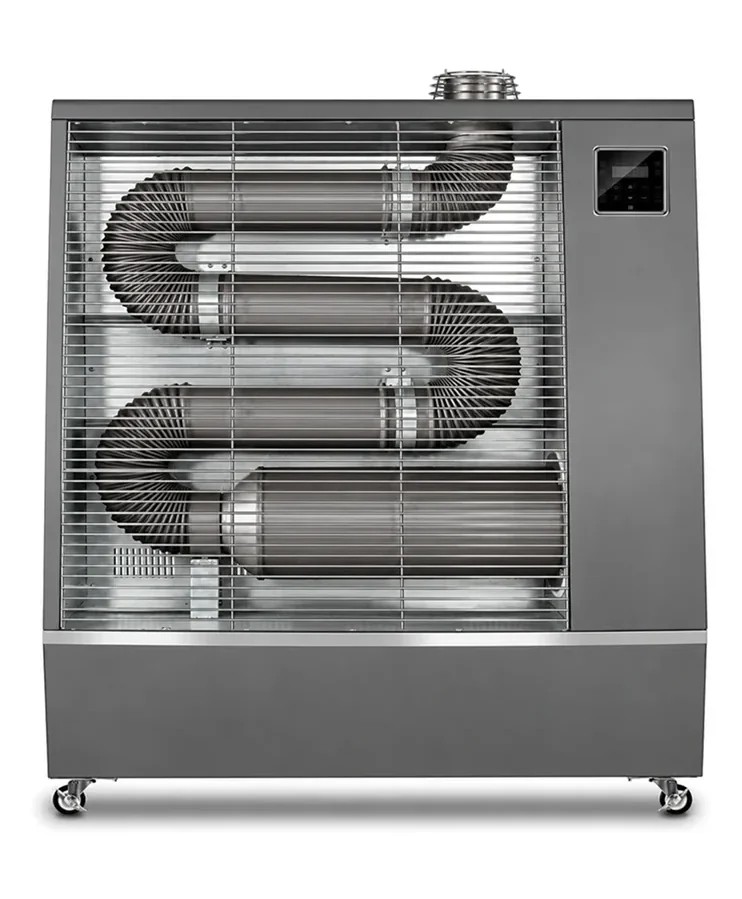
A house under construction can be heated in winter with an EMLO diesel heater if the space is at
least 80 m² and ventilated regularly. When there is no electricity, the EMLO DC 8 (€1,299) or DC 16
(€1,799) runs for up to 8 hours on its built-in battery. At maximum output, fuel costs up to €1.69
per hour (DC 8) or €3.26 (DC 16).
In short
- EMLO is a construction heater for large, regularly ventilated spaces. The manufacturer states
that it is also suitable for building sites, and the manual allows it in rooms from 80 m². A smaller
room needs a different solution. - The heater’s electronics need little electricity: 80 W for the EMLO 13/16/20, 30–35 W for the
DC series. If you choose the DC series, you do not need a generator just for heating: off the mains
it runs for up to 8 h. - At the average diesel price of 6 November 2026 (€2.249/l), an hour at maximum output costs
€2.14–2.56 with the EMLO 13 and €2.65–3.26 with the EMLO 16. Under the optimal conditions stated by
the manufacturer, average consumption is more than three times lower. - You need a generator when there is no electricity on the plot and, besides the heater, you also
want to power lighting, tools or electric heating. Our smallest generator costs €619. - The surface of fresh concrete must not cool below 0 °C until its strength reaches 5 MPa. How
many days and at what temperature to keep it is set by the concrete supplier or the structural
engineer.
Why does a house under construction need heating in winter?
You heat not for comfort but so that work does not stop and materials cure the way their
manufacturer intended. In the cold, wet materials harden more slowly, and a fresh mix can be spoilt if
it freezes.
The clearest example is concrete. The cement maker Holcim (Lafarge) in Poland compared identical
concrete samples: after one day, the samples kept in the laboratory had a compressive strength of
13 MPa, while those kept outdoors in winter had only 0.3 MPa. After 28 days the difference was still
there: 43.8 MPa and 34.3 MPa. MPa (megapascal) is the unit used to measure concrete strength.
Plaster, filler, tile adhesive and floor levelling compound also have a minimum working
temperature. It is stated on the packaging or in the manufacturer’s technical data sheet, so look
there first. The heater is there to keep that temperature both while you work and while the material
cures.
Which construction heater suits a house under construction?
For an unfinished house, a timber frame or an open floor without partitions, an EMLO diesel
infrared heater is suitable. It burns diesel or kerosene. The burner heats a tube, and the tube
radiates heat, so the walls, floors and people warm up first, not just the air.
In large spaces no flue is needed. Because the heater uses the room’s air for combustion, the
manufacturer’s manual sets out a few simple conditions:
- the space is at least 80 m² (EMLO 13, 16, 20 and DC series);
- the space is ventilated regularly: a window is opened or a fan is switched on. The DC series
manual states that the air must be changed 6 times per hour; - the heater stands at least 15 cm from the wall, with at least 1 m left above and in front of
it; - a fire extinguisher is kept nearby;
- the heater is not used in bedrooms, small enclosed rooms or while sleeping. Nobody may sleep next
to it on the building site.
If the floor has no partitions yet, count the area of the whole floor. If the partitions are
already up and the rooms are smaller than 80 m², choose electric heating (more on it below).
The manufacturer states what volume of space the heater can warm, so work out the volume: multiply
the floor area by the ceiling height. For example, a 100 m² floor with 2.7 m ceilings has a volume of
270 m³. How much heat is really needed depends on insulation, and in an unfinished house without
windows heat losses are higher.
| Model | Shop price | Output | Volume (manufacturer’s figure) | Electricity | Fuel, l/h (maximum output) | Fuel cost per hour |
|---|---|---|---|---|---|---|
| EMLO DC 8 | €1,299 | 2–8 kW (adjustable) | up to 550 m³ | 230 V or built-in 24 V battery, up to 8 h | 0.2–0.75 | €0.45–1.69 |
| EMLO DC 16 | €1,799 | 16 kW | up to 1,100 m³ | 230 V or built-in 24 V battery, up to 8 h | 1.18–1.45 | €2.65–3.26 |
| EMLO 13 | €1,599 | 13 kW | up to 900 m³ | 230 V, 80 W | 0.95–1.14 | €2.14–2.56 |
| EMLO 16 | €1,699 | 16 kW | up to 1,100 m³ | 230 V, 80 W | 1.18–1.45 | €2.65–3.26 |
| EMLO 20 | €2,199 | 20 kW | up to 1,400 m³ | 230 V, 80 W | 1.40–1.60 | €3.15–3.60 |
Fuel cost is calculated from the average diesel price of 6 November 2026 (€2.249/l) published by
the Lithuanian Energy Agency (LEA). For larger spaces (up to 2,000 m³) there is also the
EMLO 29
(€2,699), but a private house does not usually need it.
How much does it cost to heat a building site per day?
Work out the cost of one shift like this: multiply fuel consumption per hour by the number of
hours and the fuel price. In 8 hours at maximum output the EMLO DC 8 uses 6 l of diesel, which is
about €13.49. The EMLO 16 uses 9.44–11.6 l in the same time, which is €21.23–26.09.
These are the highest possible costs, with the heater running flat out the whole time. The
manufacturer (emlo.com.pl) also gives average consumption under optimal conditions, when the space is
heated to about 15 °C: EMLO 13 about 0.31 l/h, EMLO 16 about 0.38 l/h, EMLO 20 about
0.48 l/h. At the same diesel price that is €0.70, €0.85 and €1.08 per hour. In an unfinished house
without windows and doors, consumption will be higher.
Not all costs are measured in money: the heater (even the lightest, the DC 8, weighs 33 kg) has to
be brought to the site, a fuel supply has to be kept, and the space has to be ventilated regularly.
When the heater is switched off, a by-pass valve returns the remaining fuel to the tank, so the smell
of fuel is noticeably reduced. A brief smell at start-up is normal.
No electricity on the plot yet: battery or generator?
If you need electricity only for the heater, a generator is not essential. The EMLO DC 8 has a
built-in 24 V, 8 Ah battery, the DC 16 a 24 V, 16 Ah one. According to the manufacturer, with it the
heater runs without 230 V mains for up to 8 h, and how long in practice depends on the conditions.
That is enough for a full working day on a plot that has no electricity yet.
A generator is needed when heating is only one of several jobs: you need lighting, power tools,
battery charging, or heating for longer than 8 hours. The EMLO DC series also runs from 230 V
mains, so once the battery is flat a generator can power it.
| Generator | Shop price | Power and long-term load | Fuel and consumption at rated load | Fuel cost per hour | Tank and noise |
|---|---|---|---|---|---|
| Marsun MVB2PI | €619 | 1.8 kW, single-phase; long-term 1.35–1.44 kW | petrol, about 0.96 l/h | about €1.79 | 4.3 l, up to 3.5 h; ≤ 73 dB; 19 kg |
| Marsun MVB3.5PI | €769 | 3 kW, single-phase; long-term 2.25–2.4 kW | petrol, about 1.6 l/h | about €2.99 | 6 l, up to 3.5 h; ≤ 75 dB; 22 kg |
| Marsun MVD6 | €1,969 | 5.5 kW, three-phase 230/400 V; long-term 4.1–4.4 kW | diesel, about 1.8 l/h | about €4.05 | 12.5 l, about 7 h; 72 dB; 170 kg |
The petrol cost is calculated from the LEA average price of 95 petrol on 6 November 2026
(€1.868/l). The lower the load, the less fuel is used. Running a generator at full power for long
periods is not recommended: the product pages give 75–80 % of rated power as the optimal long-term
mode.
How to choose? The MVB2PI is the lightest and cheapest of these three; it is enough for the
heater’s electronics, lighting and charging tool batteries. The MVB3.5PI suits when you need more,
for example a power tool or one electric heater. The MVD6 is designed for longer work and three-phase
equipment. It is heavy, but it has a soundproof enclosure and electric start, and with an ATS module
bought separately it can switch on automatically. An ATS (automatic transfer switch) is a switch that
transfers the supply to the generator by itself. Once the house has a permanent grid connection, you
can keep the same generator for backup power. We explain how to choose a generator for a home in the
article on home generator
power and ATS.
The Marsun MVB2PI product page states: use only outdoors, leave at least 1 m of free space all
round, and do not use in rain or snow, because the exhaust contains carbon monoxide. For other models,
see the conditions in their manuals. A generator may be connected to the house’s internal wiring only
through a fixed connection that stops its voltage from getting into the ESO grid. ESO advises
entrusting this work only to qualified specialists.
Concreting in winter: what temperature does concrete need?
You can pour concrete in winter, but only with protective measures. The basic rule: fresh
concrete must not freeze until it reaches its so-called critical strength. The extract from the
European standard EN 13670 published by the cement maker Holcim (Lafarge) states that the concrete
surface temperature should not fall below 0 °C until the compressive strength of the surface layer
reaches at least 5 MPa. The Belgian concrete producer Inter-Beton (Heidelberg Materials) gives the
same 5 N/mm² threshold (equal to 5 MPa) as the strength at which young concrete can withstand a
single freeze.
The Holcim guidelines also state:
- the temperature of the concrete mix should not be lower than 5 °C;
- the mix must not be poured onto frozen ground;
- there must be no ice in the formwork, and the reinforcement must be cleared of snow and ice;
- under EN 13670, if the concrete surface temperature is below 5 °C, the curing period is extended
by the time the temperature was below 5 °C.
How can critical strength be reached faster? The guidelines list these methods: a higher class of
cement or accelerating admixtures, heated mix components, covering the structure with polystyrene,
geotextile, plastic sheeting or mineral wool mats, heating fresh concrete with steam or warm air, and
working in enclosed heated spaces or temporary shelters. Inter-Beton adds: measures must be agreed
with the concrete plant, because it knows how to prepare the mix for cold weather.
We do not state here how many days and at what temperature to keep your foundations or floor slab.
That depends on the concrete mix, the structure and the weather, so the curing regime is set by the
concrete supplier or the structural engineer. If the regime calls for an enclosed heated space, write
to us and we will tell you which of our heaters fits the manufacturer’s conditions. But whether a
diesel infrared heater is suitable for curing concrete must be confirmed by whoever set the regime.
And in that case, too, the 80 m² and ventilation requirements apply.
What if the room is smaller than 80 m²?
To heat a smaller room or a single workplace, Termofol electric infrared heaters are suitable. They
give off no combustion products, but they need 230 V mains or a generator. Because they warm people
and objects rather than the air, this is local heating over a workplace, not drying out the whole
house.
The TF-IR2400 and TF-IR3200 are mounted no lower than 2.2 m. The heater’s power in watts shows
what long-term generator load it needs: the TF-IR1600 (1.6 kW) stays within the MVB3.5PI’s long-term
load (2.25–2.4 kW), while the larger ones need a more powerful generator. When the time comes to
choose permanent heating for the house, read our article
“Heat Pump: What to Know Before You Buy”.
What you can do yourself
- Measure the space you need to heat: floor area and ceiling height. If it is smaller than 80 m²,
do not use EMLO in it. - Find the minimum working temperature on the packaging of the plaster, adhesive or levelling
compound and write it down. - If you plan to pour concrete, ask the concrete supplier or the structural engineer what mix they
suggest for cold weather, and for how many days and at what temperature the concrete must be
protected. - List what will need electricity on site: the heater, floodlights, tools, battery charging. Next to
each, write the power in watts (stated on the device). - Plan where you will keep the fuel and the fire extinguisher, and how you will ventilate the space:
through window openings, doors or with a fan.
What we will do
Hybrid Energy is more than a shop. We work out how much electricity your building site really
needs and select a generator so that everything works as one system. We deliver the equipment
anywhere in Lithuania within 14 days (delivery is free) and install it. All products carry the
manufacturer’s warranty, and before you buy we answer your questions.
Send us: the floor area and ceiling height of the space to be heated; whether the windows and doors
are already in; whether there is electricity on the plot; which devices you want to power and their
power; and the curing regime given by the concrete supplier, if you already know it. Email
sales@hybridenergy.lt or call
+370 636 52 222 (Monday to Friday, 9:00–18:00).
Frequently asked questions
Can you heat a house under construction with an EMLO heater?
Yes, if the heated space is at least 80 m² and ventilated regularly. The manufacturer states that
EMLO heaters are intended for building sites, workshops and warehouses, but not for living spaces.
Hybrid Energy recommends them for an unfinished house, a timber frame or an open floor where people
work during the day. Nobody may sleep next to the heater.
How much does it cost to run a construction heater per hour?
At the average diesel price of 6 November 2026 (€2.249/l), an hour with the EMLO DC 8 costs
€0.45–1.69, depending on output. At maximum output: €2.14–2.56 with the EMLO 13, €2.65–3.26 with the
EMLO 16. Hybrid Energy points out that under the manufacturer’s optimal conditions the EMLO 16
averages about 0.38 l/h, about €0.85 per hour.
Do EMLO diesel heaters need electricity?
The DC series can run without the mains: the EMLO DC 8 and DC 16 have a built-in 24 V battery,
and according to the manufacturer it runs the heater for up to 8 h. The EMLO 13, 16 and 20 need the
mains or a generator, but use only 80 W. Ask Hybrid Energy before buying.
What temperature is needed to pour concrete in winter?
The Holcim guidelines, based on EN 13670, say the mix should not be colder than 5 °C, and the
surface should not cool below 0 °C until the strength reaches 5 MPa. The days and temperature for
your concrete are set by the supplier or structural engineer. Hybrid Energy
reminds you: the mix must not be poured onto frozen ground.
What size generator do I need for a construction site?
It depends on what you need to power. For the heater’s electronics, lighting and battery charging,
the 1.8 kW Marsun MVB2PI (€619) is enough; for more tools, the 3 kW MVB3.5PI (€769); and the
5.5 kW MVD6 (€1,969) is designed for long work with three-phase equipment.
Hybrid Energy will calculate the power you need from your list of devices.
Sources
- Termo-fol, EMLO 13/16/20 user manual (PL) – 80 m², ventilation, clearances, fire extinguisher:
emlo.com.pl (checked 8 November 2026) - Termo-fol, EMLO DC-08 user manual (PL/EN/DE), valid for the DC series – battery, 80 m², air changed 6 times per hour:
termofol.pl (checked 8 November 2026) - Termofol, diesel heater catalogue – heated volume, consumption:
termofol.pl (checked 8 November 2026) - EMLO, manufacturer’s website – average fuel consumption under optimal conditions (space heated to about 15 °C):
emlo.com.pl (checked 8 November 2026) - LEA data on pigiausidegalai.lt – average price of diesel (€2.249/l) and 95 petrol (€1.868/l) on 6 November 2026:
pigiausidegalai.lt (checked 8 November 2026) - Holcim (Lafarge) Polska, “Betonowanie i pielęgnacja betonu w obniżonych temperaturach” (Concreting and curing concrete at low temperatures), with an extract from PN-EN 13670:
holcim.pl (checked 8 November 2026) - Inter-Beton (Heidelberg Materials), “Beton in de winter, waarop letten?” (Concrete in winter: what to watch out for):
heidelbergmaterials-benelux.com (checked 8 November 2026) - ESO, “Rekomendacijos rezervinio šaltinio įsirengimui” (Recommendations for installing a backup source) – connecting a generator to internal wiring:
eso.lt (checked 8 November 2026) - Hybrid Energy, Marsun MVB2PI product page – outdoor use only, 1 m of free space, carbon monoxide:
hybridenergy.lt (checked 8 November 2026) - Hybrid Energy, product pages – prices, generator and heater specifications:
generators,
EMLO heaters,
infrared heating (checked 8 November 2026)