


Renewable energy equipment for homes and businesses — we help you choose before you buy.
Fuel cells for defense and critical-infrastructure sites
Power for comms hubs, command posts, workshops, and training grounds: quiet, odorless, and without hot exhaust. This page sticks to facts backed by documents, with the technology’s limit spelled out separately.
We also write about what the technology can’t do
This page makes no promises. It states what’s confirmed by documents: where fuel cells are already used by armed forces, what power classes that covers, and where claims stop having grounding. A supplier who stays quiet about the limits is selling you those limits along with the equipment.
We also carry diesel generators and battery storage in our catalog, so we have no reason to oversell just one option.
What NATO found out itself: an experiment by the Vilnius-based center
The NATO Energy Security Centre of Excellence (ENSEC COE) is based in Vilnius. In the summer of 2023 it ran a field experiment with hydrogen fuel cells at a French military site: „two hydrogen fuel cells (FC) for 400 Watts and 1000 Watts“.
„Quiet operation and reliability“ were rated positively, along with reduced logistical constraints. But the center was upfront about the limit too: the 1 kW unit turned out too heavy for a soldier on foot. The overall conclusion: fuel cells offer valuable capability for specific tasks, but for now they don’t replace conventional fuel sources.
Experiment summary at enseccoe.org →Ukraine’s lesson and the Estonian military’s assessment
In January 2025, Estonian public broadcaster ERR reported on local company PowerUP Energy Technologies, which makes 400 W–3 kW hydrogen generators for charging drones and powering communications gear. The Estonian armed forces and the Estonian Defence League (Kaitseliit) have already started testing smaller portable hydrogen generators. The article states the reason plainly:
„Paraku on Ukraina sõda näidanud, et diiselgeneraatoritele iseloomulik müra ja suur soojusjalajälg võivad rindel kergesti saatuslikuks saada. Vaenlase luuredroonid on varustatud enamasti ka soojuskaameratega.“
ERR Novaator, 2025-01-13
In English: unfortunately, the war in Ukraine has shown that the noise and large heat signature typical of diesel generators can easily become fatal at the front. Enemy reconnaissance drones are also mostly equipped with thermal cameras.
Estonian armed forces representative Lieutenant Liis Vaksmann pointed out both an advantage and a drawback, so we quote both statements:
„Taktikalises vaates töötab vesinikgeneraator ilma jalajäljeta ning toodab piisavalt elektrienergiat, et katta üksuse vajadused.“
„Seevastu aga logistilise jalajälje vaates ei ole generaator otstarbekas – probleemiks on tagada vesinik-kütuseelementide logistika.“
ERR Novaator, 2025-01-13
In English: tactically, a hydrogen generator leaves no signature and produces enough electricity to cover a unit’s needs. Logistically, it’s less practical: securing the supply chain for hydrogen fuel cells is a real problem. That’s the same limit we spell out below. So, according to the same representative, the armed forces are indeed considering further trials and looking into the possibility of fielding hydrogen generators in units.
Baltic defense budgets, 2025–2026
| Country | 2025 | 2026 | Plan |
|---|---|---|---|
| Lithuania | €3.34 billion / 4.01% of GDP | €4.79 billion / 5.38% of GDP | 5–6% of GDP every year, 2026–2030 |
| Latvia | €1.59 billion / 3.80% of GDP | €2.16 billion / 4.73% of GDP | targeting 5% of GDP |
| Estonia | — | about 5.4% of GDP | about 5.4% of GDP every year, 2026–2029 |
Latvia’s Ministry of Defence gives its 2026 figure as „4.73% of GDP, or 2,157,966,637 EUR“, while Estonia’s ministry cites roughly 5.4% of GDP annually from 2026 through 2029. Alongside growing capabilities comes more construction: command posts, warehouses, workshops, comms hubs, and training-ground infrastructure. All of these sites need electricity, and some of them sit where there’s no grid, or where its capacity is limited.
What’s already used by armed forces
In January 2019, BAAINBw ordered €1.4 million worth of portable methanol fuel-cell systems for radio sets, night-vision devices, and laptops. The system is described as operating „nahezu lautlos und emissionsfrei“, cutting a soldier’s carried weight by up to 80%.
In May 2025, a fuel-cell integration into the Polaris MRZR platform was announced. The description sums it up: „virtually silent performance, producing minimal acoustic and thermal signatures“, letting units operate longer without giving away their position.
In September 2024, the IAPUNIT II project launched: an 8 kW auxiliary power unit demonstrator running on standard military fuel. The goal is to reduce the acoustic and infrared signature of armored vehicles. Note: this was the start of the work, not a fielded deployment.
All of these cases fall into the low-power class, from a few hundred watts to a few kilowatts, not tens of kilowatts.
Fuel demand isn’t just a cost, it’s a vulnerability
„High fuel demand of combat forces can diminish their performance, increase their vulnerability, and may require the diverting of combat forces to protect supply lines.“
NATO, Energy security
In other words, a fuel convoy needs protecting, and the troops protecting it aren’t carrying out combat tasks while they do. US operations in Afghanistan and Iraq show best what that costs. This isn’t Baltic data, but the principle is the same.
All four figures come from the Modern War Institute at West Point (MWI) review, which draws on a US Army report and a RAND study. Every site that doesn’t need daily fuel deliveries means fewer convoys, freeing up both money and people.
What we do NOT claim
All of the military examples described above fall in the range of a few hundred watts to a few kilowatts. That’s equipment a soldier carries or that’s integrated into vehicles. The units we supply are in the 80 and 160 kW class, an entirely different category.
So we say it openly: we have no verified public data on armed forces using hydrogen generators at this power level, and we don’t cite any. Nobody can honestly offer a 100 kVA hydrogen generator today as „proven in military use.“
What we can support: the physics is the same. No combustion means no hot exhaust, no engine noise, no vibration. What NATO ENSEC COE rated as „quiet operation“ at the 1 kW class holds true at higher power too. But a property is not the same thing as proven military service, and we don’t conflate the two.
The second limit is fuel. In the field, hydrogen logistics are more complex than diesel: the fuel has to be transported compressed and stored under special requirements. Lithuania currently has one green-hydrogen station, in Klaipėda. The most realistic sites today are stationary or semi-stationary ones, not mobile.
Not in the field with a backpack, but in infrastructure
| Site | Why a fuel cell instead of a diesel generator |
|---|---|
| Comms and surveillance hubs | No engine noise or hot exhaust; the unit runs quietly and without vibration |
| Command posts and HQ buildings | No exhaust near the building or its ventilation intakes |
| Workshops and hangars | The unit sits outside near the building; with no exhaust, none reaches the doors or the ventilation |
| Training-ground power | Often no grid, or limited capacity, and running a cable is expensive |
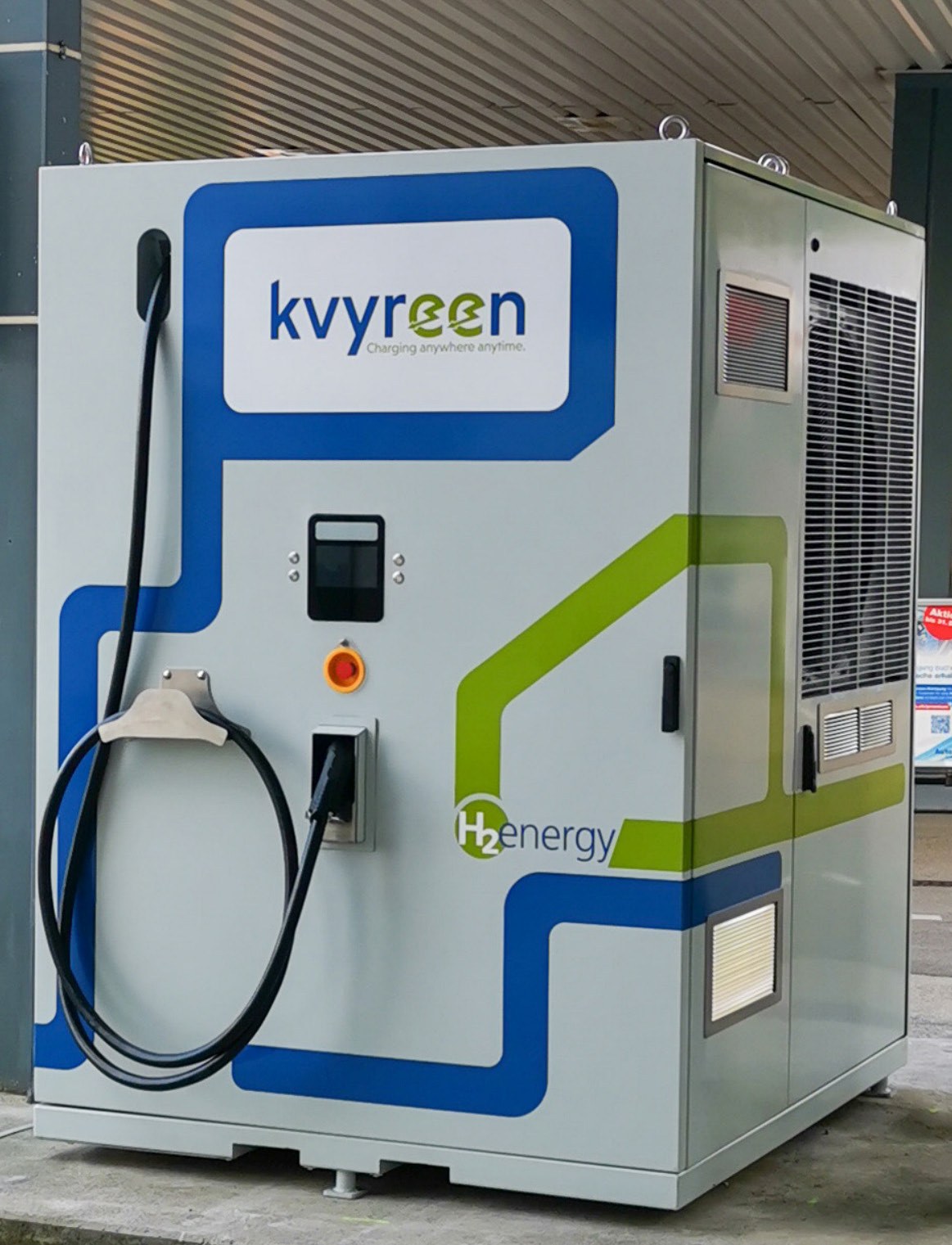
| Charging electric vehicles | 90 or 180 kW DC with no grid connection at all |
Where hydrogen is no longer a trial
In June 2024, GenCell signed a roughly $4.9 million contract with a major European telecom operator. Over at least 6 years, GenCell will supply, install, and maintain 5 kW-class hydrogen backup power systems for dozens of remote comms hubs, keeping them running for 72 hours during a power outage.
Microsoft, Ballard, and Caterpillar simulated a 48-hour power outage at a data center in Cheyenne, USA. A 1.5 MW hydrogen fuel-cell system powered the critical load at an altitude of 1,855 m, in sub-zero temperatures.
Comms-hub systems are 5 kW class, the data center is 1.5 MW. Our 80 and 160 kW units sit between them. They’re built for backup power at water pumping stations, hospitals, and telecom operators, wherever it matters that the building has neither noise nor exhaust.
What we suggest doing
Send us your site’s data: the power you need, how many hours a day, whether the site is stationary, and what matters most, silence, no exhaust, or independence from the grid. We’ll answer with numbers, and tell you plainly if a diesel generator or battery storage would suit your case better. We carry both in our catalog.
Sources
- NATO ENSEC COE (Vilnius), summer 2023 field experiment with 400 W and 1,000 W hydrogen fuel cells: enseccoe.org (reviewed 2026-09-22)
- ERR Novaator, Estonian armed forces and Kaitseliit hydrogen-generator trials, Lieutenant L. Vaksmann’s assessment, 2025-01-13: novaator.err.ee (reviewed 2026-09-22)
- Modern War Institute at West Point, fuel-convoy casualties and fuel-delivery cost in Afghanistan, 2021-12-27: mwi.westpoint.edu (reviewed 2026-09-22)
- GenCell contract with a European telecom operator, $4.9 million, 72 hours, 2024-06-06: hydrogen-central.com (reviewed 2026-09-22)
- Ballard, Caterpillar, and Microsoft, 1.5 MW hydrogen backup power at a data center, 48-hour trial: blog.ballard.com (reviewed 2026-09-22)
- NATO, Energy security, statement on fuel demand and supply-line protection: nato.int (reviewed 2026-09-22)
- European Defence Agency IAPUNIT II project, 8 kW PEM auxiliary power unit: defensemirror.com (reviewed 2026-09-22)
- Bundeswehr (BAAINBw) order, January 2019: hardthoehenkurier.de (reviewed 2026-09-22)
- Fuel-cell integration into the Polaris MRZR, May 2025: soldiersystems.net (reviewed 2026-09-22)
- Latvia’s Ministry of Defence, 2025 and 2026 budgets: mod.gov.lv (reviewed 2026-09-22)
- Estonia’s Ministry of Defence, Baltic commitment to 5% of GDP: kaitseministeerium.ee (reviewed 2026-09-22)
- Lithuania’s 2026 defense budget and 2026–2030 target: europeaninterest.eu, spacewar.com / AFP (reviewed 2026-09-22)