


Tinklaraštis
Advice on choosing equipment: power, compatibility, subsidies and running costs.
How to heat your house during a power outage?

When the power goes out, the heating usually stops too, even if you heat with gas: the boiler
controls and the 230 V circulation pump run on mains electricity, and a heat pump cannot work
without power at all. The heating keeps running if you have a generator with a transfer switch (ATS),
a battery with a hybrid inverter, or both. ESO says a single-phase 3 kW generator covers minimum
needs; for heating equipment, the power must be worked out from its model.
In short
- What you need is not a source of heat but electricity for your heating system. A gas boiler and
its pump need less electricity than a heat pump; you will find the exact power on the rating plate
or in the manual of the boiler and the pump. This decides what size of equipment you need. - A generator’s running time is limited mainly by the fuel you have, but it is noisy and needs a
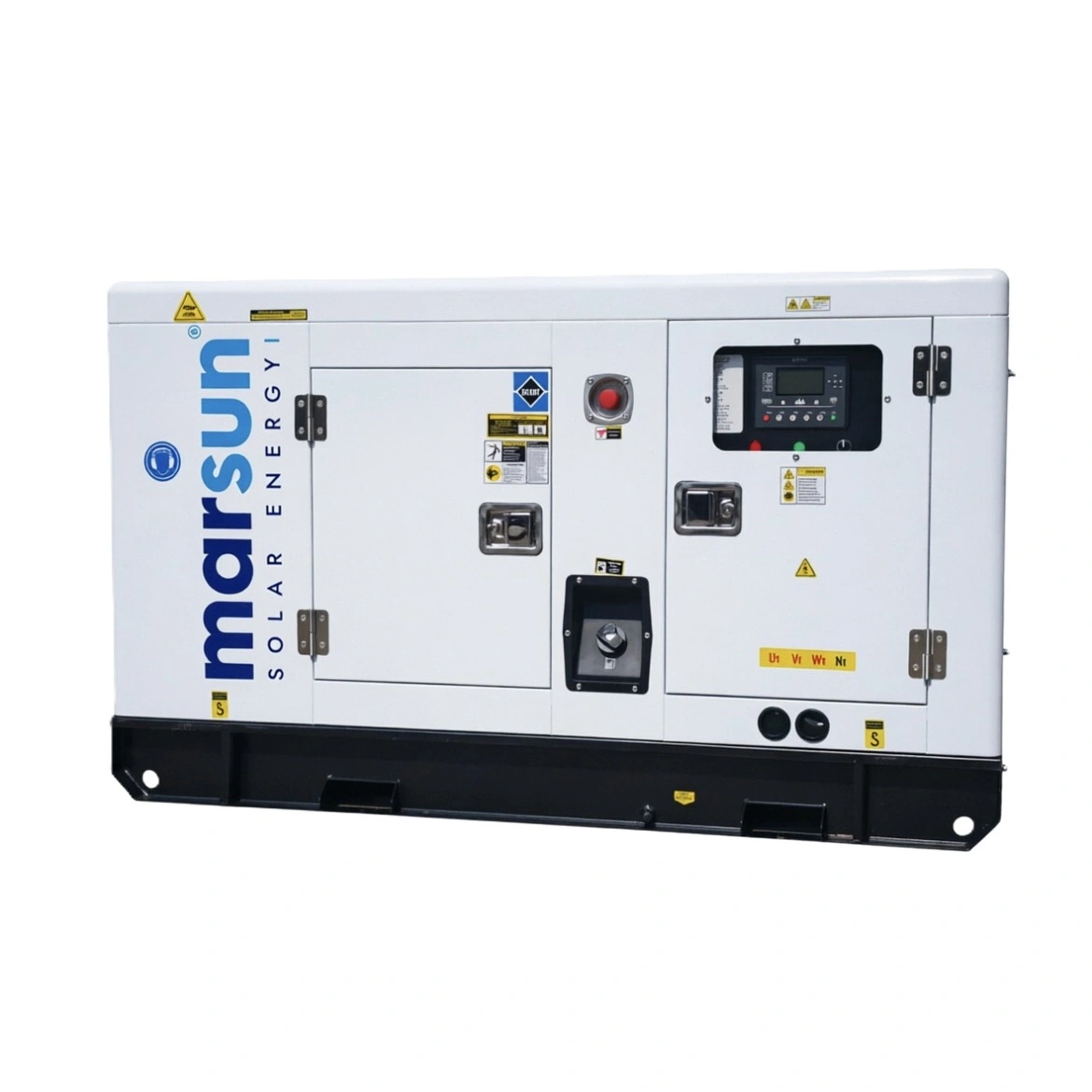
fuel supply and test runs. For example, the 9 kW Marsun MVD10 uses about 2.84 l of diesel per
hour at full power, which is about €6.39 per hour. - A battery with a hybrid inverter works quietly and without fuel, but its capacity is limited,
and in winter the sun hardly charges it. - A generator may be connected to the house wiring only through a fixed connection with a transfer
switch. Otherwise its voltage can get into the ESO grid, which, according to ESO, puts people’s lives
at serious risk. - A generator indoors, in a garage or in a cellar, and heating with a gas oven are dangerous
because of carbon monoxide: US safety agencies warn about this. Diesel heaters burn fuel inside the
room, so their manufacturers’ manuals restrict where they may be used (see below).
Does a gas boiler work without electricity?
A modern boiler is not just a burner, it is also electronics. When there is no electricity, the
controller and the thermostat stop working, and the boiler switches off with them. The manufacturer
Worcester Bosch says so plainly about its thermostat:
“The EasyControl does not have power and the heating appliance is switched off.”
Worcester Bosch – We’ve had a power cut. Does that affect EasyControl?
The second reason is the circulation pump. It pushes hot water from the boiler to the radiators
or the underfloor heating. Such pumps are usually connected to the ordinary 230 V mains: for
example, the first page of the manual for the LEO LRP32-60/180 pump states 230 V and a maximum
power of 96 W. When the pump stops, even a hot boiler cannot pass its heat to the rooms.
The third case is a heat pump. It makes heat using electricity, so without it it does not work at
all. It is also one of the biggest electricity users in a home: when ESO explains how to choose a
generator, it names the heat pump among the appliances you will not be able to use together with
others if the generator’s power is lower than your connection capacity. The names of the Midea
M-Thermal PRO Split heat pumps in our catalogue also mention an additional 3 kW or 9 kW electric
heater, and that uses electricity too. We wrote about heat pump power and types in the article
“Heat Pump: What to Know
Before You Buy”.
The conclusion is simple: the question “how do I heat my home without electricity” usually means
“how do I keep electricity going to my heating system”. How much of it you need depends not on the
size of the house but on what you heat with.
Which appliances must keep running during a power cut?
You do not have to power the whole house: the heating and a few essential appliances are enough.
ESO, the Lithuanian electricity distribution network operator, recommends that you first decide
whether you want to connect all appliances to the backup source or only a few:
„Pasirinkus mažesnės galios generatorių nei įvadas iš ESO, tam tikrų elektros prietaisų
(elektros viryklė, elektrinis vandens šildytuvas, šilumos siurblys, ir pan.), kurių galios
poreikis yra didelis, dirbant elektros generatoriui negalėsite naudoti vienu metu. Tačiau,
minimaliems poreikiams patenkinti pakanka vienfazio 3 kW galios kilnojamo elektros
generatoriaus.“(In English: “If you choose a generator with lower power than your ESO connection, you will not
be able to use certain appliances with high power demand (an electric cooker, an electric water
heater, a heat pump, etc.) at the same time while the generator is running. However, a single-phase
3 kW portable generator is enough to meet minimum needs.”)
So there are two ways to go. If you heat with a gas or other boiler and a pump, a source whose
power is at least the combined power of the boiler, the pump, the fridge and the lighting is enough.
If you heat with a heat pump, the backup source needs power close to your connection capacity,
otherwise the heat pump will only run when everything else is switched off.
One more piece of advice from ESO: the generator should be the same type as your grid connection,
single-phase or three-phase. The power of a three-phase generator is stated as the total for all
three phases, so a single-phase boiler or pump gets only the share of one phase. You can find your
connection capacity and number of phases in ESO self-service. We explained in more detail how to
choose generator power on that basis in our article
on home generator power and
ATS.
Generator with ATS: heating for as long as there is fuel
A generator’s running time is limited mainly by the fuel you have. That is why it suits long
winter faults, when there is no electricity for a day or longer. An ATS (automatic transfer switch)
is a panel that switches the house over to the generator when the power goes out and back to the
grid when it returns. Without it you have to start the generator and switch over yourself, even at
night.
For a house with a boiler and a three-phase supply.
Marsun MVD10
is a 9 kW three-phase diesel generator in a soundproof enclosure, shop price €2,649. It has no
built-in ATS, but it has a connector for an external module: the
ATS for
6–15 kW generators costs €199. The product page calculates that at a full 9 kW load it uses
about 2.84 l/h, and the 12.5 l tank lasts about 4.4 h; at roughly half load, about 8.8 h.
For a house with a heat pump.
Marsun MHD20H
is a 20 kW three-phase diesel generator with a factory-fitted ATS and a heated fuel unit; the
product page says this unit makes it easier to start the engine at low temperatures. Shop price
€9,099. The manufacturer states that with its 70 l tank it can run continuously for up to
8 h. The product page also gives an indicative calculation: at its full 20 kW it uses about
4.9 l of diesel per hour. This is already a stationary unit: it weighs 650 kg, so it needs space
outdoors and a solid base.
For a house with a single-phase supply.
Marsun MVB6PI
is a 5.5 kW single-phase petrol generator with electric start, shop price €1,469. It weighs
47 kg and has wheels. The manufacturer states up to 6.7 h of running time on its 12 l tank, but
does not say at what load. The product page calculates that at a full 5.5 kW load it uses about
3.4 l of petrol per hour, and the tank lasts about 3.6 h.
Running costs on top of the purchase price. Fuel: on 6 November 2026 the average
price of diesel in Lithuania was €2.249/l and of 95 petrol €1.868/l (LEA, the Lithuanian Energy
Agency). So one hour at full power costs about €6.39 (MVD10), about €11 (MHD20H) and about €6.35
(MVB6PI). Noise: according to the manufacturer, the MVD10 and MHD20H produce 72 dB and the MVB6PI
68 dB. Maintenance: a fuel supply, oil and test runs. A generator that has not been used for a long
time may not start on the day of the fault, so it is worth testing it regularly according to the
manufacturer’s manual.
Battery with a hybrid inverter: quiet, but limited
A home battery stores electricity from the grid or a solar power system, and a hybrid inverter is
the device that, when the power goes out, switches the house over to run from that battery by
itself. No fuel is needed, nothing has to be started, and it runs quietly. But a battery does not
generate electricity: once it is flat, the heating stops again.
For a single-phase house with a boiler.
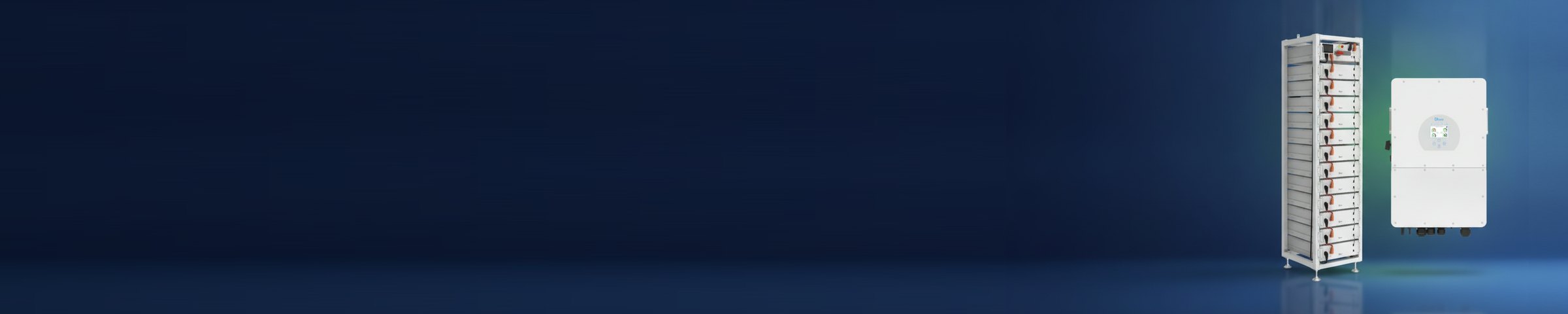
Deye kit V
is a single-phase 6 kW hybrid inverter with a 5.1 kWh battery, shop price €1,999. The inverter
also works in off-grid mode, that is, without the grid.
When you need more capacity.
GenixGreen ES-BOX11 PLUS
is a 10.24 kWh LiFePO4 battery, shop price €1,549. The product page calculates that at a 1 kW
load it lasts about 10 h in theory. Note: the manufacturer states that it can be charged at 0 to
55 °C, so in an unheated garage in winter it may not charge.
What to weigh up. Capacity is limited, and in December and January the sun hardly
charges the battery. So a battery is good for short outages, while for a long fault a generator is
usually added. We described how a generator connects to a hybrid inverter in the article
“Generator and Solar System: How Do
They Work Together?”, and compared all three options in the article
“Backup Power
When the Grid Goes Down: Generator, Battery or Hybrid Inverter?”.
What to choose for your home: a comparison
| How you heat | Backup source | Example and shop price | How long it lasts | What else to consider |
|---|---|---|---|---|
| Gas or other boiler, three-phase supply | Generator and ATS | Marsun MVD10 9 kW, €2,649 + ATS 6–15 kW, €199 | About 4.4 h at full load, about 8.8 h at half load (per product page), then as long as you refuel | About €6.39 per hour at full power, 72 dB, test runs |
| Gas or other boiler, single-phase supply | Single-phase generator through a connection installed by an electrician | Marsun MVB6PI 5.5 kW, €1,469 | Up to 6.7 h on a 12 l tank (manufacturer’s figure, load not stated), about 3.6 h at full power (per product page) | About 3.4 l of petrol and €6.35 per hour at full power, 68 dB, manual switch-over |
| Boiler, short and frequent outages | Hybrid inverter and battery | Deye kit V, 6 kW and 5.1 kWh, €1,999 | Depends on the load; ends when the battery is flat | No fuel needed; in winter the sun hardly charges it |
| Heat pump | Generator with ATS, power close to your connection capacity | Marsun MHD20H 20 kW with built-in ATS, €9,099 | Up to 8 h on a 70 l tank (manufacturer’s figure) | About 4.9 l of diesel and €11 per hour at full power (indicative product page calculation), 72 dB, 650 kg, needs space outdoors |
| Any, when you want quiet and a long backup | Battery for short outages and generator for a long fault | GenixGreen battery 10.24 kWh, €1,549 + generator sized to your supply | First the battery, then the generator | The price of both units and generator maintenance |
What is dangerous when you try to heat a house without electricity?
The most dangerous things are combustion gases indoors and a wrongly connected generator. This is
not our invention: official bodies warn about both.
A generator in the house, garage or cellar. Generator exhaust contains carbon
monoxide, which you can neither see nor smell. The US Consumer Product Safety Commission (CPSC)
writes:
“NEVER use inside a home or garage, EVEN IF doors and windows are open.”
In the same leaflet the CPSC also rules out placing a generator in a basement, shed or porch, and
advises placing it outdoors at least 20 feet (about 6 m) from the house, with the exhaust pointed
away from buildings. It also advises fitting battery-operated carbon monoxide alarms near bedrooms and
on every floor.
A generator plugged into the house wiring without a transfer switch. ESO
states:
„Elektros generatorių jungti su visos patalpos vidaus elektros tinklu galima tik
įsirengiant stacionarią jungtį ir priemones, kurios užtikrina, jog generatoriaus generuojama
įtampa nebūtų perduota į ESO elektros tinklus, dėl ko kiltų didelė rizika žmonių gyvybei ir
sveikatai, ar būtų sugadinti jūsų prietaisai, generatorius ar padaryta kita žala.“(In English: “A generator may be connected to the internal wiring of the whole building only by
installing a fixed connection and means that ensure the voltage produced by the generator is not
passed into ESO’s electricity networks, which would create a serious risk to people’s life and
health, or damage your appliances or the generator, or cause other harm.”)
ESO advises entrusting this work to qualified specialists and does not recommend “lending”
electricity from your generator to neighbours. When the power comes back, the generator is stopped
first, and only then is the house reconnected to the ESO grid with the transfer switch.
Heating with a gas oven. The US Centers for Disease Control and Prevention (CDC)
say briefly in their carbon monoxide leaflet: “Don’t heat home with gas oven.”
Diesel heaters in living rooms. Such heaters burn fuel inside the room itself.
For example, in the manuals for EMLO diesel heaters the manufacturer says they must not be used in
bedrooms, in small enclosed rooms or while sleeping, and the EMLO 13, 16, 20 and DC series heaters
also not in rooms smaller than 80 m². They are intended for workshops, warehouses, garages and
building sites where the space is ventilated regularly, not for a living room.
Electric heaters run from a generator or a battery. ESO reminds you that
appliances above 1200 W should not be plugged into a single 230 V socket, a heater must stand at
least a metre from curtains and furniture, and home-made heaters should not be used. ESO also
advises against choosing a generator with lower power than the combined power of the appliances you
want to connect at the same time: connecting a higher load risks damaging the appliances and/or the
generator.
What you can do yourself
- Log in to ESO self-service and write down your permitted power and type of connection:
single-phase or three-phase. - Write down the models of your boiler, circulation pump and, if you have one, heat pump. Their
power is stated on the rating plate on the appliance or in the manual. - Decide what must keep running during a power cut: heating, fridge, water pump, lighting,
internet. Everything else can wait. - If you already have a generator, do not plug it into a socket or the fuse box yourself. Ask an
electrician to install a fixed connection with a transfer switch. ESO says the connection point can
be prepared in advance so that a generator can be connected later. - Choose a place for the generator outdoors, away from windows, doors and vents, and fit a
battery-operated carbon monoxide alarm. - If the generator is not used for long periods, start it regularly and check your fuel
supply.
How we can help
We work out how much electricity your heating and essential appliances really need, and select
an inverter, battery or generator so that everything works as one system. The consultation before
purchase is free. Delivery anywhere in Lithuania is free; we deliver and install the equipment
within 14 days. All products carry the manufacturer’s warranty.
To let us do the calculation, send us: your connection capacity and number of phases from ESO
self-service, the model of your boiler or heat pump, a list of the other appliances you want to
power, and how long outages usually last where you live. Write to
sales@hybridenergy.lt or call
+370 636 52 222, Monday to Friday, 9:00–18:00.
Frequently asked questions
Does a gas boiler work without electricity?
Usually not. A modern boiler’s controller, thermostat and circulation pump run on 230 V
mains, so the boiler switches off in a power cut, even if there is gas. Hybrid Energy advises keeping
exactly these devices powered: a generator at least as powerful as the boiler and pump, with a
transfer switch, or a hybrid inverter with a battery.
What size generator do I need to run my heating?
It depends on what you heat with. ESO says a single-phase 3 kW generator is enough for minimum
needs, but to use all your appliances, choose the power according to your grid connection. A heat
pump needs far more than a boiler. Hybrid Energy works out the power from your
connection and your list of appliances.
Can I plug a generator into a wall socket?
No. ESO says a generator may be connected to the house’s internal wiring only through a fixed
connection and means that stop its voltage from getting into the ESO grid. Otherwise there is a
serious risk to people’s lives and to your appliances. Hybrid Energy offers ATS transfer switches,
and the connection must be made by a qualified electrician.
How long will a home battery keep the heating running?
That depends on the battery capacity and the power of the connected appliances. For example, the
product page of the 10.24 kWh GenixGreen battery calculates that it lasts about 10 h at a 1 kW
load. In winter the sun hardly charges it, so for long faults Hybrid Energy can work out how to
combine the battery with a generator.
Can you use a diesel heater in a house?
Not in bedrooms, small enclosed rooms or while you sleep. Such heaters burn fuel inside the room.
For example, the EMLO manuals forbid exactly this, and for the EMLO 13–20 and DC series also use in
rooms under 80 m². Hybrid Energy offers them for
workshops, warehouses and garages, and for homes, electric heating with backup power.
Sources
- ESO, Rekomendacijos rezervinio šaltinio įsirengimui (Recommendations for installing a backup source) – choosing the power, 3 kW for minimum needs, phases, fixed connection and transfer switch, “lending” to neighbours:
eso.lt (checked 8 November 2026) - ESO, ESO pataria, kaip saugiai naudoti elektrinius šildytuvus (ESO advice on using electric heaters safely) – 1200 W per socket, distance from flammable materials, home-made heaters:
eso.lt (checked 8 November 2026) - ESO, Kritinės situacijos (Critical situations) – home-made heaters:
eso.lt (checked 8 November 2026) - Worcester Bosch, We’ve had a power cut. Does that affect EasyControl? – the heating appliance switches off in a power cut:
worcester-bosch.co.uk (checked 8 November 2026) - LEO LRP32-60/180 circulation pump manual – 230 V supply, up to 96 W:
siurbliai.lt (PDF) (checked 8 November 2026) - CPSC, What to Know About Generators and Carbon Monoxide – generator outdoors only, 20 feet, carbon monoxide alarms:
cpsc.gov (PDF) (checked 8 November 2026) - CDC, Avoiding Carbon Monoxide Poisoning – do not heat the home with a gas oven:
cdc.gov (checked 8 November 2026) - EMLO 13/16/20 and EMLO DC-08 user manuals (Termo-fol) – restrictions on indoor use:
emlo.com.pl (PDF),
termofol.pl (PDF) (checked 3 November 2026) - LEA data via pigiausidegalai.lt – average price of diesel and 95 petrol on 6 November 2026:
pigiausidegalai.lt (checked 8 November 2026) - Hybrid Energy product pages – specifications and prices of generators, ATS, inverters and batteries:
hybridenergy.lt (checked 8 November 2026)