


Tinklaraštis
Advice on choosing equipment: power, compatibility, subsidies and running costs.
How to prepare your home for a power outage: what stops and what you need

Outside the big cities, ESO must restore electricity within 12 hours, and after a storm within
72 hours. A planned outage for households lasts no more than 24 hours in a row, and you are told
about it at least 5 days in advance. You can prepare at three levels: the basics cost almost
nothing, a 3 kW generator costs from €619, and automatic backup from €1,999.
In short
- ESO’s longest deadline for restoring electricity applies not to planned work but to faults caused
by natural events: 72 hours, not 12. - In a private house, a power cut turns off more than the lights: the heating circulation pump
stops, water no longer comes from the well, the freezer stops freezing and the internet goes down.
First list which of these you really need. - According to ESO, a single-phase 3 kW generator is enough for minimum needs. It
is cheap, but it is started by hand and cannot power all appliances at the same time. - A generator may be connected to the whole house’s internal wiring only through a fixed connection
with means that stop its voltage from getting into the ESO grid. ESO warns that otherwise there is a
serious risk to people’s life and health, and advises entrusting this work to qualified
specialists. - A battery is quiet and needs no fuel, but its capacity is limited. During a long winter fault,
when there is hardly any sun, only a generator or a combination of generator and battery helps
reliably.
How long can a power outage last in Lithuania?
It depends on the cause. ESO, the Lithuanian electricity distribution network operator, gives the
deadlines set by law: electricity is restored within 6 hours in Vilnius, Kaunas, Klaipėda, Šiauliai,
Panevėžys and the free economic zones, within 12 hours in the rest of Lithuania, and within
72 hours when supply is interrupted by a fault caused by natural events or a fire.
Planned work is more predictable. For household customers, a single planned outage may not last
longer than 24 hours in a row, and the network operator must give notice of it no later than
5 calendar days in advance. Notices are sent by text message or email; you can sign up for them by
calling the free ESO number 1852.
So in a country house it is worth preparing not for an hour but for a day or several.
What stops working at home when the power goes out?
In a city flat, a power cut turns off the lights. In a private house, things you do not see also
stop: pumps, controls, communications. Below is a list for a typical country or suburban house. Not
everything on it will apply to your home, but any preparation starts with exactly this kind of
list.
| In the house | What happens without electricity | What you can do |
|---|---|---|
| Gas or pellet boiler | The controls and circulation pump stop, the radiators cool down | Connect the boiler to backup power; it is one of the first appliances on the list |
| Heat pump, electric heating | Stops heating immediately | The backup must be more powerful; these appliances decide the power of the generator or inverter |
| Borehole or well pump | No water from the tap, and the toilet cistern does not refill after flushing | Keep a supply of drinking and household water; connect the pump to backup power |
| Fridge and freezer | They slowly warm up inside, and each opening speeds this up | Open them as little as possible; connect the freezer to backup power if it holds a lot of food |
| Internet router | Home internet and Wi-Fi go down | Charge phones in advance; the router uses little electricity and is worth connecting to backup power |
| Sewage pump (if you have one) | Waste water is no longer pumped away | Use as little water as possible while there is no power; connect the pump to backup power |
| Gates, alarm, ventilation | They stop unless they have their own battery | Know how to open the gates by hand |
Heat pump owners need to know one more thing: it is often one of the most powerful appliances in
the house, so it is the heat pump that decides what backup you need. More on this in the article
Heat Pump: What to Know
Before You Buy.
Three levels of preparation: what each one costs
You do not have to buy the most expensive solution straight away. For most homes the first level
is enough, and the second and third are added once it is clear which appliances you really need.
The cost of each level is not only money but also noise, fuel and your time.
| Level | What works during a power cut | Shop price | How much effort it takes |
|---|---|---|---|
| 1. The basics | Light, phones, food prepared in advance | Almost nothing if you already have a torch and chargers | One evening to prepare and the habit of keeping phones charged |
| 2. Backup for essential appliances | A few chosen appliances, but not all at the same time | 3 kW generator, €619 or €769, plus an electrician’s work | You start it yourself, refuel it, and the generator is noisy |
| 3a. Battery with a hybrid inverter | Selected circuits in the fuse box, until the battery is flat | Kits from €1,999 (single-phase) and €2,799 (three-phase, pre-order), installation extra | None day to day; at installation you decide which circuits will run during a power cut |
| 3b. Generator with ATS | Appliances whose combined power does not exceed the generator’s, as long as there is fuel in the tank | 11 kW, €4,369 (ATS extra), 20 kW with built-in ATS, €9,099, installation extra | A location as required by the manufacturer’s manual, a fuel supply, regular test starts |
Level one: what ESO advises
The first level needs no equipment. ESO advises that when you hear about possible faults you
unplug electronic household appliances, and before heavy rain or a flood you switch off the main
circuit breakers of the whole house. ESO also writes:
„Iš anksto pasigaminkite maisto, įkraukite telefono ar nešiojamojo kompiuterio baterijas,
pasirūpinkite alternatyviu šviesos šaltiniu – žvakėmis, žibintuvėliais.“(In English: “Prepare food in advance, charge your phone or laptop batteries, and arrange an
alternative source of light: candles, torches.”)
For a country house, add a few more things: a water supply if your water comes from a borehole,
and find out where the fuse box is and how to open the gates without electricity.
What to weigh up: this level needs almost no money, but it keeps not a single
appliance running. The heating, water and freezer still stop.
Level two: backup for essential appliances
The second level is a small generator just for what you really need: the boiler controls with the
circulation pump, the freezer, the router, the lights. ESO’s recommendations on installing a backup
source say:
„Tačiau, minimaliems poreikiams patenkinti pakanka vienfazio 3 kW galios kilnojamo elektros
generatoriaus. Turint vienfazį 3 kW elektros generatorių, galėsite naudotis dauguma savo
elektros prietaisais, tačiau ne tuo pačiu metu.“(In English: “However, a single-phase 3 kW portable generator is enough to meet minimum needs.
With a single-phase 3 kW generator you will be able to use most of your electrical appliances, but
not at the same time.”)
Our shop has two such models, and they differ in more than price:
- Marsun MVB3.5PI
– 3 kW inverter petrol generator, €769. Noise level ≤ 75 dB, weight 22 kg; at 100 % load the
6 l tank lasts up to 3.5 h. An inverter generator supplies a pure sine wave voltage, so it also
suits sensitive electronics. - Marsun MVBG3.5PI
– 3 kW, runs on petrol or LPG, €619. The tank is bigger, 13 l (up to 6.5 h at 100 % load), but
the generator itself is much louder: ≤ 97 dB.
What to weigh up: both generators are started by hand, so you have to be at home
when the power goes out. You need to keep fuel in stock and refuel, and the neighbours hear the noise
too. In addition, a generator can be connected to the house wiring only through a fixed connection
installed by an electrician; that is an extra cost, and how much depends on your fuse box. Pumps and
fridges draw more current when they start than when they run, so with a 3 kW generator you have to
choose what runs at the same time.
Level three: automatic backup
At the third level, the backup does not need to be started by hand. There are two solutions, and
they suit different situations.
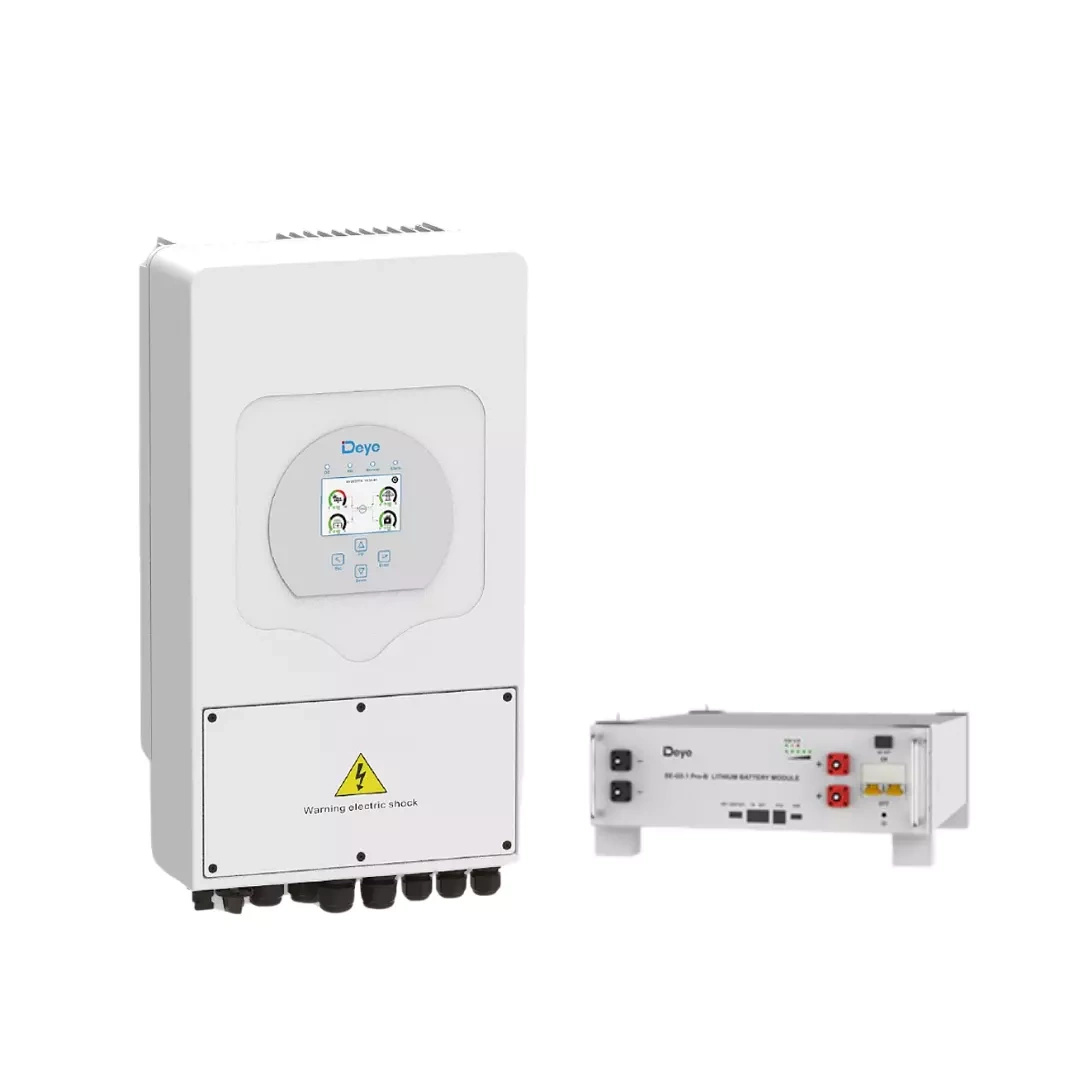
Battery with a hybrid inverter. A hybrid inverter is a device to which you can
connect a battery and solar panels. When the power goes out, it supplies selected circuits of the
house from the battery: quietly and without fuel. For example,
Deye
kit V (a single-phase 6 kW inverter and a 5.1 kWh battery) costs €1,999, and the
three-phase
Deye SUN-10K with a 5.12 kWh battery costs €2,799 (this kit is sold on pre-order). Working out how
many hours the battery will power the house is simple: divide the capacity (kWh) by the power of the
appliances running at the same time (kW).
What to weigh up: battery capacity is limited. During a long winter fault, when
there is hardly any sun, the battery runs flat and does not recharge. Also, before installation you
need to decide which circuits will run during a power cut, because changing this later costs more.
We described how a battery works together with a generator in the article
Generator and Solar System: How Do They
Work Together?.
Generator with ATS. ATS stands for automatic transfer switch: a unit that, when
the power goes out, starts the generator by itself and switches the house over to it, and when the
power returns switches it back to the grid.
Marsun
MVD12 (11 kW, three-phase, diesel, in a soundproof enclosure) costs €4,369; its ATS module is
bought separately.
Marsun
MHD20H (20 kW) has a factory-fitted ATS and a heated fuel unit that makes it easier to start in
the cold; it costs €9,099. According to the manufacturer, the 70 l tank lasts up to 8 h of
continuous running.
What to weigh up: for most of the year the generator stands unused. The MHD20H
weighs 650 kg, and it needs a location that meets the manufacturer’s manual, a fuel supply and
regular test starts. A generator that nobody has started for a long time may not start on the day it
is needed. We explained what size generator you need and when a three-phase one is worth choosing in
the article
on home generator power and
ATS, and you will find a comparison of a generator, a battery and a hybrid inverter here:
Backup Power
When the Grid Goes Down: Generator, Battery or Hybrid Inverter?.
How to connect a generator to your house safely?
Only through a fixed connection installed by a specialist. This is not excessive caution on our
part but ESO’s recommendation, and the reason is serious: the voltage of a wrongly connected
generator can get into the ESO grid and endanger people’s lives.
„Elektros generatorių jungti su visos patalpos vidaus elektros tinklu galima tik įsirengiant
stacionarią jungtį ir priemones, kurios užtikrina, jog generatoriaus generuojama įtampa nebūtų
perduota į ESO elektros tinklus, dėl ko kiltų didelė rizika žmonių gyvybei ir sveikatai, ar būtų
sugadinti jūsų prietaisai, generatorius ar padaryta kita žala. Šį darbą patikėkite atlikti tik
kvalifikuotiems specialistams.“(In English: “A generator may be connected to the internal wiring of the whole building only by
installing a fixed connection and means that ensure the voltage produced by the generator is not
passed into ESO’s electricity networks, which would create a serious risk to people’s life and
health, or damage your appliances or the generator, or cause other harm. Entrust this work only to
qualified specialists.”)
In the same recommendations ESO gives a few more tips. The generator’s power must not be lower
than the combined power of the appliances connected at the same time. Place the generator where and
under the conditions its manual specifies, so read the whole manual before starting it for the first
time. Start, look after and stop a running generator as the manual says. ESO advises against
“lending” electricity to neighbours, because you do not know the condition of their internal
wiring.
One more detail: phases. ESO advises choosing a generator of the same type as your grid
connection: single-phase or three-phase. ESO also reminds you that the power of three-phase
generators is stated as the total for all three phases. You can find your connection type and
permitted power in ESO self-service.
Does ESO pay compensation if the power is out for a long time?
In some cases, yes, but it does not replace being prepared. For private customers whose
electricity was not restored within 72 hours after the storm of 22 August 2026, ESO applied a
simplified procedure for compensating direct losses: up to €60 for spoiled food, up to €220 for buying
a generator, €40 per day for hiring a generator and €90 for generator fuel per day of generator
operation. Accommodation, generator hire and fuel share a common limit of €220, €440 or €660,
depending on how many days there was no electricity, while food and the purchase of a generator have
separate limits.
In addition, ESO separately pays the compensation set by VERT (the National Energy Regulatory
Council) when electricity is not restored within the set deadline: 30 % of the transmission fees paid
as a fixed part, plus 0.7 % for each additional hour of delay. It goes to customers whose
electricity was not restored within 72 hours because of the storm damage, and you do not need to
apply: ESO calculates it itself. The compensation covers part of the costs, but it will not give you
back heat and water for those days.
What you can do yourself right now
- List the appliances your home cannot do without for even a day: the boiler and its pump, the
water pump, the freezer, the sewage pump, the router. Next to each, write its power (stated on the
sticker or in the manual). - Call ESO on 1852 and sign up for planned outage notices by text message or email.
- Get torches, charge your phones and power banks, and keep a supply of drinking water.
- Find the fuse box and work out which circuit breaker powers what. During a power cut, check the
breakers first and see whether the neighbours have lost power too. - In ESO self-service, check whether your connection is single-phase or three-phase and what the
permitted power is. - If you already have a generator, start it now, not during a storm, and talk to an electrician
about a fixed connection.
How we can help
We work out how much electricity you really need and select an inverter, battery or generator so
that everything works as one system. We deliver the equipment anywhere in Lithuania within
14 days and install it. Delivery is free, all products carry the manufacturer’s warranty, and the
consultation before purchase is free as well.
So that we can do the full calculation, send us three things: the list of appliances with their
power (see point 1 above), your connection type and permitted power from ESO self-service, and an
answer to whether it matters more to you that the backup switches on by itself, or starting it by
hand is enough. Write to
sales@hybridenergy.lt or call
+370 636 52 222 (Monday to Friday, 9:00–18:00).
Frequently asked questions
Who do I call when the power goes out?
First check the circuit breakers in your fuse box and see whether the neighbours have lost power
too. If the whole street is without electricity, report the fault to ESO on the free number 1852.
Hybrid Energy suggests using the same call to sign up for planned outage notices, so that next time
you hear about them in advance.
What size generator do I need for my house?
According to ESO, a single-phase 3 kW generator is enough for minimum needs, but then you have to
use appliances one after another. If you want all appliances to work, ESO advises choosing the
generator’s power according to your grid connection capacity. Hybrid Energy works out how much
electricity you really need and selects a suitable generator on that basis.
Can I plug a generator into a wall socket?
Not to power the whole house. ESO writes that a generator may be connected to the house wiring
only through a fixed connection that stops its voltage from getting into the ESO grid, and advises
leaving this work to qualified specialists. Hybrid Energy notes that single appliances can run from a
generator on extension leads rated for their combined power.
How long will a home battery power the house?
That depends on capacity and load: divide the battery capacity (kWh) by the power of the
appliances running at the same time (kW) to get hours. For example, the Deye kits sold by
Hybrid Energy include a 5.1 kWh battery. In a long winter fault with hardly any sun, the battery runs flat
without a generator and does not recharge.
Does ESO pay compensation if the power is out for several days?
In some cases, yes. After the storm of 22 August 2026, customers whose electricity was not
restored within 72 hours were compensated by ESO up to €60 for food and up to €220 for buying a
generator. Hybrid Energy suggests seeing this as partial cover of costs: the compensation does not
replace heat and water at home.
Sources
- ESO, Elektros energijos persiuntimo atstatymo laikai (Electricity restoration times) – 6, 12 and 72-hour deadlines, compensation for losses after the storm of 22 August 2026, VERT compensation:
eso.lt (checked 8 November 2026) - ESO, Suplanuotų elektros atjungimų informacija (Planned outage information) – 24-hour limit, notice 5 days in advance, phone 1852:
eso.lt (checked 8 November 2026) - ESO, Kritinės situacijos (Critical situations) – what to do before a fault:
eso.lt (checked 8 November 2026) - ESO, Rekomendacijos rezervinio šaltinio įsirengimui (Recommendations for installing a backup source) – 3 kW for minimum needs, fixed connection, phases, location as per the manual:
eso.lt (checked 8 November 2026) - Hybrid Energy product pages (links in the text above) – generator and kit prices, power, tanks, noise (checked 8 November 2026)