


Tinklaraštis
Advice on choosing equipment: power, compatibility, subsidies and running costs.
Infrared Heating: How Much Power You Need and What an Hour Costs

Every September the same question comes back: the heating season has not started yet, but the house is already cold. Firing up the whole boiler for one room makes no sense, and a fan heater is loud and dries the air. So people start looking at infrared heating — and get lost almost immediately. One shop offers a thin panel for €299, another a 20 kW diesel unit for €2,249. These are not competitors, and it is not a case of cheaper versus pricier. They are three different devices for three different situations, and the main thing is knowing which one you are in.
Why infrared heats differently
A normal radiator heats the air. Warm air rises to the ceiling, cools, sinks back down, and it takes time before the room feels warm. An infrared panel heats surfaces instead: the floor, the walls, the furniture and you. That is why you feel it almost at once — much like stepping out of the shade into the sun, even though the air temperature has not changed.
Two practical consequences follow. First, you feel the warmth before the thermometer registers it, so you can keep the air about a degree cooler and be just as comfortable. Second, when a door opens the heat does not leave with the air as fast as it does from a convector — warmed surfaces stay warm and keep giving heat back.
What an hour actually costs
The maths is simple, and it is worth doing before you buy rather than after. Multiply the device’s power in kilowatts by your electricity tariff. A 750 W panel running continuously uses 0.75 kWh per hour. At €0.20/kWh that is 15 cents an hour.
In practice a panel does not run continuously. With a thermostat it heats until the room reaches the set temperature and then only maintains it — on average about half the time. So the real cost is closer to 7–8 cents an hour, and a bathroom adds up to a few dozen cents over a full day.
Let us be straight about this: it is not cheaper than a heat pump. A heat pump turns one kilowatt-hour of electricity into three or four kilowatt-hours of heat; an infrared panel turns it into one. The panel does not win on efficiency. It wins where there is no heat pump, or where running one is not worth it: a single room, a bathroom, a workshop, a terrace, a summer house, or a home used only at weekends. If you are heating a whole house year-round, start with heat pumps and let panels cover what the pump cannot reach.
Three situations and what fits them
A room, a bathroom, a work corner
This is where thin wall or ceiling panels from 400 to 1000 W belong. They hang on the wall like a picture or drop into a suspended-ceiling cassette, they are one and a half to three centimetres thick, and they make no noise at all.
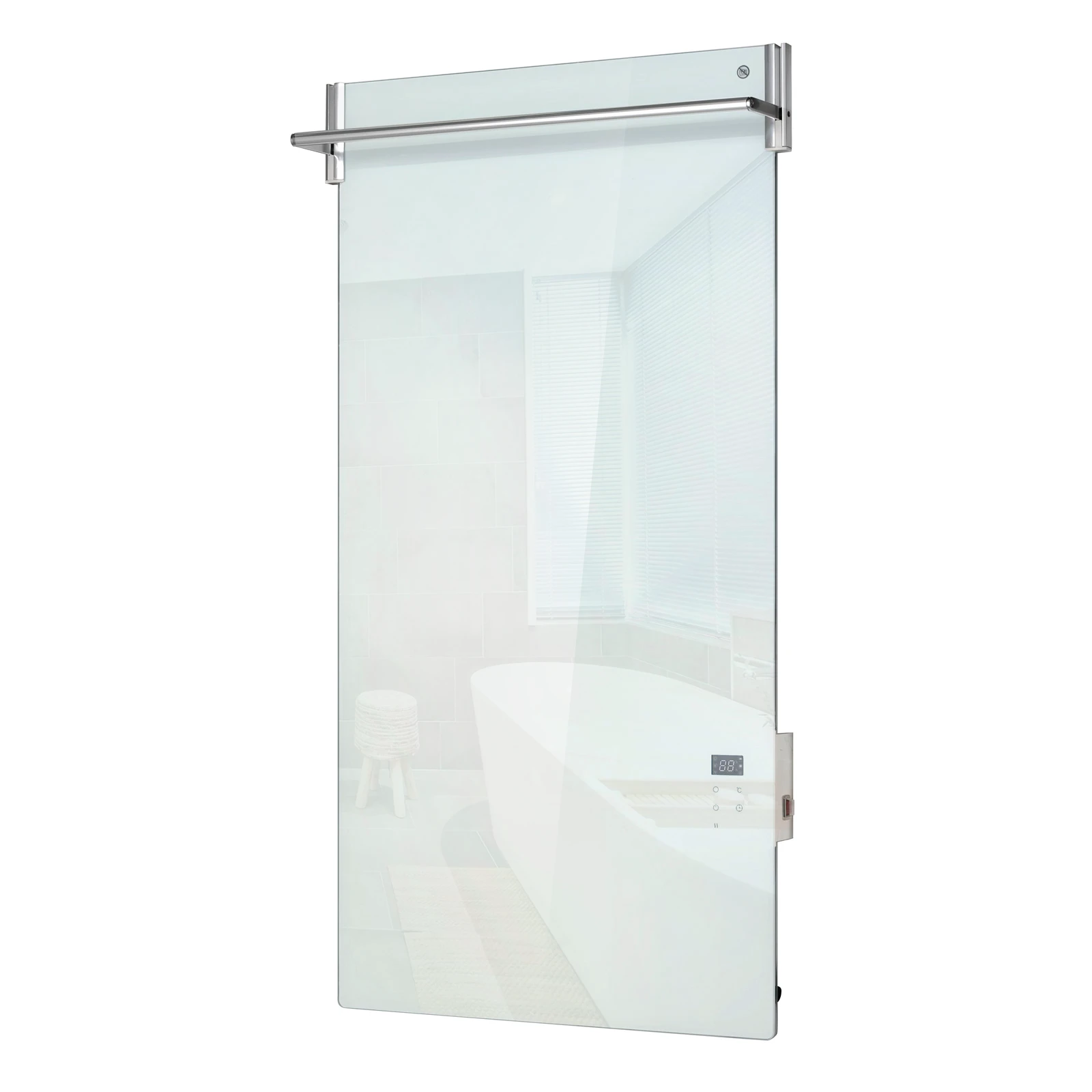
For a bathroom the moisture rating matters more than the wattage. The TF-SW750 is IP34, has a towel rail, and is controlled over WiFi or by remote. If you would rather not see a heater at all, there is the TF-LG400 heated mirror with LED lighting: 400 W of heat, and the mirror stops fogging up as a bonus.
For a larger room the TF-HMP1000 works well — a 120 × 60 cm steel panel with a built-in WiFi thermostat and a 24-hour timer. For a small room the TF-HMP500 is enough.
One thing worth checking before you order: not every panel has a thermostat inside. The ceiling-mounted TF-SWPO450 does not, so it needs a separate external one. Without it the panel heats non-stop and the bill comes in at twice what you calculated.
A tall or open space
In a workshop, a garage or on a terrace a wall panel will not help — there is nothing to heat, the warmth simply rises away. Those places call for radiant heaters: narrow units mounted no lower than 2.2 m and aimed at the zone where people actually are.
The TF-IR2400 gives 2400 W with IPX4 protection, so it also works under an outdoor canopy. For a bigger space there is the TF-IR3200 at 3200 W. Both are controlled by remote and through the Termofol Smart app.
It helps to understand what they actually do. A radiant heater does not bring a whole garage up to twenty degrees — it heats you, underneath it. So mount it above the workbench or the table, not somewhere in a corner.
Construction sites, warehouses, hangars
When a thousand cubic metres of uninsulated space needs heating, electricity will not do it — there simply is no supply of that size. This is where the EMLO diesel infrared heaters come in. EMLO 13 delivers 13 kW for up to 900 m³, EMLO 16 16 kW for up to 1100 m³, and EMLO 20 20 kW for up to 1400 m³.
They use almost no electricity: 80 W for the controls and the fan, less than a light bulb. Fuel consumption runs from 0.92 to 1.25 litres per hour depending on the model and the load. The tank covers a full shift: 50 litres on the EMLO 13 and 16, 70 litres on the EMLO 20.
Choosing the power without ending up short
The most common mistake is choosing by square metres. The same device covers a completely different area in different buildings, and it shows up right in the manufacturer’s own figures. The same 750 W panel:
| Well-insulated room | up to 20 m² |
|---|---|
| Moderately insulated | up to 12 m² |
| Not insulated | up to 8 m² |
That is more than a twofold difference, and it depends on the walls, not on the heater. So answer the insulation question first — a warm room in a new build, an old brick house, or an uninsulated extension — and only then look at the watts.
The second factor is ceiling height. The table holds for a standard 2.5 m ceiling. At 3 m and above a wall panel is no longer the right answer: use a ceiling panel or a radiant heater.
If you are unsure how much power the whole house needs, or what to buy first, the home page has a power calculator and an equipment picker. They take a couple of minutes and show what your system is missing.
What to check before buying
For a bathroom, a moisture rating of at least IP34. Outdoors or under a canopy, IPX4 as a minimum. For radiant heaters, whether you have the 2.2 m of height they need — if the ceiling is lower, the device is not suitable. For panels, whether the thermostat is built in or has to be bought separately. And finally the electrical supply: a 3200 W heater sharing a circuit with kitchen appliances will trip the breaker.
Common questions
Can infrared heating replace the main heating system?
In one room or a few, yes — especially in a well-insulated house that is not lived in every day. For a whole house year-round it costs more than a heat pump, because one kilowatt-hour of electricity gives you one kilowatt-hour of heat rather than three.
Does a panel dry out the air?
No. It neither heats nor moves the air, so humidity does not drop the way it does with a fan heater. In a bathroom that is actually useful: surfaces dry out while the air stays normal.
Can a panel go above a bed or in a child’s room?
Yes, as long as you keep the clearance the manufacturer specifies from furniture and curtains. Surface temperature reaches up to 95 °C, so the panel must not touch textiles. In children’s rooms ceiling mounting is the more common choice — that way the unit is out of reach entirely.
How long do these devices last?
Panels have no moving parts, so only the electronics and the thermostat wear out. In practice it is the controls rather than the heating element that decide the lifespan, which is a good reason to choose models with a separately replaceable thermostat.
Is EMLO suitable for a home?
No. These are diesel heaters for construction sites, warehouses, hangars and workshops, where a large volume has to be warmed quickly and there is no heavy electrical supply. They are not used in living spaces.
Where to start
One room or a bathroom — look at panels from 400 to 1000 W, and check the insulation before the floor area. A workshop, garage or terrace — pick a radiant heater and mount it above the work area. A large cold building — that is an EMLO question.
The full range sits in the infrared heating section. If you are not sure which one fits your case, write to us: tell us the room size, the ceiling height and whether the wall is insulated, and we will tell you what power you need.