


Tinklaraštis
Advice on choosing equipment: power, compatibility, subsidies and running costs.
Backup Power When the Grid Goes Down: Generator, Battery or Hybrid Inverter?

Short answer: a generator gives you fuel-powered backup for as long as you can keep refuelling it. A battery paired with a hybrid inverter gives you silent, automatic backup for as long as it stays charged. A hybrid inverter on its own does neither — it only provides backup once a battery is connected to it and its backup function is enabled. For most homes, a battery-and-hybrid-inverter system covers short, frequent power cuts automatically; a generator covers long outages or heavier loads; many businesses and off-grid sites end up running both.
These are two backup strategies, not three separate products
It helps to be clear about what each part actually does before comparing them. A generator is a standalone, fuel-powered source of electricity — it doesn’t need an inverter or a battery to work. A hybrid inverter is the component that manages your solar generation and, if fitted, a storage battery — but by itself, without a battery attached, it behaves like a plain grid-tie inverter and shuts off in a power cut, exactly like any other grid-connected inverter. The real backup pairing is battery plus hybrid inverter, compared against a generator.
1. Diesel or petrol generator
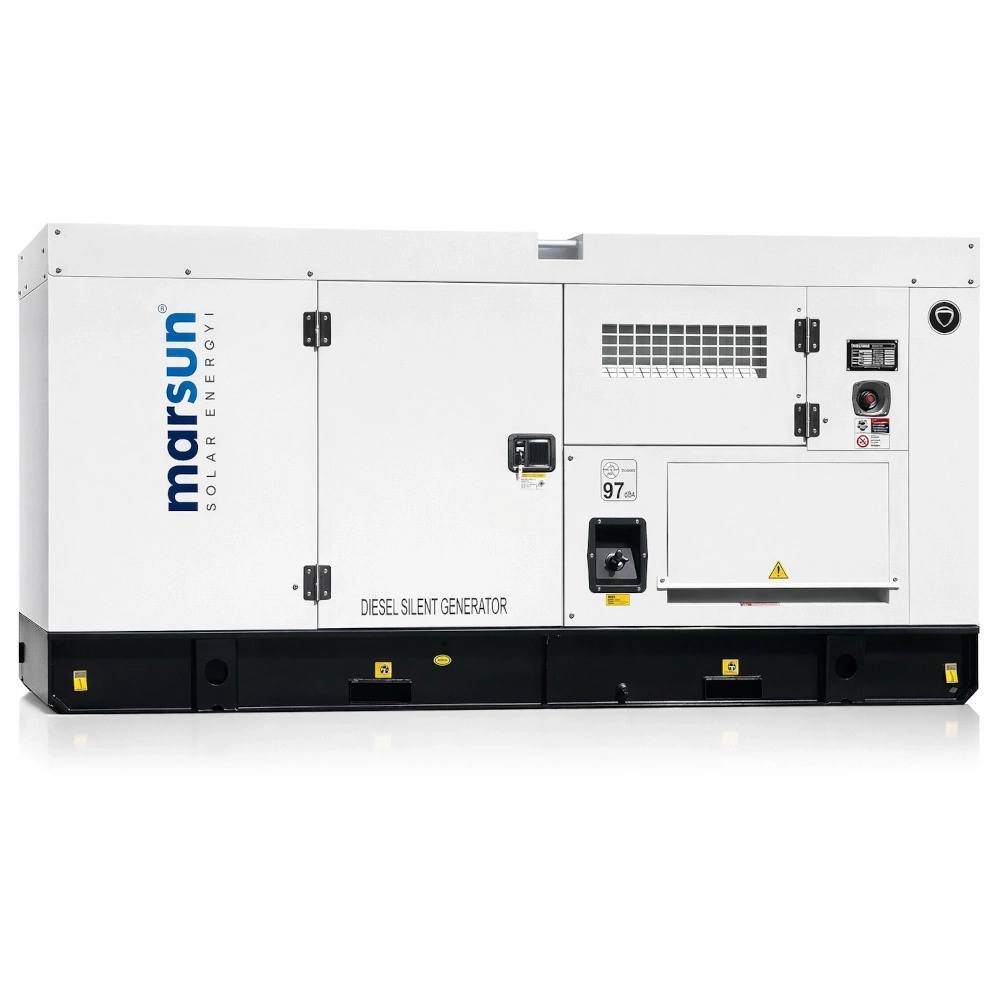
Runs on stored fuel and produces power independently of the grid or any solar system. Starting can be manual (you go and start it) or automatic if it’s paired with an automatic transfer switch (ATS), which detects an outage and starts the unit without you. Generators are noisy, produce exhaust fumes, and need siting outdoors with ventilation and clearance from windows. Runtime is limited only by how much fuel you have on hand, which makes them well suited to long outages and to loads that a battery bank would struggle to sustain for hours at a time. Our range is Marsun diesel (three-phase) and petrol generators with automatic voltage regulation (AVR), from 5.5 kW up to 250 kW.
2. Battery plus hybrid inverter
Silent, no fuel, and — with the backup function enabled — switches over automatically the moment the grid drops. Its runtime is capped by the battery’s capacity (kWh) and by how much load you’re asking it to carry, so it’s built to cover essential circuits (lighting, router, fridge, heating controls) for a defined stretch of time rather than a whole house indefinitely. Unlike a generator, it also does useful work every day the grid is up, storing surplus solar energy for use in the evening. Sizing it means matching battery capacity to your expected evening/night consumption plus your expected outage length.
3. Hybrid inverter alone, no battery
Worth stating plainly because it’s a common assumption: a hybrid inverter without a battery connected does not keep your power on during a cut. It needs a battery, and the backup function switched on, before it can do that. If backup power is the goal and you don’t yet have a battery, that’s the piece to add.
Generator vs battery-and-hybrid-inverter: comparison
| Factor | Diesel/petrol generator | Battery + hybrid inverter |
|---|---|---|
| Runtime | As long as fuel lasts | Limited by battery capacity (kWh) and load |
| Start type | Manual, or automatic with an ATS | Automatic, if the backup function is enabled |
| Noise | Audible, needs outdoor siting | Silent |
| Fuel / running cost | Diesel or petrol needed on hand | No fuel; draws on stored solar/grid energy |
| Everyday use (no outage) | None — sits idle | Stores solar surplus for daily use |
| Best suited to | Long outages, heavy or continuous loads | Short, frequent cuts and essential loads |
Which suits a house, a business, or an off-grid site?
A house dealing with occasional storm-related power cuts is usually best served by a battery and hybrid inverter: it’s automatic, silent, and doubles as a daily energy-storage tool the rest of the time. Add a generator only if outages in your area tend to run long or you have loads a home battery bank can’t comfortably cover.
A business depends on the load. Workshops, production equipment and anything drawing continuous three-phase power are usually better matched to a three-phase generator sized to the full site, while a smaller battery-and-hybrid-inverter setup can separately protect critical loads like servers, refrigeration or security systems that must never drop out, even for the seconds it takes a generator to start.
An off-grid site — one with no grid connection at all — typically runs the battery and hybrid inverter as the primary system, charged from solar (and optionally wind), with a generator as the backup that tops up the battery when there’s been too little sun or wind for too long. This is the classic off-grid pairing rather than an either/or choice.
Frequently asked questions
Does a hybrid inverter work during a power cut without a battery?
No. Without a battery connected and the backup function enabled, a hybrid inverter shuts off in a power cut, the same as a grid-tie inverter.
Is a generator noisy for home use?
Yes — generators produce noise and exhaust fumes and need to be sited outdoors, away from windows and with adequate ventilation.
What size battery do I need for home backup?
Size it to the loads you actually want to keep running (lighting, router, fridge, heating controls) and how long you expect outages to last — not to your whole household’s daytime consumption. We offer a free consultation to help you work out a realistic figure.
Can I combine a generator with a battery-and-hybrid-inverter system?
Many off-grid and business installations do run both, using the battery for instant, silent coverage of critical loads and the generator for extended runtime or heavier loads. Tell us your site and load list and we’ll help you work out whether that combination makes sense for you.
What to choose: the short verdict
- Short but frequent cuts (minutes to a few hours). Go with a hybrid inverter and a battery: the Deye SUN-5K-SG05LP1-EU-AM2-PLUS hybrid inverter at 999 €, with battery capacity picked from our battery storage range. Changeover is silent and automatic, so the fridge, router and lights never notice the grid has gone.
- Long and frequent outages (rural property, site away from town). This is where fuel wins: the Marsun MVD6 5.5 kW three-phase diesel generator in a sound-insulating enclosure with AVR at 1 549 €. Add the ATS panel for 6–15 kW generators at 199 € — without it you have to start the unit by hand, which means getting up at 3 a.m. to do it. The cheaper way into generators is the petrol Marsun MVB6 5.5 kW, from 999 €.
- A business that cannot afford downtime. You need both halves: the Deye SUN-6K-SG05LP1 hybrid inverter at 999 € with a battery carries the critical loads — servers, refrigeration, security — with no interruption at all, while the Marsun MHD20B 20 kW three-phase liquid-cooled diesel generator with AVR at 5 999 €, paired with the ATS panel for 20 kW generators at 269 €, keeps the whole site running for as long as it takes.
One technical point worth settling before you buy: every diesel generator we stock is three-phase — we do not carry single-phase diesel units. If your property has a single-phase supply, talk to an electrician first about whether upgrading the incoming connection makes sense. If it doesn’t, the realistic alternative is exactly the battery-and-hybrid-inverter route, which works on a single-phase supply without any rewiring of the incoming connection. Also worth knowing: some items in the battery category are racks for battery modules rather than the modules themselves, so it is best to confirm the capacity (kWh) and the specific model before ordering.
Why buy from us: we are not VAT-registered, so the price you see in the catalogue is the final price — no VAT is added on top. Delivery anywhere in Lithuania is free, within 14 days. Returns are accepted within 14 days and we cover the cost of the return shipment. All equipment carries the manufacturer’s warranty and CE conformity. Before you buy, we will size the system for you free of charge — send us the list of appliances you want to keep running during an outage and we’ll tell you what it actually takes. Prices are as of the day of publication.
Browse the ranges
See our full range of generators (Marsun diesel and petrol models, three-phase and single-phase, with AVR), batteries (21 models) and hybrid inverters (65 models). Not sure which combination fits your situation? Contact us for a free pre-purchase consultation.